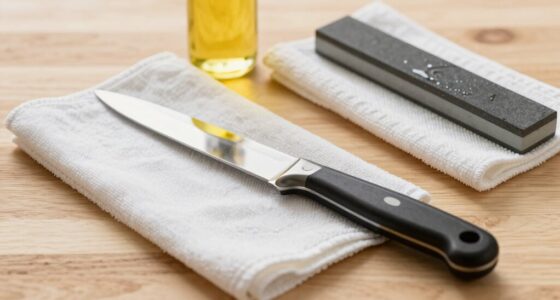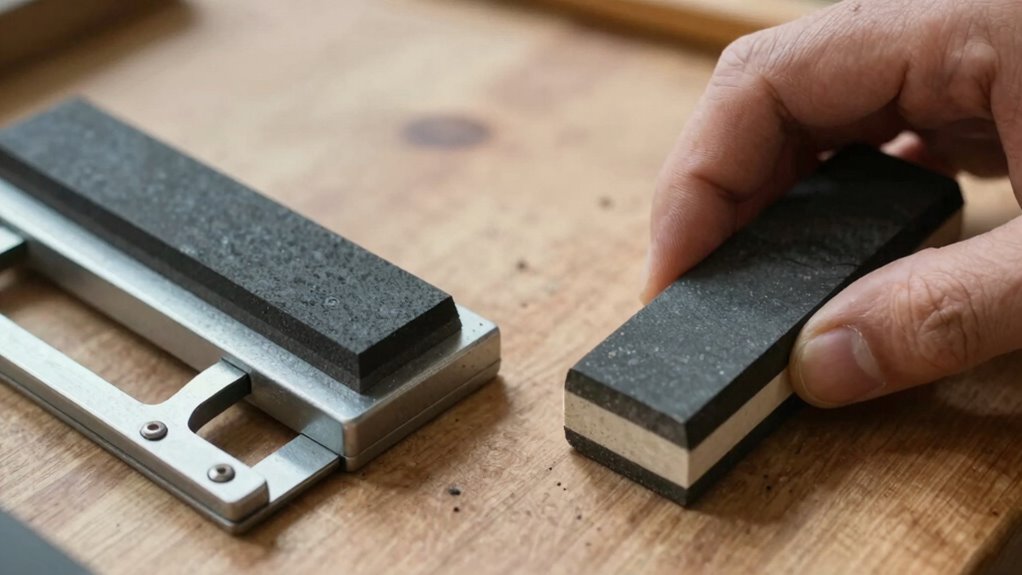
If you’re new to sharpening or want quick, reliable results, a fixed-angle system might suit you best since it guides you to hold the blade at a consistent angle, making it easier to maintain. However, if you enjoy more control and craft, and don’t mind practicing, freehand sharpening lets you customize and refine edges precisely. To choose the right method for you, consider your skill level, preferences, and the types of blades you want to care for—more details await those who explore further.

Get kitchen gear delivered free with Prime
- Fast, free delivery on millions of items
- Prime Video, Amazon Music and more included
- Member-only deals all year
Key Takeaways
- Fixed-angle sharpeners are ideal for beginners seeking consistent, quick, and hassle-free results.
- Freehand sharpening offers greater control and customization for experienced users and craft enthusiasts.
- Choose fixed-angle tools if you prefer simplicity and reliability with minimal skill required.
- Opt for freehand if you enjoy the craft of sharpening and want to refine your technique over time.
- Consider your knife types, skill level, and time commitment to determine the best method for you.
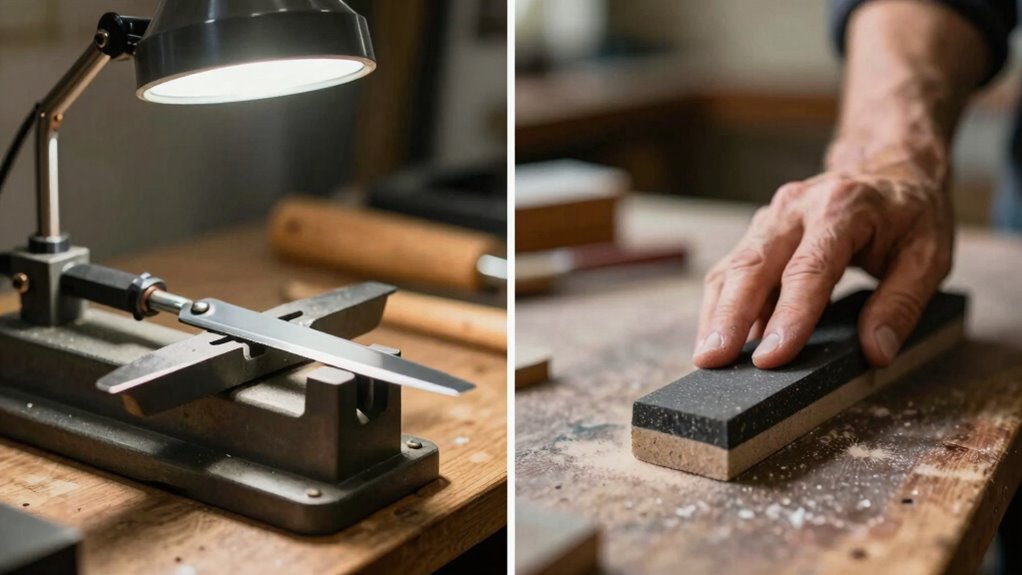
When it comes to sharpening knives, choosing between fixed-angle and freehand techniques can considerably impact the precision and ease of your process. Your decision directly affects how well you maintain your blades and the types of sharpening tools you’ll need. Fixed-angle sharpeners, such as guided systems or sharpening jigs, are designed to hold the blade at a consistent angle throughout the process. This consistency makes blade maintenance straightforward, especially if you’re new to sharpening. These tools are often simple to use and produce reliable results, helping you keep your knives sharp without much fuss. The main advantage is that they eliminate guesswork; you set the angle once, and the device does the rest. This can be particularly helpful when working with expensive or delicate blades that require careful handling. However, fixed-angle systems tend to be bulkier and might limit your control over the sharpening process. If you prefer precision and a more hands-off approach, they’re an excellent choice.
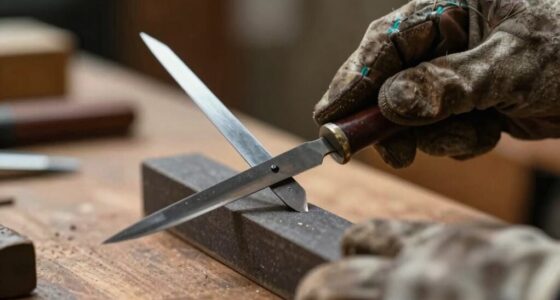
On the other hand, freehand sharpening offers a more traditional route. You hold the sharpening tool, like a whetstone or diamond stone, at a consistent angle and manually move the blade across it. This method demands more skill and practice but grants you greater control over the sharpening process. With freehand techniques, you can adjust the angle slightly to refine your blade’s edge or address specific wear patterns. It’s also more versatile, allowing you to sharpen a variety of blade sizes and shapes without needing specialized equipment. The key to success with freehand sharpening lies in your ability to maintain a steady, consistent angle, which can take time to master. Your blade maintenance improves as you develop your technique, and you often find that you use fewer sharpening tools overall, relying instead on a few quality stones. Additionally, understanding the types of sharpening tools available can help you choose the right equipment for your needs.
Ultimately, your choice depends on your comfort level, the types of knives you own, and how much time you want to dedicate to blade maintenance. Fixed-angle sharpeners tend to be more convenient and user-friendly, making them ideal for beginners or those who want quick, reliable results. Freehand sharpening appeals to enthusiasts who enjoy the craft and want complete control over their sharpening process. Whichever path you take, understanding the strengths and limitations of each method helps you make informed decisions, ensuring your knives stay sharp and effective.
As an affiliate, we earn on qualifying purchases.
Frequently Asked Questions
Can I Switch Between Fixed-Angle and Freehand Sharpening Easily?
Yes, you can switch between fixed-angle and freehand sharpening easily. While fixed-angle sharpening offers consistent sharpening accuracy, freehand sharpening provides technique flexibility, allowing you to adapt to different blade shapes. With practice, you’ll become comfortable shifting between both methods, gaining the benefits of precision and adaptability. This versatility guarantees you can choose the best approach depending on the blade, ultimately sharpening more effectively and confidently.
Which Method Is Better for Sharpening Serrated Knives?
For sharpening a serrated edge, freehand sharpening works best because it allows you to precisely target each scallop, maintaining the unique blade geometry. Fixed-angle systems are less effective here, as they often can’t match the serrations’ shape. Proper blade maintenance involves careful, controlled strokes to preserve the serrated edge’s integrity. So, if you want detailed control, go freehand; for convenience, fixed-angle might be easier, but less precise.
How Long Does Each Sharpening Method Typically Take?
Fixed-angle sharpening usually takes about 5 to 10 minutes, depending on blade condition, because it’s more precise and consistent. Freehand sharpening might take slightly longer, around 10 to 15 minutes, as it requires more skill but allows for custom angles. Both methods, if done properly, help maintain blade durability and can reduce sharpening frequency over time, saving you effort and extending the life of your knives.
Do I Need Special Equipment for Either Sharpening Technique?
Think of sharpening your knife as fine-tuning a musical instrument—you’ll need the right tools. For either method, you don’t need much beyond sharpening accessories like stones or guides. Just remember, kitchen safety is key; always handle tools carefully. Fixed-angle sharpening might require a jig, while freehand sharpening relies on your skill. Both techniques are doable with basic equipment, but safety should always be your top priority.
How Do I Maintain Consistent Angles in Freehand Sharpening?
To maintain consistent angles in freehand sharpening, focus on your grip and hand position to improve angle consistency and sharpening accuracy. Use visual guides or markings on your sharpening tools to help keep the angle steady. Practice regularly, and slow down to make certain each stroke maintains the same angle. Over time, these habits will enhance your ability to achieve precise, consistent results, boosting your overall sharpening accuracy.
whetstone for freehand sharpening
As an affiliate, we earn on qualifying purchases.
As an affiliate, we earn on qualifying purchases.
Conclusion
Ultimately, choosing between fixed-angle and freehand sharpening depends on your needs and nuance. If you prefer precision and consistency, fixed-angle sharpening offers a straightforward solution. But if you seek skill and spontaneity, freehand sharpening invites experimentation and excellence. Remember, mastering either method enhances your edge, elevates your expertise, and empowers your enjoyment. So, step into the world of sharpening with confidence—commit to your craft, cultivate your skills, and create cutting-edge results that truly count.
knife sharpening jig for beginners
As an affiliate, we earn on qualifying purchases.
As an affiliate, we earn on qualifying purchases.
diamond stone for kitchen knives
As an affiliate, we earn on qualifying purchases.
As an affiliate, we earn on qualifying purchases.
Fall Picks
fall essentials
As an affiliate, we earn on qualifying purchases.