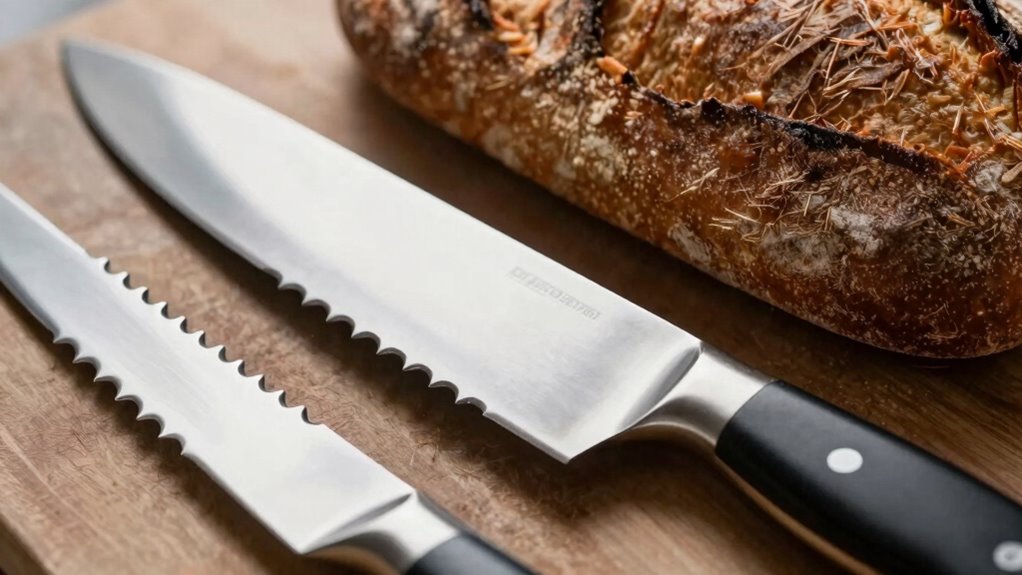
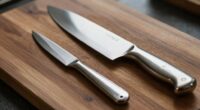
Knowing why serrations matter helps you choose the right knife for different tasks. Serrated bread knives grip crusts and tear through tough exteriors while gently cutting soft insides, preventing damage. In contrast, chef knives use smooth blades for precise, clean slices on ingredients. Understanding these differences improves your technique and keeps your knives performing well longer. If you’d like to discover how to maintain and select the best knife for every job, there’s more to explore.
Key Takeaways
- Serrations are essential for slicing bread without crushing the soft interior, making bread knives ideal for baked goods.
- Chef knives, with smooth edges, excel at precise cuts but are less effective on crusty bread.
- Proper technique, like gentle sawing, enhances slicing efficiency for serrated knives, preventing tearing or crushing.
- Maintaining serrated edges requires specialized sharpening tools to preserve their saw-like grip and longevity.
- Recognizing when to use each knife type ensures better results and prevents damage to the blade or food.
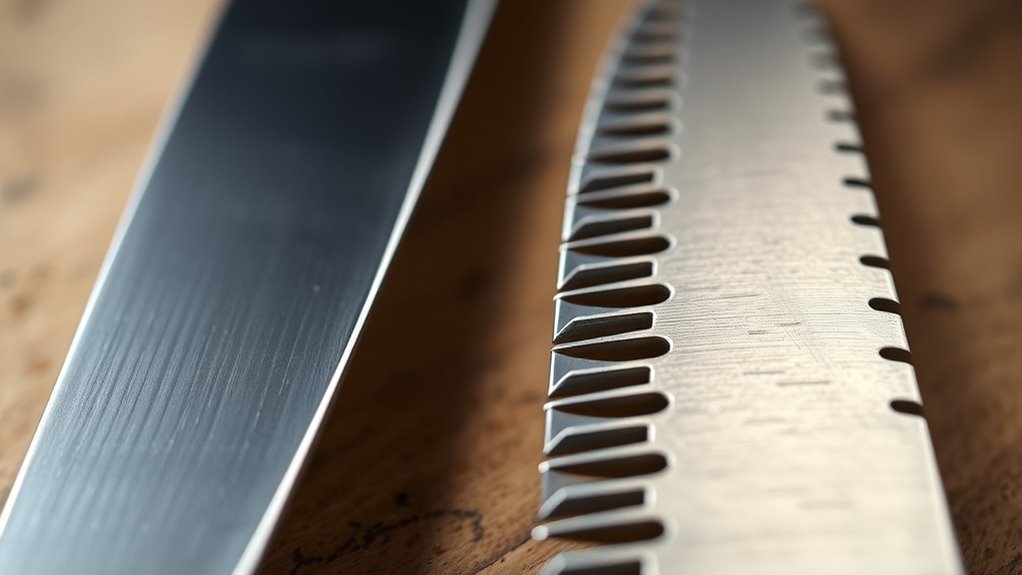
Have you ever wondered how a chef knife differs from a bread knife? These two tools are designed for different tasks, and understanding their unique features can help you work more efficiently in the kitchen. A chef knife is versatile, with a sharp, smooth blade ideal for slicing, dicing, and chopping a variety of ingredients. In contrast, a bread knife is specialized for cutting bread and baked goods, featuring serrated edges that grip and tear through crusts without crushing the soft interior. Recognizing these differences is essential for mastering cutting techniques and making sure your knives stay in top shape through proper knife maintenance.
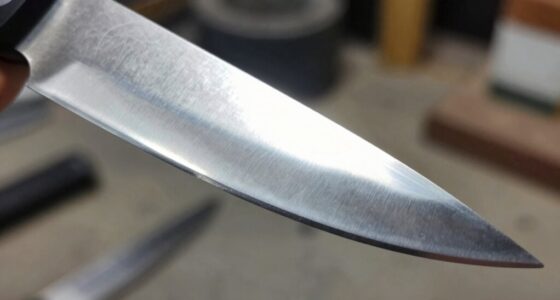
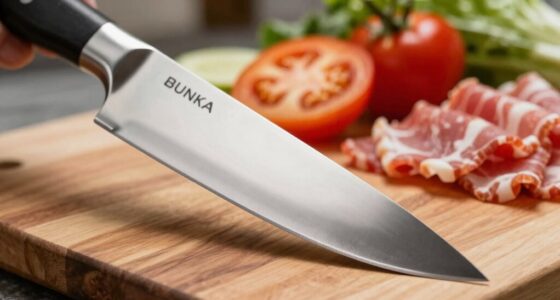
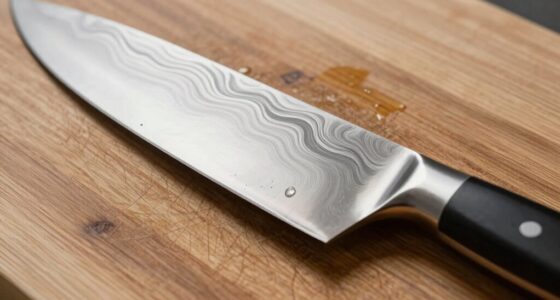
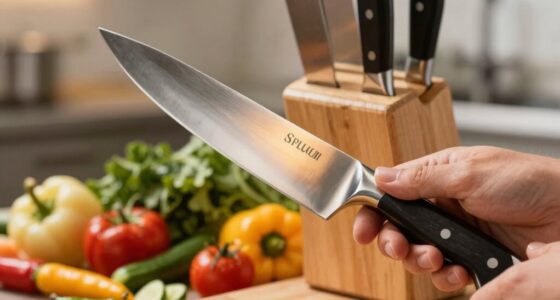
When you’re using a chef knife, your cutting techniques often involve a rocking motion. You slice through ingredients with a smooth, continuous movement, applying even pressure to get clean, precise cuts. This technique relies on a sharp, smooth-edged blade that glides through vegetables, meats, and herbs with minimal effort. Proper knife maintenance—such as regularly honing and occasionally sharpening—keeps the edge in the best condition, making your cuts safer and more accurate. A dull chef knife requires more force, increases the risk of slips, and damages the blade over time. Maintaining your knives ensures they perform well, which in turn improves your cutting techniques.
On the other hand, a bread knife’s serrated edge is designed to saw through tough crusts without crushing the soft bread inside. The serrations act like tiny saw blades, grabbing onto the bread’s surface and making it easier to cut cleanly. When you’re using a bread knife, your cutting technique involves gentle sawing rather than pressing down. This helps prevent tearing or squishing the bread. Because of the serrated design, knife maintenance differs slightly: you don’t need to sharpen a bread knife as often, but when it does become dull, a specialized sharpening tool or professional service can restore the serrations effectively. Proper care extends the life of the serrated edge and maintains its cutting performance, which is vital when you’re slicing through different types of bread and baked goods. Additionally, understanding specialized sharpening techniques can help keep your serrated knives in optimal condition for a longer lifespan.
best bread knife with serrated edge
As an affiliate, we earn on qualifying purchases.
As an affiliate, we earn on qualifying purchases.
Frequently Asked Questions
Can a Chef Knife Replace a Bread Knife Effectively?
A chef knife can replace a bread knife for bread slicing, but it might not be as effective. Chef knives lack the serration effectiveness needed to cut through crusty or soft bread without crushing it. While you can use one in a pinch, a bread knife’s serrations are designed to grip and slice smoothly, making it the better choice for achieving clean, even slices without tearing.
Are Serrated Knives More Durable Than Straight-Edged Knives?
Serrated knives tend to be more durable than straight-edged ones because their blade longevity is often better due to the less frequent need for sharpening. Additionally, many serrated knives have higher corrosion resistance, especially if made from high-quality stainless steel, which helps them withstand moisture and prevent rust. However, they can be harder to sharpen properly, so you should consider maintenance when choosing between serrated and straight-edged knives.
When Should I Choose a Serrated Over a Non-Serrated Knife?
Imagine slicing through a soft loaf as if it’s cutting through clouds—you’ll want a serrated knife. When bread’s crust is thick and chewy, serrations act like tiny saw blades, making bread slicing smooth without crushing. Choose a serrated knife when precision matters for bread or delicate foods with tough exteriors. For clean, straight cuts on softer items, a non-serrated knife does the trick.
How Do Maintenance Requirements Differ Between the Two Knives?
You’ll find that maintenance differs for serrated and non-serrated knives. With a chef knife, you’ll need to regularly sharpen the blade using a sharpening stone or rod to maintain its edge, and handle maintenance involves keeping it dry and clean. For a bread knife, you’ll rarely sharpen the blade; instead, focus on gentle cleaning to prevent damage to the serrations. Handle maintenance is similar for both, requiring careful cleaning and drying.
Is a High-Quality Chef Knife Suitable for Slicing Bread?
A high-quality chef knife can be your versatile sword, but it’s not ideal for bread slicing. Its smooth blade lacks the serrated edge needed to grip and saw through crusty bread without crushing the soft interior. For perfect bread slicing, a bread knife with serrations guarantees knife sharpness and clean, even cuts. Relying solely on a chef knife may result in uneven slices and damaged bread, making a dedicated bread knife your best tool.
professional chef knife for slicing
As an affiliate, we earn on qualifying purchases.
As an affiliate, we earn on qualifying purchases.
Conclusion
Choosing the right knife depends on what you cook most often. A chef’s knife offers versatility for prep work, while a bread knife’s serrations excel at slicing through crusty loaves without crushing them. Did you know that serrated knives can last up to twice as long as straight-edged ones because they experience less wear? So, investing in the right knife for your needs not only improves your cooking but also extends the life of your tools.
serrated bread knife sharpening tool
As an affiliate, we earn on qualifying purchases.
As an affiliate, we earn on qualifying purchases.
high-quality chef and bread knife set
As an affiliate, we earn on qualifying purchases.
As an affiliate, we earn on qualifying purchases.