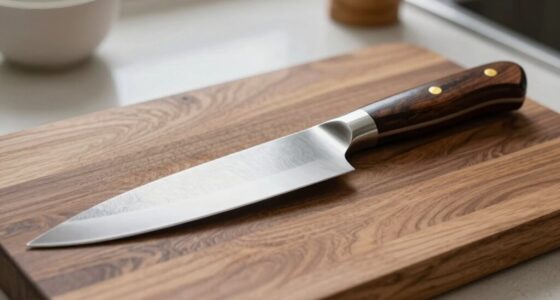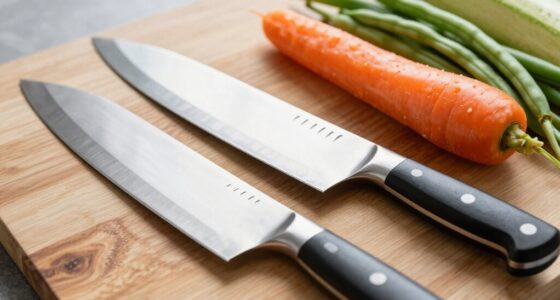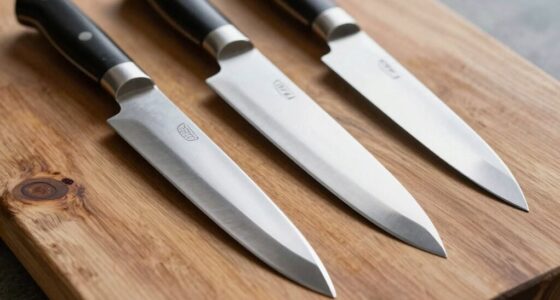
The curvature of your chef’s knife, especially the belly, plays a big role in how smoothly you can perform rocking and push cuts. A prominent curve lets you rock the blade easily, guiding the tip for precise mincing and herbs, while a flatter profile supports straight push cuts for slicing ingredients thinly. Your hand movement, control, and comfort depend on this design. Keep exploring to discover how to choose the perfect shape for your style.
Key Takeaways
- A pronounced belly allows smooth rocking motions by enabling the blade tip to contact the cutting surface easily.
- Larger curves enhance efficiency in mincing and herb chopping through larger rocking arcs.
- Flatter blades support precise push cuts, ideal for delicate slicing and straight-down cuts.
- The belly’s shape influences the knife’s balance, affecting control during rocking and push techniques.
- Proper curvature reduces wrist strain, improving comfort and accuracy in both rocking and push cutting motions.
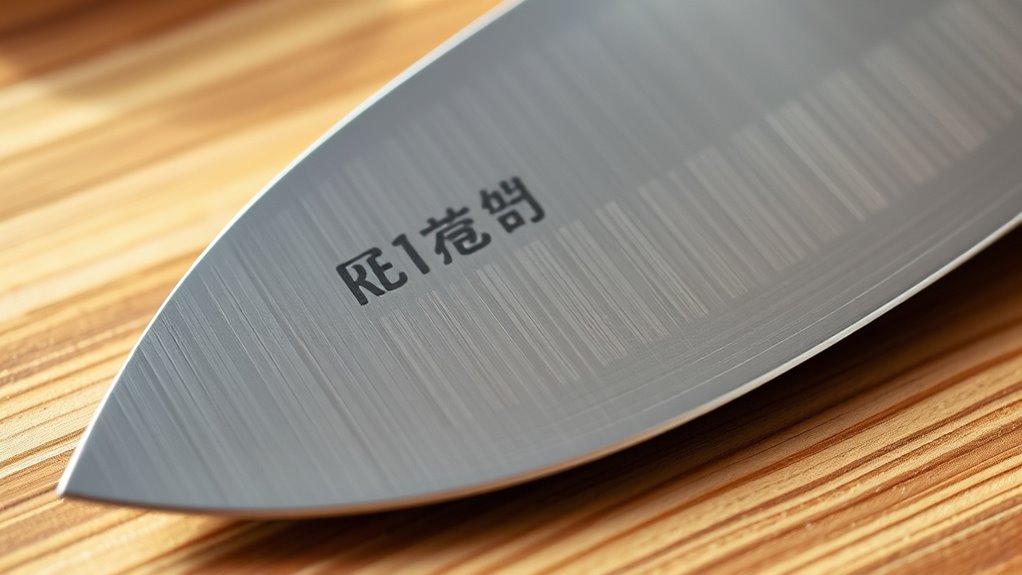
Have you ever wondered how the curvature of a chef’s knife impacts your chopping and slicing? The shape of the blade, especially the belly or curve, plays a vital role in how you handle your cuts. When you’re working in the kitchen, the way your knife balances in your hand and the ergonomics of the handle considerably influence your comfort and efficiency. A well-designed curvature allows for smoother rocking motions and more controlled push cuts, making your prep work faster and less tiring.
The curvature of the blade affects the knife’s balance point, which in turn impacts how you maneuver it. If the knife’s center of gravity is properly aligned with the handle, you’ll experience less fatigue and more control during prolonged use. A balanced knife feels natural, letting you switch seamlessly between chopping, slicing, and rocking without strain. Handle ergonomics complement this by providing a comfortable grip that molds well to your hand’s shape. When your handle is designed with ergonomics in mind, it reduces pressure points and guarantees a secure grip, enabling precise cuts without slipping.
A well-balanced knife with ergonomic handle reduces fatigue and enhances control during extended use.
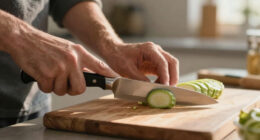
The belly of the knife, with its gentle or pronounced curve, determines how easily you can perform rocking cuts. A more pronounced curve offers a larger arc, ideal for rocking motions where the tip remains in contact with the cutting board. This makes mincing garlic, herbs, or slicing vegetables more fluid and swift. Conversely, a flatter blade with less curvature is better suited for push cuts, which require pressing straight down through ingredients. These cuts are more controlled and precise, especially for delicate tasks like slicing paper-thin vegetables or fish.
Your ability to perform these cuts efficiently hinges on understanding how the curvature interacts with your hand mechanics. When the knife’s belly complements your natural rocking motion, it reduces wrist strain and enhances accuracy. Proper handle ergonomics help you maintain this alignment comfortably. For example, a handle with a slight contour or a non-slip material allows you to grip firmly without exerting excessive force. This comfort translates into better control and less fatigue over time.
Additionally, research in sound healing science suggests that the way a knife’s shape influences movement can also affect your overall cooking experience by promoting better focus and mindfulness. In essence, the curvature of a chef’s knife isn’t just about aesthetics. It’s about how the blade’s shape, combined with the knife’s balance and handle ergonomics, shapes your cutting experience. A thoughtfully curved knife enables smoother, more efficient cuts, whether rocking or pushing. By choosing a knife with the right curvature and ensuring it feels balanced and comfortable in your hand, you’ll elevate your cooking precision and make your prep work more enjoyable.
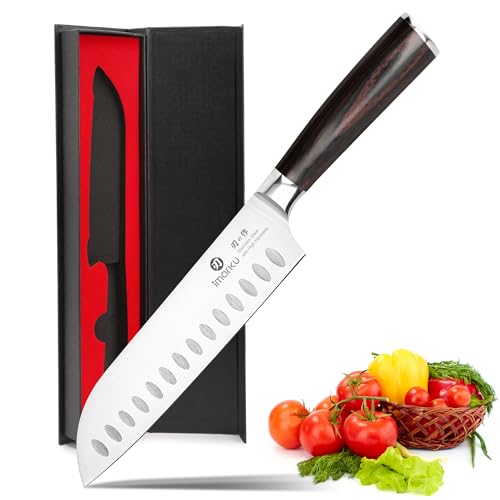
imarku Chef Knife 7 Inch Kitchen Knife Ultra Sharp Santoku Knife - High Carbon Japanese Chefs Knife, Kitchen Gadgets 2025, Apartment Essentials, Birthday Gifts for Him Her, Best Gifts for Women Men
Professional Santoku Knife: This imarku super sharp santoku knife is made of high carbon stainless steel that resists...
As an affiliate, we earn on qualifying purchases.
Frequently Asked Questions
How Does Blade Thickness Impact Cutting Performance?
Blade thickness directly impacts your cutting performance by influencing metal fatigue and edge durability. Thinner blades cut more easily, requiring less force and reducing metal fatigue, but they may be more prone to chipping and less durable over time. Thicker blades provide greater edge durability and resist bending, but may require more effort and limit precision. Choose a blade thickness that balances your cutting needs with durability for ideal results.
What Materials Influence a Chef Knife’s Overall Flexibility?
Certain blade materials, like softer steels and high-carbon alloys, increase a chef knife’s flexibility, allowing easier bending and maneuvering. Flexibility factors also include the blade’s thickness and heat treatment; thinner blades tend to be more pliable. You’ll find that softer steels offer more bend, ideal for delicate tasks, while harder steels provide stability. Choosing the right material depends on your specific cutting needs and the level of flexibility you want.
Can a Curved Blade Improve Precision in Delicate Cuts?
Like a skilled painter’s fine brush, a curved blade enhances your precision, making delicate slicing feel effortless. The belly’s gentle curve allows for more controlled, fluid cuts, reducing slips and increasing accuracy. This design truly elevates your precision enhancement, letting you handle intricate tasks with confidence. When precision matters most, a curved blade becomes your trusted partner, transforming simple cuts into artful, meticulous work every time.
How Does Handle Design Affect Knife Balance and Control?
Your handle design directly impacts knife balance and control. An ergonomic grip fits comfortably in your hand, reducing fatigue and increasing precision. Handle weight plays a vital role; a well-balanced handle prevents wrist strain and allows smooth movements. When you choose a handle with the right weight and ergonomic features, you gain better control during delicate cuts, making your work more efficient and comfortable, especially during extended use.
Are There Specific Cuisines That Benefit From Certain Curvature Styles?
Did you know that Japanese santoku knives often feature a flatter curvature, ideal for precise slicing? You’ll find that certain cuisines benefit from specific curvature styles, as cultural knife designs adapt to cuisine-specific techniques. For example, French knives emphasize rocking cuts for herbs, while Chinese cleavers excel with push cuts. Choosing the right curvature enhances your efficiency and authenticity, making your prep work smoother and more accurate.
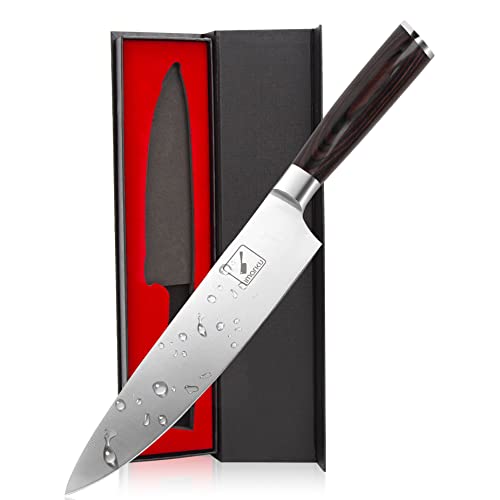
imarku Japanese Chef Knife - Sharp Kitchen Knife 8 Inch Chef's Knives HC Steel Paring Knife, Unique Gifts for Men and Women, Gifts for Mom or Dad, Kitchen Gadgets with Gift Box, Gyutou Knives
High-Carbon Stainless Steel Blade: It is manufactured from high-quality stainless steel that maintains its functionality for a long...
As an affiliate, we earn on qualifying purchases.
Conclusion
Understanding the curvature of your chef’s knife is like tuning an instrument—it sets the rhythm for your cutting dance. The belly guides your rocking motions, making push cuts feel smooth as a whisper and rocking cuts glide effortlessly across the board. When you grasp how the curve influences your technique, each slice becomes a melody of precision and control. Embrace the belly’s bend, and let your culinary rhythm flourish with every chop and glide.

HOSHANHO Kitchen Knife in Japanese High Carbon Steel, Professional High-Class Chef's Knife 8 inch, Non-slip Ultra Sharp Cooking Knives with Ergonomic Handle
【High-End Japanese Steel Chef's Knife】 HOSHANHO chef's knife is made of Japanese high carbon steel 10Cr15CoMoV, 2x of...
As an affiliate, we earn on qualifying purchases.

Japanese Chef Knife, 8 Inch Damascus Kitchen Knife with VG10 Steel, Handcrafted Sharp Knife with Ergonomic Handle, Cooking Knives for Home Chefs, Cooking Gifts for Men and Women
【Premium Damascus Chef Knife with VG-10 Steel Core】Our Japanese knives feature a VG-10 steel core (60 HRC) for...
As an affiliate, we earn on qualifying purchases.