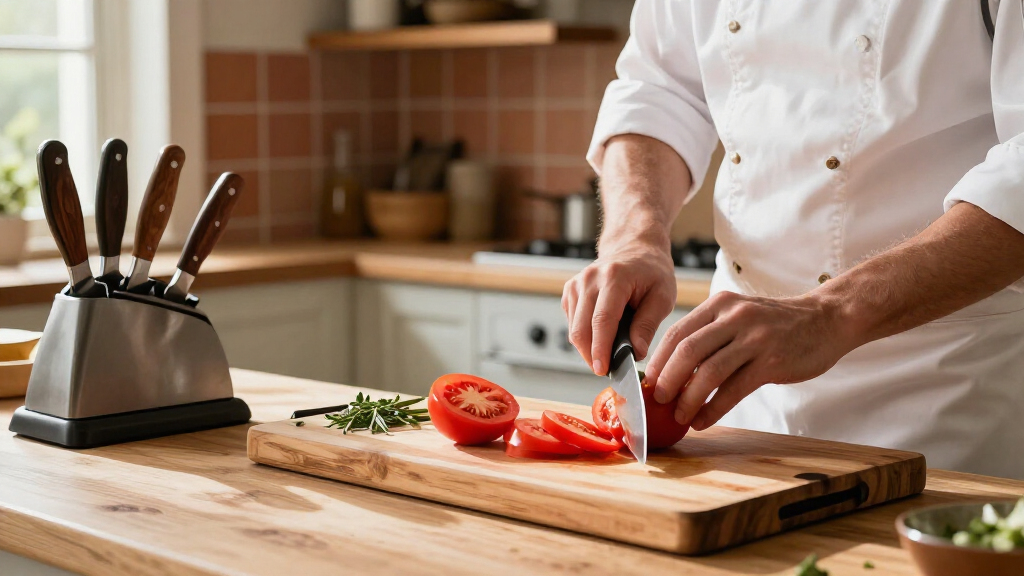

Choosing a professional chef knife set is a choice between buying a broad collection up front and investing in a smaller group of knives you are likely to use every day. A full professional set typically adds specialist blades, such as a boning knife, slicer, or utility knife, to the core chef’s knife, paring knife, and bread knife. A five-piece core set concentrates on those everyday tools and may include kitchen shears or a honing steel.

Get kitchen gear delivered free with Prime
- Fast, free delivery on millions of items
- Prime Video, Amazon Music and more included
- Member-only deals all year
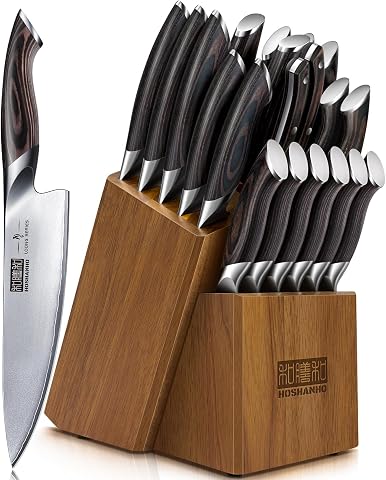
HOSHANHO 20-Piece Japanese Kitchen Knife Set with Block
- ✔ Set size: 20 pieces
- ✔ Blade material: Japanese 10Cr15CoMoV high-carbon stainless steel
- ✔ Blade hardness: 60 HRC

DRGSKL 6-Piece Japanese Kitchen Knife Set with Walnut Handles
- ✔ Set size: 6 pieces
- ✔ Included knives: Chef, santoku, utility, cleaver, fillet and boning
- ✔ Blade steel: ATS-34

HOSHANHO 8-Piece Butcher Knife Set with Carrying Bag
- ✔ Set size: 8 pieces
- ✔ Included knives: 6-inch bone chopper, 6-inch meat cleaver, 5.9-inch Viking knife, 5.5-inch cleaver, 6.7-inch fillet knife, 6-inch dividing knife, 5.5-inch paring knife
- ✔ Blade material: High-carbon stainless steel
The full set suits cooks who regularly prepare varied ingredients, want matching knives, and have room to store them safely. The core set makes more sense for home cooks and working cooks who value a sharp, dependable essential knife for most tasks and would rather choose any specialist blades separately. The central tradeoff is coverage against cost and upkeep: extra knives help when their specific jobs come up, but unused blades still take space and care.
At a Glance
| Criteria | Full professional chef knife set | Five-piece professional core set | Winner |
|---|---|---|---|
| Everyday task coverage | Broad selection for routine prep | Covers most daily prep with a chef’s knife, paring knife, and bread knife | Tie |
| Specialist tasks | Usually includes blades for slicing, boning, or other specific work | Limited; add a specialist knife only when a recurring need appears | A |
| Upfront value | Higher total spend; value depends on use of the extra knives | Lower entry cost and less spent on rarely used blades | B |
| Storage and organization | Needs more drawer, block, or magnetic-strip space | Compact and easier to store safely | B |
| Maintenance | More edges and handles to clean, dry, sharpen, and inspect | Fewer knives mean less routine care | B |
| Flexibility | Matching set is convenient, though blade choices are fixed | Buyers can add preferred knives over time | B |
HOSHANHO 20-Piece Japanese Kitchen Knife Set with Block
For cooks building a complete kitchen station, the HOSHANHO 20-piece set is the most rounded option in this group. Its lineup covers chef, bread, carving, nakiri, santoku, fillet, utility, tomato, fruit and paring knives, then adds six steak knives, shears, a meat fork, sharpener and block. That breadth makes it easier to equip shared meals and varied prep without buying several separate tools. By comparison, DRGSKL keeps the collection to six knives, while HOSHANHO’s butcher set concentrates its assortment on meat and fish tasks.The set gives buyers more technical detail than the other two: Japanese 10Cr15CoMoV high-carbon stainless steel, 60 HRC hardness and a 15-degree double bevel are specified. Those figures help us understand the intended edge profile and steel, though they do not guarantee how long the edge will last or how it will feel in use. Pakkawood handles offer a traditional look with a grip intended to be secure. The main compromise is scale: a 20-piece set takes counter or cabinet space, and some pieces may see little use in a smaller kitchen. The listing also leaves care instructions unspecified, so we should plan on careful cleaning for the handles and blades.We rank it above DRGSKL because it provides a more complete set-up and clearer edge specifications. It is less specialized than the butcher set, but makes more sense when our daily work ranges from bread and vegetables to serving steak.
Pros:
- Broad assortment includes everyday, specialty and steak knives.
- Storage block, kitchen shears, meat fork and sharpener are included.
- Lists 60 HRC hardness and a 15-degree double bevel.
- Pakkawood handles are designed for a non-slip grip.
Cons:
- The 20-piece count may mean storing tools that see little use.
- Care and cleaning instructions are not specified in the supplied description.
- The listed 10-inch blade length does not clarify which knife it describes.
Best for: Cooks equipping a full kitchen station who want broad knife coverage, a block and included sharpening tool.
Not ideal for: Minimalist cooks, small kitchens, or buyers who need a portable meat-focused kit rather than a large block set.
Bottom line: We recommend this as the most complete station set when we want broad kitchen coverage and can accommodate its larger footprint.
“We recommend this as the most complete station set when we want broad kitchen coverage and can accommodate its larger footprint.”
DRGSKL 6-Piece Japanese Kitchen Knife Set with Walnut Handles
The DRGSKL six-piece set is the most restrained everyday collection here, and its mix is designed to cover more than basic chopping. It pairs chef and santoku knives with utility, cleaver, fillet and boning blades. That makes it a better fit for cooks who want a compact group that can move between general prep and particular jobs, without committing to the block and serving accessories in HOSHANHO’s 20-piece set. It is less specialized for meat processing than HOSHANHO’s butcher collection, which includes several cleaver-style tools and a portable bag.Its defining material claim is forged ATS-34 steel, combined with full-tang construction and walnut handles. Sculpted finger grooves are intended to support grip and control, while a metal spacer is included as a balance and durability feature. The black titanium plating gives the blades a matte finish, but buyers should not mistake a coating for a stated cutting-performance advantage: the listing does not explain how it affects maintenance or long-term wear. There are also no blade dimensions or individual knife weights, which makes it harder to assess whether the handles and blade sizes will suit our hands and prep space.Care is clearer than for either HOSHANHO set: hand wash and dry promptly. That routine takes more attention than a set with explicit dishwasher-safe claims, and it matters for anyone using the knives through a busy service. DRGSKL earns second place because the selection is focused and its steel is named, but the more complete HOSHANHO set provides more tools and more specification detail for an all-purpose kitchen.
Pros:
- Six knives span chef, santoku, utility, cleaver, fillet and boning tasks.
- Forged ATS-34 blades and full-tang construction are specified.
- Walnut handles have sculpted finger grooves.
- Hand-wash and drying care guidance is provided.
Cons:
- Individual blade dimensions and weights are not provided.
- Hand washing and prompt drying require more upkeep.
- No block, carrying bag or sharpener is listed.
Best for: Cooks who want six distinct kitchen and specialty knives, walnut handles and a defined hand-washing routine.
Not ideal for: Buyers who need a storage block, exact blade sizing, included sharpening equipment or a portable kit.
Bottom line: We see this as the focused middle ground for cooks who want a varied six-knife set and can accept limited sizing details and hands-on care.
“We see this as the focused middle ground for cooks who want a varied six-knife set and can accept limited sizing details and hands-on care.”
HOSHANHO 8-Piece Butcher Knife Set with Carrying Bag
Among these three, the HOSHANHO butcher set has the clearest specialist identity. Its eight-piece assortment includes a bone chopper, two cleaver-style knives, a Viking knife, fillet knife, dividing knife and paring knife. That range is aimed at cooks who regularly break down or portion meat and fish, while still keeping a small blade for trimming. The carrying bag distinguishes it from the other two: DRGSKL does not list storage, and the 20-piece HOSHANHO set is arranged around a home block rather than travel.Construction details are a strong point. The knives are described as forged, full tang and three-rivet, with high-carbon stainless steel blades and walnut handles. The listed 16-degree-per-side V-edge is a little less acute than the 15-degree double bevel stated for the 20-piece HOSHANHO set, although the descriptions alone do not establish which will perform better in practice. A stonewashed and hammered finish contributes to the set’s distinctive appearance; the listing also describes the blades as wear-resistant and non-sticking, claims we cannot compare from the specifications alone.This set is third in our overall ranking because its lineup is less balanced for a general professional kitchen: it offers multiple meat-oriented tools but no bread knife or standard chef knife is specified. For a butcher, barbecue cook or outdoor food-prep kit, that specialization is the reason to choose it, not a drawback. We should also account for the unspecified care instructions for the walnut handles and blades, and the possibility that several tools will go unused in an everyday home kitchen.
Pros:
- Eight knives target meat, fish and vegetable preparation.
- Forged full-tang construction with three-rivet walnut handles.
- Portable bag keeps the knives organized for transport.
- Lists a 16-degree-per-side plain V-edge.
Cons:
- Several blades are specialized and may be redundant for basic kitchen work.
- No standard chef or bread knife is specified in the assortment.
- Care instructions for the wood handles and blades are not provided.
Best for: Cooks who prepare meat and fish regularly or want a dedicated knife assortment they can carry to outdoor cooking.
Not ideal for: Buyers looking for a balanced daily chef set with a standard chef knife, block, bread knife or detailed care guidance.
Bottom line: We recommend this set for portable, meat-centered prep, while general cooks will get a more balanced kitchen assortment from the 20-piece HOSHANHO.
“We recommend this set for portable, meat-centered prep, while general cooks will get a more balanced kitchen assortment from the 20-piece HOSHANHO.”
As an Amazon Associate we earn from qualifying purchases.
Key Differences
The main practical difference is how often the additional blades earn their place. A chef’s knife handles much of the chopping and slicing; a paring knife manages small, controlled work; and a bread knife cuts crusts without crushing soft interiors. A larger set can add meaningful capability for frequent fish preparation, trimming meat, or carving roasts. If those jobs are occasional, a full block may mostly add cost and storage demands.
Neither piece count nor a “professional” label guarantees better cutting. Steel, heat treatment, edge geometry, balance, handle comfort, and the ability to sharpen the blade matter more. Compare the individual knife specifications and warranty, and check whether the set includes useful care tools. For most buyers, the core set is the better starting value. Pay more for the full collection when its specialist knives match your regular work and you have a safe, accessible place for them.
Detailed Comparison
Everyday task coverage (moderate difference)
Both options should cover the core routine: a chef’s knife for most chopping, a paring knife for small precise cuts, and a bread knife for crusty loaves. A full set may add a utility knife, but that can overlap with a chef’s knife or paring knife for many cooks. This is close to a tie for daily home cooking; choose based on the quality and comfort of those core blades rather than the total count.
Specialist tasks (Full professional chef knife set wins — moderate)
The full set wins by including more purpose-built blades, often for boning, carving, or slicing. That is a moderate advantage for cooks who prepare whole fish, break down meat, or serve roasts regularly. For occasional use, a suitable chef’s knife or a separately chosen specialist blade may be enough, so the extra coverage has little practical value.
Upfront value (Five-piece professional core set wins — moderate)
The five-piece set usually costs less and directs more of the budget toward knives used frequently. That makes it the stronger value for a buyer who wants dependable essentials. A full set can be worthwhile if its included specialist knives would otherwise be bought individually, but only after comparing materials, construction, and warranty across the actual models.
Storage and organization (Five-piece professional core set wins — moderate)
The core set is easier to fit in a compact block, drawer insert, or on a magnetic strip. A full set takes more room and can make safe storage harder in a small kitchen. The gap is minor in a spacious kitchen with a suitable block, but moderate where counter and drawer space are limited.
Maintenance (Five-piece professional core set wins — minor)
Both sets need careful washing, prompt drying, and regular edge care; the exact routine depends on the steel and maker’s guidance. The smaller set wins because there are fewer knives to maintain, sharpen, and keep track of. This is a modest convenience difference, though it grows when a large set includes blades used rarely enough that their upkeep is easy to overlook.
Flexibility (Five-piece professional core set wins — moderate)
The core set gives buyers room to select a specialist knife later based on real cooking habits, preferred handle shape, and sharpening needs. The full set provides a consistent appearance and a ready-made collection, but commits to its included blade choices. The core set is the better fit for buyers who want control over how their collection grows.
Full professional chef knife set: Pros and Cons
Pros:
- Includes more specialized knives for varied preparation
- Convenient matching collection in a single purchase
- Can cost less than buying every included specialist blade separately
Cons:
- Higher initial cost, with weaker value if extra knives go unused
- Requires more storage space and safe organization
- More blades need cleaning, drying, and edge care
Five-piece professional core set: Pros and Cons
Pros:
- Lower cost for the knives used most often
- Compact and simpler to store safely
- Leaves room to add a preferred specialist knife later
Cons:
- Does not provide as many purpose-built blades for specialized work
- A frequent fish, meat, or carving task may call for an extra purchase
- A small set may omit useful extras such as shears or a honing steel
Who Should Choose What
Choose Full professional chef knife set if:
- You regularly prepare varied ingredients that benefit from dedicated boning, slicing, or carving knives.
- You want a coordinated collection in one purchase and have safe storage space.
- The specific extra knives are good quality and would otherwise be bought separately.
Choose Five-piece professional core set if:
- Most of your work is everyday chopping, peeling, and slicing bread.
- You want to put more of your budget toward a few frequently used knives.
- You have limited storage or prefer to choose specialist blades after identifying a recurring need.
Skip both if: Skip both if neither set has comfortable handles, suitable blade specifications, and a sharpening plan; compare individual knives or a different set built around the tasks you actually do.
Value for Money
The five-piece set is generally the better value for a cook who needs reliable daily tools, because a lower price and smaller collection avoid paying for blades that may sit unused. Paying more for the full set is worthwhile when its extra knives solve recurring tasks and the included models meet your standards for steel, edge, comfort, and warranty. Compare the actual contents and quality rather than assuming a larger set is a bargain because it has more pieces. A lower-priced set with a poor chef’s knife is not good value, regardless of its count.
Final Verdict
For most home cooks, choose the five-piece professional core set. It covers routine preparation, costs less to buy and maintain, and leaves you free to add a specialist knife when your habits justify it. Choose the full professional set if you regularly handle tasks such as boning, carving, or detailed slicing, and its specific extra blades are useful enough to justify their price and storage needs. The deciding factor is not how many knives come in the block; it is whether the knives you pay for will earn regular use.
Frequently Asked Questions
Is a larger professional knife set better for a home cook?
Not by default. A larger set adds options for specialized tasks, but most everyday prep can be covered by a chef’s knife, paring knife, and bread knife. Buy extra blades when you have recurring jobs for them and a safe place to keep them.
Is a five-piece set enough for professional cooking?
It can cover many core tasks, but the right setup depends on the kitchen’s menu and workflow. A cook who regularly trims meat or prepares fish may need additional purpose-built knives. Check what the set includes and fill genuine gaps with individually selected blades.
Should I pay more for a full knife set?
Pay more when the included specialist knives match tasks you perform often and their quality compares well with individual alternatives. If they are likely to remain unused, the core set is usually the better value.
What matters more than the number of knives?
Look at the quality of the core blades, their comfort and balance in your hand, steel and construction details, warranty, and how you will sharpen them. A smaller set of knives you enjoy using can serve you better than a larger collection chosen by piece count alone.