TL;DR
A professional chef knife set is a group of kitchen knives for frequent use, but “professional” is a marketing label rather than a regulated quality grade. Compare the steel, shape, comfort, care needs, and useful pieces; for many cooks, a chef’s knife, paring knife, and bread knife cover more daily work than a large block.
A knife block can look impressive on the counter while the knife you reach for every night is the same one. A professional chef knife set can offer useful tools at a good price, but the label itself tells you little about how the blades will feel or hold up.

Get kitchen gear delivered free with Prime
- Fast, free delivery on millions of items
- Prime Video, Amazon Music and more included
- Member-only deals all year
This guide explains what the knives are, which pieces cover everyday cooking, and how steel, shape, handles, and upkeep affect your experience. You’ll also get a practical way to judge whether a set fits your kitchen, whether you’re buying for culinary school or simply tired of sawing through tomatoes with a blunt blade.
For example, if you mostly chop vegetables, slice bread, and peel fruit, a compact set may serve you better than a block containing steak knives and specialty blades you rarely touch. The right choice depends on your cooking habits, available storage, and willingness to maintain the edges.
“Professional” is a marketing label, not a regulated quality grade; inspect the materials and build details.
A chef’s knife, paring knife, and bread knife cover many everyday jobs, while specialty blades depend on your cooking.
Steel type, heat treatment, geometry, handle comfort, and care needs all shape how a knife performs.
Honing realigns an edge; sharpening removes material to form a new edge.
Choose a block, magnetic strip, insert, or guard that protects edges and suits your kitchen space.
What a Professional Chef Knife Set Actually Gives You
A professional chef knife set is a collection of kitchen knives intended for frequent, demanding use, but “professional” is not a regulated quality grade. The word does not certify the steel, balance, construction, or durability, so you need to inspect the actual specifications. A well-chosen set can make prep feel smoother; a poorly matched one can leave you storing unused blades in a bulky block.
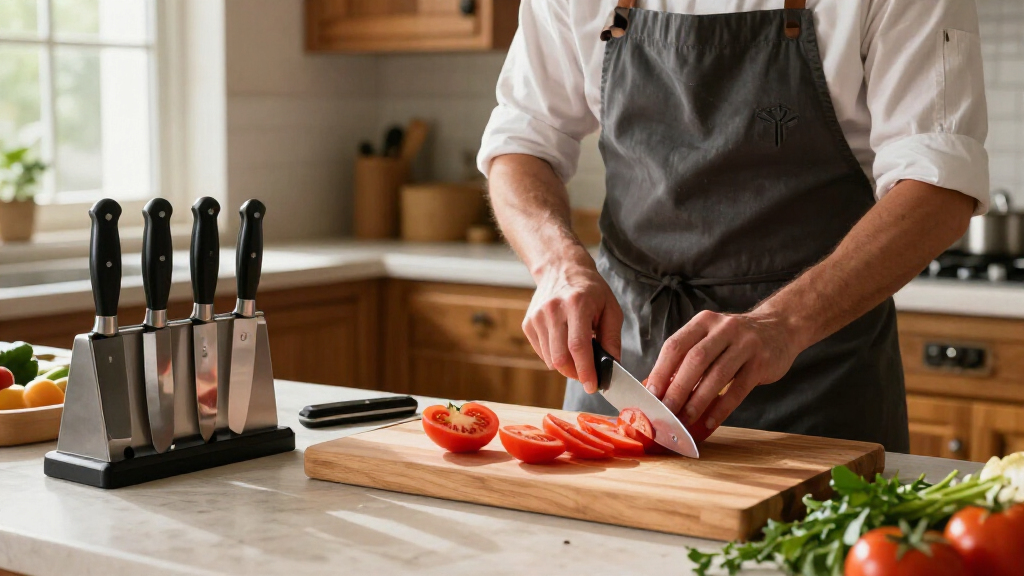
Most sets center on a chef’s knife, often about 8 inches long, for chopping, slicing, and mincing. You may also find a paring knife for peeling and small, careful cuts, plus a serrated bread knife for crusty loaves and foods with tender insides. Some include a utility knife, boning or fillet knife, kitchen shears, honing rod, carving knife, steak knives, or a storage block.
Imagine making Sunday dinner: the chef’s knife cuts onions, the paring knife trims a bruised spot from an apple, and the bread knife slices a crackling sourdough crust without crushing the soft center. Those three pieces may do more for you than ten blades you seldom use. Read the item list as a map of tasks, not a measure of quality.
A set makes sense when the included knives match how you cook and cost less than buying useful pieces separately. If you already own a comfortable chef’s knife, a smaller expansion set may be the better fit. Count the knives you would use in a typical week before paying for a polished block.
Products Worth Considering

Ninja HyperHeat 9-in-1 Electric Pressure Cooker, 6.5 Qt, Dark Gray, PC201GY

Cuisinart Chef's Classic 17-Piece Stainless Steel Cookware Set

Vitamix Nano Personal Blender with SmoothiePilot Technology, Black
As an affiliate, we earn on qualifying purchases.
Choose the Three Knives That Handle Most Weeknight Prep
A chef’s knife, paring knife, and bread knife cover a large share of everyday kitchen jobs. The chef’s knife handles broad cuts, the paring knife handles precise work, and the bread knife uses serrations to grip crusts and soft skins. That trio is a practical starting point for a new cook, even if a larger set looks tempting.
Start with the chef’s knife. An 8-inch blade is a common choice: it can mince a pile of herbs and slice a melon, while a shorter knife may feel easier to control if you have smaller hands or little counter space. A longer blade can help with larger ingredients, but only if you can guide it comfortably. Try the grip if you can; your wrist should not feel strained after a few chopping motions.
A paring knife is handy for peeling a pear, removing a strawberry stem, or making small garnishes. A bread knife is built for a different job: its teeth pass through a crisp baguette without pressing the airy middle flat. If your knife set is missing one of these core pieces, ask whether another included blade truly fills that role.
For instance, a home cook who makes salads, toast, and fruit snacks might use those three knives daily but never touch a boning knife. A cook who regularly prepares whole fish or poultry may value a flexible fillet or boning knife much more. Build your selection around the food you actually cut, not an imaginary professional kitchen.
- Chef’s knife: chopping, slicing, and mincing.
- Paring knife: peeling and detailed cuts.
- Bread knife: crusty bread and delicate interiors.
- Specialty pieces: choose only when your routine calls for them.
Compare Steel and Construction Without Falling for the Label
Steel performance depends on the alloy, heat treatment, and blade geometry, not a dramatic phrase on the box. Stainless steel generally resists rust and staining, while carbon steel can develop a patina and needs more attentive care. Labels such as “high carbon,” “German,” or “Japanese” do not tell the whole story; look for specific material and maintenance details.
Harder steel can hold an edge longer, but it may chip if you twist the blade through a hard squash or let it clatter into a sink. Softer steel is often easier to maintain, though it may need sharpening more often. If you cook fast and wash up in a hurry, stain resistance and straightforward care may matter more than chasing the hardest blade.
Forged knives are shaped from heated steel, while stamped knives are cut from sheet steel. Either can work well; design, quality control, and heat treatment matter more than the construction label alone. A full tang means the blade metal extends through much or all of the handle, but that feature alone does not guarantee a good knife.
Consider two cooks cutting carrots for soup. One likes a heavier Western-style blade and a rocking motion; the other prefers a lighter Japanese-style profile with a flatter edge for push-cutting. These are broad tendencies, not rules, and individual models vary. If a professional chef tests a knife, their hand size and technique may differ from yours.
“Professional” describes the intended audience in marketing; it does not certify how the knife is made or how it performs.
Find a Handle and Blade Shape That Feel Natural in Your Hand
The best knife for you feels secure and predictable through a full round of prep. Weight and balance are personal: some cooks like the reassuring heft of a heavier knife, while others prefer a lighter blade that changes direction quickly. Neither preference signals better skill; comfort helps you keep control when your cutting board fills with chopped vegetables.
Handle materials commonly include wood, composite, and plastic. Each can work, but the grip should feel stable in your hand, including when you’re moving between ingredients. If you shop in person, hold the knife as you would while chopping. If you shop online, look for clear handle dimensions, weight, and reviews that describe extended use rather than only a first impression.
Blade profile matters too. Many Western-style chef’s knives have a curved edge that suits a rocking cut, where the tip stays near the board as the heel rises and falls. Many Japanese-style knives have flatter profiles that work well for a forward push-cut. Those patterns are broad guides: a particular model may feel different, and your technique can adapt.
Picture a small kitchen with a narrow cutting board and a cook who chops one onion at a time. A shorter, lighter knife may feel nimble and leave more room to work. Someone regularly breaking down large squash may prefer more blade length and weight. When a knife feels awkward during a quick test, a set price or fancy handle won’t make it more comfortable at home.
Use This Five-Step Check Before You Buy a Set
You can judge a professional chef knife set by matching its pieces to your cooking, then checking comfort, care, storage, and value. This simple order prevents a long row of accessories from distracting you from the knives you’ll actually hold. For a student moving into a shared apartment, that might mean prioritizing three useful blades and a storage option that fits one drawer.
- List your regular tasks. Write down what you cut in a normal week: vegetables, bread, fish, poultry, or fruit.
- Mark the knives that serve those tasks. A chef’s knife, paring knife, and bread knife cover many home kitchens; add a boning or fillet knife only if you prepare meat or fish that calls for it.
- Check dimensions and feel. Compare length, weight, handle shape, and blade profile. An 8-inch chef’s knife is a common starting point, but comfort decides.
- Read care and warranty details. Look for specific steel information, cleaning guidance, sharpening options, and useful warranty terms.
- Compare the usable value. Consider the price of the pieces you will use, not the number of slots filled in the block.
Suppose a set costs more because it includes eight steak knives, but you rarely host guests and already own table knives. The headline count adds little value for your kitchen. A smaller set with a comfortable chef’s knife and the two supporting blades may earn its space every week.
Online demonstrations can help you see blade shape and handling, but a video cannot fully tell you whether the handle fits your hand. Reviews are most useful when they describe real cooking, cleaning, edge care, and wear over time. Treat claims like “razor sharp” as marketing unless the seller backs them with clear specifications and care information.
Keep Your Knives Sharp, Clean, and Ready for Dinner
Good knife care starts with hand-washing, prompt drying, and edge-safe storage. Dishwashers expose blades and handles to heat, moisture, detergent, and impacts; that can dull edges or damage handles. Wash a knife by hand after slicing a lemon or chopping garlic, then dry it before putting it away.
Use a wood or plastic cutting board, which gives the edge a more forgiving surface. Glass, stone, and ceramic boards can damage a blade’s edge. If you slice a tomato and the skin keeps slipping away from the knife, that can be a sign the edge needs attention; forcing the blade harder is a poor fix.
A honing rod helps realign an edge during routine maintenance, while sharpening removes material to create a new edge. They are different jobs. How often a knife needs sharpening depends on its steel, use, and care, so there is no single calendar rule that fits every kitchen.
Choose storage that keeps edges from knocking against other utensils: a block, magnetic wall strip, drawer insert, or blade guard can all work. A block protects knives and keeps them easy to grab, but it uses counter space and needs cleaning. For a renter with crowded counters, blade guards in a drawer may be the more practical option.
Spend on the Blades You Reach for, Not the Biggest Block
A more expensive set is not automatically better, because price can reflect materials, manufacturing, design, branding, or extra accessories. Compare the knives themselves: steel details, construction, comfort, care requirements, warranty, and how many pieces match your routine. The useful question is not “How many knives do I get?” but “Which of these will make dinner prep easier?”
Knife-set marketing has increasingly highlighted Japanese-inspired profiles, harder steels, lighter construction, ergonomic handles, direct-to-consumer brands, and smaller collections. These are broad market trends, not proof that every new release performs better. Smaller sets can appeal to buyers who want fewer duplicates and less clutter, but you still need to assess the individual knives.
Imagine choosing between a large block with a boning knife, carving knife, and steak knives or a compact set with a chef’s knife, paring knife, and bread knife. If your usual meal is roasted vegetables with crusty bread, the second group likely earns more use. If you often fillet fish or carve roasts, the specialty pieces may justify their cost.
A professional chef knife set pays off when it brings together blades you need, in shapes you can handle, with care you’re willing to provide. For some cooks, buying three separate knives gives better fit and less waste. For others, a set is a convenient and cost-effective start. Compare the contents and test the grip whenever possible.
Frequently Asked Questions
Do professional cooks need a full knife set?
Usually not; many cooks rely on a few knives they use regularly. A set makes sense when its pieces match your tasks and offer good value, such as a chef’s knife, paring knife, and bread knife for a home cook.
Are Japanese knives better than German knives?
Neither style is universally better. Japanese-style knives often have thinner, harder blades and flatter profiles, while German-style knives often have more curved profiles and may feel heavier. Individual models vary, so choose by comfort, technique, and intended use.
What size chef’s knife should I buy?
An 8-inch chef’s knife is a common starting point. A shorter blade can feel easier to control for smaller hands or limited counter space, while a longer one can help with larger ingredients. Your comfort is the deciding factor.
What is the difference between honing and sharpening?
Honing helps realign a blade’s edge during routine care. Sharpening removes material to create a new edge. How often you need sharpening depends on the knife, how you use it, and how you maintain it.
Can chef knives go in the dishwasher?
Hand-washing and drying promptly is the safer general recommendation. Dishwasher heat, moisture, detergent, and impacts can dull an edge or damage a handle, so wash your knives by hand after use.
How can I avoid misleading knife claims?
Look for specific steel and care information, clear dimensions, useful warranty terms, and reviews that describe real use. Treat terms such as “professional,” “surgical steel,” and “razor sharp” as marketing unless meaningful specifications support them.
Conclusion
Buy knives for the jobs you do, then choose the blades that feel comfortable and fit your care routine. A useful three-knife core can serve you better than a crowded block, though frequent fish or meat preparation may call for a specialty blade.
Let your next knife earn its place at the cutting board: a steady grip, a clean slice through tomato skin, and no unused steel gathering dust.