
TL;DR
A professional chef knife set is a group of knives selected for common kitchen tasks, but “professional” is a marketing term rather than a regulated grade. Start with a comfortable chef’s knife, a paring knife, and a serrated bread knife; compare steel, balance, care needs, and warranty before paying for extra pieces.
A knife block can hold 15 gleaming blades and still leave you reaching for the same three. A professional chef knife set should make everyday prep easier, whether you’re slicing ripe tomatoes at home or breaking down a tray of vegetables before dinner service. The word “professional” sounds like a quality guarantee, but it has no regulated grade; the contents and how they perform matter more.

Get kitchen gear delivered free with Prime
- Fast, free delivery on millions of items
- Prime Video, Amazon Music and more included
- Member-only deals all year
This guide helps you judge a set by the work it can do. You’ll learn which knives earn regular use, how steel and construction affect cutting and care, and when a smaller group of individually chosen knives makes more sense. Think of it as choosing tools for your hands and habits, not buying a block because it looks impressive on the counter.
For example, if you mostly chop onions, slice bread, and peel fruit, a chef’s knife, bread knife, and paring knife may cover nearly every meal. A set that adds six steak knives and a pair of shears may have a larger number on the box, but not more value for your kitchen.
Start with a chef’s knife, paring knife, and serrated bread knife; count useful blades rather than advertised pieces.
Choose steel by balancing edge retention, ease of sharpening, toughness, and rust resistance.
Hold a knife if you can; weight, grip, handle shape, and balance shape everyday comfort.
Buy a set when its contents match your regular meals; buy individual knives when fit and control matter more.
Hand-wash, dry, and store blades safely; honing realigns an edge, while sharpening removes material to create a new one.
Start with three knives that cover most kitchen jobs
A practical professional chef knife set usually starts with a chef’s knife, a paring knife, and a serrated bread knife. Together, they cover most common chopping, peeling, and crusty-bread jobs without filling a drawer with blades you rarely touch. The chef’s knife is the workhorse: an 8-inch blade suits many cooks, while a shorter blade can feel easier to control if you have smaller hands or limited counter space. The useful distinction is not simply blade length: a longer edge gives room for broad slices and fewer strokes, while a shorter one can be easier to steer in a crowded prep area.
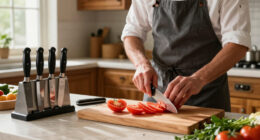
Picture a weeknight dinner: you use the chef’s knife to dice an onion, the paring knife to trim a strawberry, and the bread knife to cut a crisp baguette without crushing its soft center. Each blade’s shape is suited to a different interaction with food. A broad chef’s blade supports rocking cuts and scooping ingredients; a small paring blade gives close control; serrations grip a hard crust while passing through a soft interior. A set may add a utility knife, kitchen shears, a honing rod, or a block; each can help, but ask whether you’ll use it before treating it as a bonus.
Read the contents list carefully. Some boxes count steak knives and accessories toward the advertised piece total, so a “15-piece” set may contain fewer than 15 cooking knives. If a knife set is being compared by size alone, count the blades that match your cooking, then compare those blades with the tasks you do each week. This avoids paying for a bundle whose headline price looks economical but whose rarely used pieces take up storage and add no practical coverage.
Key fact: A chef’s knife, paring knife, and serrated bread knife make a more useful starting point than a crowded block of specialty blades for many home kitchens. If you bake sourdough every weekend, the bread knife earns its place; if you rarely cut bread, prioritize the chef’s knife’s fit and feel. The right starter group is a baseline, not a rule: replace or add a knife when a recurring task shows that your current tools struggle.
Products Worth Considering

Breville Bambino Espresso Machine, Brushed Stainless Steel

Cuisinart Chef's Classic 11-Piece Stainless Steel Cookware Set

Instant Pot Pro Plus 6-Quart 10-in-1 Electric Pressure Cooker
As an affiliate, we earn on qualifying purchases.
Judge the steel by its trade-offs, not its label
The best blade steel for you balances edge retention, sharpening effort, toughness, and corrosion resistance; no single label wins every category. Edge retention affects how often you need to restore a keen edge, while ease of sharpening affects how much time and skill that upkeep takes. Stainless steel generally resists stains and rust, which suits a busy kitchen where a knife may sit beside a damp cutting board for a few minutes. Carbon steel can take a very keen edge, but you need to dry it promptly and accept that it may develop a patina. That patina is a surface change, not automatically a defect, though neglect can allow damaging rust.
High-carbon stainless steel aims to combine useful edge performance with better stain resistance, though results depend on the exact alloy and its heat treatment. “German steel” or “Japanese style” on a product page cannot tell you how well a blade will cut by itself. Steel composition is only one part of performance; blade geometry and heat treatment also influence how keen an edge can be, how long it lasts, and how readily it can be renewed. Likewise, a wavy Damascus pattern may look striking under kitchen lights, but its appearance alone does not prove that the edge holds longer or slices better.
Imagine you cook once a week and sometimes leave cleanup until after dinner. A corrosion-resistant blade may suit you better than a steel that demands immediate drying, because care habits matter as much as theoretical edge performance. If you enjoy sharpening and wipe your knife between tasks, a carbon-steel blade may reward that care with a keen edge and a distinctive darkening surface over time. The tradeoff is a routine obligation: if that maintenance is likely to be skipped, the steel’s potential advantage may not translate into a better experience.
When you compare kitchen knives selected for your needs, look for clear information about steel, sharpening support, and care. Ask a seller what the maker recommends for sharpening and whether the warranty covers defects or edge damage. Specific answers tell you more than a shiny pattern or a string of prestige words. They also help you estimate the ongoing cost and effort of ownership, which can matter more than a small difference in the purchase price.
Choose a knife that feels steady in your hand
A comfortable, controllable knife is a better fit than one that merely claims forged or professional construction. Forged knives are shaped from heated steel and may include a bolster; stamped knives are cut from sheet steel and often feel lighter. Either type can cut well. Handle shape, grip, balance, blade geometry, and weight tell you more about daily comfort than the construction label on its own. In practice, comfort affects control and fatigue: a knife that suits your grip is easier to guide repeatedly, so a brief trial can tell you more than a prestige label.
If possible, hold the knife before buying. Use a relaxed pinch grip, with your thumb and index finger near the blade heel, and see whether the handle leaves your wrist straight while you make a gentle rocking motion. A heavier knife may feel reassuring when chopping a dense squash, but the same weight can tire your hand during a long stack of carrots. Balance is personal, too: a blade-heavy knife may make a downward cut feel forceful, while a handle-heavy one may feel less tiring to lift. Neither quality is universally better; the test is whether the knife stays predictable during the cuts you make often.
For example, a cook with smaller hands may find a shorter chef’s knife easier to guide around a cutting board. Another cook may prefer an 8-inch blade for slicing a large melon in fewer strokes. Neither preference makes one knife more professional; the right fit lets you keep the tip and edge under control. If the handle forces an awkward wrist angle or the blade feels difficult to stop, those discomforts are likely to become more noticeable during longer prep sessions.
Try a simple comparison if a shop allows it: hold two knives by the handle, then make a few slow cuts through a soft vegetable. Pay attention to whether the blade feels balanced and predictable, not whether it feels heavy or impressive. If you order online, check the return policy and published dimensions so you have a practical way to judge comfort at home. Dimensions and weight narrow the choices, but they cannot fully convey handle shape or the way a particular balance point feels in motion.
Buy a set only when the pieces match your cooking
A set makes sense when its core knives fit your routine and the bundle offers useful storage at a fair price. Buying knives individually makes sense when you want to choose each blade’s feel or avoid paying for pieces you will rarely use. The cheaper sticker price on a bundle does not automatically make it the better value if several knives stay untouched in the block. Consider the cost of the knives you will use, the storage they require, and whether you can replace or sharpen them conveniently; those factors shape value over years of use.
Consider two cooks. One has a small kitchen, bakes bread, and preps vegetables most nights; a three-knife set and a compact magnetic strip could serve them well. Another often hosts dinner and cuts meat at the table; a larger set with steak knives may suit that household. The right answer depends on your menus, storage space, and how many people you cook for. A block can keep knives organized, but it claims counter space; a strip saves space but needs an appropriate wall location and safe installation. Storage is part of the purchase decision because inconvenient storage can make a useful knife less accessible.
| Buying choice | Works well when | Trade-off |
|---|---|---|
| Core knife set | You want coordinated basics and storage | One included knife may not fit your hand |
| Individual knives | You know which blades you use and want to test their feel | Storage and styles may not match |
| Large block set | You will use its specialty knives and have counter space | Piece count can include little-used accessories |
Before you buy, list three meals you make often and the cuts they require. That quick exercise helps to cover common tasks without shopping for every possible kitchen job. Compare the included knives, block footprint, replacement support, and warranty, then decide whether the bundle saves money on tools you genuinely need. If a bundle’s price advantage depends on accessories you would not otherwise buy, compare its cost against purchasing just the core knives individually.
Keep your knives sharp, clean, and safely stored
Good knife care starts with simple habits: wash by hand, dry promptly, and store blades so their edges cannot bang against other tools. A dishwasher’s heat, detergent, and collisions can damage an edge or handle, and moisture can encourage corrosion. For storage, choose a stable block, a suitable magnetic strip, blade guards, or a knife roll; loose knives in a drawer are harder to handle safely. These habits protect both the edge and the person reaching for the knife: a blade that stays sharp cuts more predictably, and storage that covers or separates it reduces accidental contact.
A sharp knife is easier to guide through food than a dull one that skids off a tomato skin. A honing rod can help realign a rolled edge between sharpening sessions, but it does not sharpen in the same way as a stone or another abrasive. Sharpening removes material to create a fresh edge; how often you need it depends on use, steel, cutting surface, and technique. Honing may restore alignment when an edge has bent slightly, but it cannot repair a worn or damaged edge indefinitely. Using a rod too aggressively can also be unhelpful, so follow the maker’s guidance for the blade and tool.
After chopping herbs, rinse away residue and dry the blade before putting it away. Use a wood or plastic cutting board rather than glass or stone, which can wear an edge quickly. If your knife starts crushing a tomato instead of cutting cleanly, that is a useful sign to hone or sharpen it, depending on the blade’s condition. A stable board matters as well: a damp towel beneath it can keep it from shifting, making controlled cuts easier.
Handle every knife with the edge pointed away from your fingers, keep the board stable, and never reach blindly into a sink of soapy water. Electrical, gas, roof, and structural work around a kitchen belong to licensed professionals; switch off power before permitted electrical work, use proper PPE, and follow local code. Knife care is routine, but safe handling and code compliance deserve the same respect as a sharp edge.
Spend for support and fit, not the biggest price tag
A higher price can pay for materials, manufacturing, finishing, accessories, branding, or warranty support, but it does not guarantee better cutting for your kitchen. A well-finished mid-priced knife that feels steady in your hand may serve you better than a costly set that is too heavy or difficult to maintain. Price is one clue; the knife’s fit, care requirements, and support matter more. A higher-cost blade is worthwhile when its specific advantages solve a problem you actually have, such as a preferred handle, a useful sharpening service, or a construction quality you value.
Check exactly what the warranty covers. Some warranties address manufacturing defects but exclude ordinary edge wear, misuse, or damage from a dishwasher. Look for a clear sharpening or repair service, access to replacement parts, and instructions that explain how to care for the steel. These details reveal how much support you can expect after purchase; a warranty that excludes routine wear is not a substitute for sharpening access or sensible care guidance.
Say two sets cost different amounts, but both include a chef’s knife, paring knife, and bread knife. If the less expensive set feels comfortable, has clear care instructions, and offers a sensible warranty, it may be the more practical buy. If the more expensive set includes a knife you’ll use daily and a local sharpening service, the extra cost may make sense. Compare the features against your own use rather than assuming that a higher price means a longer-lasting edge or better control.
A professional chef may choose a single knife for a demanding station and maintain it carefully; a home cook may prefer a resilient stainless blade that survives a busy week. Neither needs to be dazzled by a “professional” label. Choose the option whose real advantages match your cooking, your hands, and the time you’re willing to spend on upkeep. That approach weighs the full ownership experience—cutting, maintenance, storage, and support—instead of treating the price or label as a shortcut for quality.
Frequently Asked Questions
What knives do I actually need in a chef knife set?
Many cooks can handle everyday prep with a chef’s knife, paring knife, and serrated bread knife. Add a utility knife, shears, or steak knives only when you’ll use them. For example, a frequent baker will get more from a bread knife than from a drawer full of specialty blades.
Is it better to buy a set or choose knives individually?
Buy a set when its core knives fit your cooking, storage, and budget. Choose knives individually when you want to test each knife’s feel or avoid accessories you will not use. A compact set can be convenient, while individual purchases give you more control over handle shape and weight.
Are forged knives better than stamped knives?
Neither construction type guarantees a better knife. Forged knives may have a bolster and feel heavier; stamped knives often feel lighter. Fit, balance, blade geometry, and edge quality matter more than the label, so hold the knife if possible before buying.
Can chef knives go in the dishwasher?
Hand-washing is the safer choice. Dishwasher heat, detergent, and contact with other items can wear the edge, damage handles, or encourage corrosion. Wash the blade by hand, dry it promptly, then store it in a block, on a suitable magnetic strip, in a blade guard, or in a knife roll.
Does a honing rod sharpen a knife?
A honing rod can help realign a rolled edge between sharpening sessions, but it does not replace sharpening. Sharpening uses an abrasive, such as a whetstone, to remove material and create a fresh edge. If your knife crushes a tomato instead of slicing its skin, inspect the edge and decide whether it needs honing or sharpening.
What does Damascus mean on a knife?
Damascus often describes a patterned layered construction or finish. The visible pattern can look beautiful, but it does not prove that the blade cuts better or holds its edge longer. Check the steel, heat treatment details, care needs, and warranty instead of judging performance by appearance alone.
Conclusion
Choose your knives around the meals you actually make: begin with a comfortable chef’s knife, then add a paring knife and bread knife if your routine calls for them. Check the steel, feel, care instructions, storage, and warranty before paying extra for a larger piece count or a professional label.
A good knife should feel like a quiet extension of your hand: steady on the board, clean through a ripe tomato, and ready for tomorrow’s dinner.