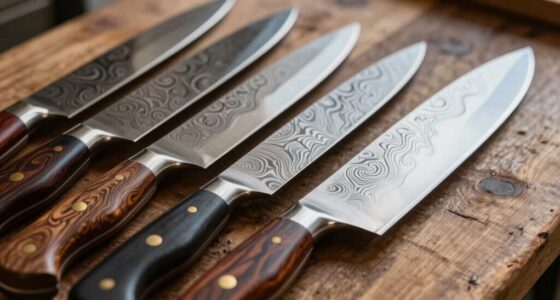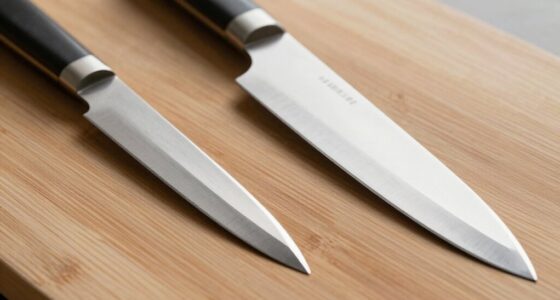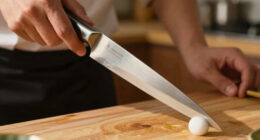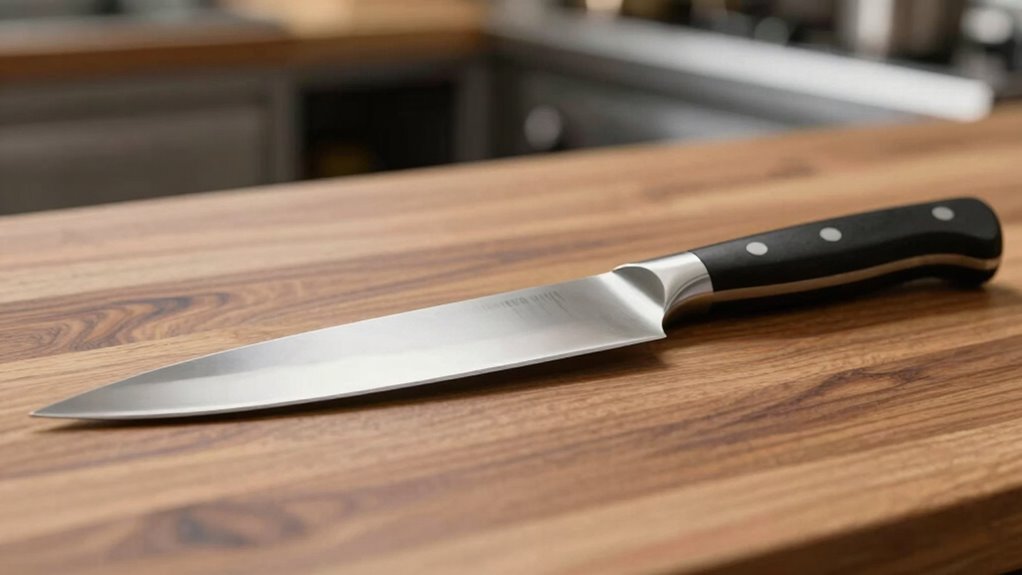

Thin knives cut better because their narrow blades reduce resistance, allowing you to make cleaner, more precise slices with less effort. They give you greater control, especially for delicate tasks like julienning or slicing sashimi. However, their fragility means you need to handle them carefully and give them proper maintenance. With respect and skill, you can harness their full power. If you’re curious about how to use and care for these blades, more details await.
Key Takeaways
- Thin blades reduce resistance, enabling cleaner, more precise cuts with less force.
- Their delicate design requires careful handling to prevent damage and maintain sharpness.
- Thinner blades offer better control for detailed tasks like julienning or sashimi slicing.
- Proper storage and regular maintenance are essential to preserve their performance and longevity.
- Increased fragility demands respect and skill to avoid accidental damage during use.
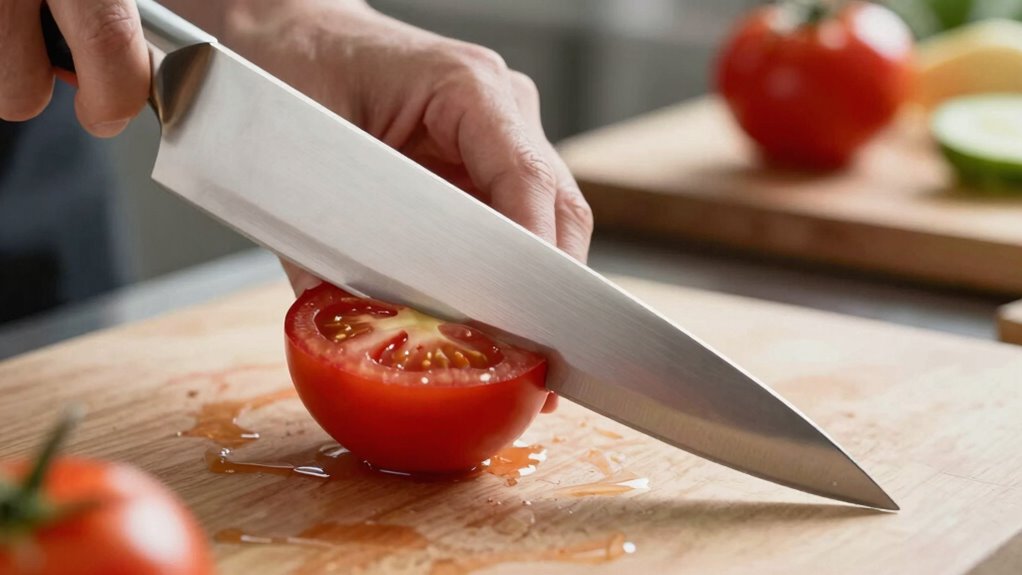
Thin knives cut more efficiently because their narrow blades reduce resistance and allow for cleaner, smoother slices. This efficiency largely comes down to blade thickness, which directly influences cutting precision. When you use a thin knife, you notice how effortlessly it slices through food, whether it’s delicate herbs or tough meats. The thinner the blade, the less surface area it has to push through, which means you exert less force and get more control over your cuts. This precision is especially important in professional kitchens where presentation and consistency matter. A thin blade offers a level of finesse that thicker blades simply can’t match, allowing you to achieve fine, even cuts with minimal effort. Additionally, the blade thickness directly impacts how well a knife maintains its sharpness over time, making proper handling even more crucial. Recognizing the importance of material quality can also help extend the lifespan of a thin knife and sustain its cutting prowess. Proper storage and cleaning techniques are essential to preserve the integrity of delicate blades, ensuring they stay in optimal condition longer.
Thin knives enable effortless, precise cuts for cleaner slices and improved control in every kitchen task.
However, this advantage also means that thin knives demand more respect. Their delicate design makes them more susceptible to damage if not handled properly. Unlike sturdy, thicker blades, a thin knife can chip or bend if it hits a hard bone or frozen food. You need to pay close attention when you’re working with such knives, ensuring you’re using the right technique and cutting surfaces. They require careful storage, too, because knocking one against a hard surface can dull or damage the edge. Because of their fragility, thin knives often need regular honing and sharpening to maintain optimal cutting precision, which can be a bit of a hassle but is essential if you want to keep that razor-sharp edge. Developing good knife handling skills is crucial for keeping these blades in top condition and ensuring safety during use.
Despite these challenges, the benefits of using a thin knife outweigh the drawbacks once you understand how to respect its limitations. With proper handling, you’ll find that your work becomes more precise, and your slices become cleaner and more consistent. This level of control is what makes thin knives a favorite among chefs who prioritize presentation and accuracy. They excel in tasks where detail matters, such as julienning vegetables or slicing sashimi, where a smooth, uniform cut elevates the overall dish. Just remember, the very qualities that make thin knives exceptional—lightness, precision, and finesse—also mean you have to be gentle and attentive during use.
In the end, choosing a thin knife is about appreciating the balance between cutting performance and the care it requires. When you respect its fragility and handle it with skill, you unlock a tool that transforms your culinary work into an art form. The payoff is a level of cutting precision that thick blades simply can’t provide, making thin knives an invaluable addition to your kitchen arsenal.

SANMEIHO 10 Inch Sushi Knife, High Carbon Japanese Steel Sashimi Knife
- Material: High-quality Japanese stainless steel
- Hardness: 57 HRC for rust resistance
- Blade Sharpness: Ultra-sharp 12° cutting angle
As an affiliate, we earn on qualifying purchases.
As an affiliate, we earn on qualifying purchases.
Frequently Asked Questions
How Do Thin Knives Maintain Their Edge Over Time?
You can keep thin knives sharp longer by paying attention to their blade flexibility and edge retention. Regular honing helps maintain the edge, preventing it from dulling quickly. Avoid using them on hard surfaces like bones or glass, which can chip or dull the blade. Proper cleaning and storage also protect the edge. With careful use and maintenance, your thin knives will stay sharp and perform well, thanks to their superior edge retention.
Are Thin Knives Suitable for All Types of Cutting Tasks?
Thin knives aren’t suitable for all cutting tasks, especially those demanding force or heavy-duty work. They excel at precision slicing and delicate cuts, allowing you to carve through ingredients with finesse. However, their fragility means you should avoid using them for tough or thick items, as they can bend or break. For intricate and precise work, thin knives are your best choice, but for rugged tasks, opt for sturdier knives.
What Materials Are Best for Making Thin Knives?
You should choose materials like high-carbon stainless steel or VG10 for making thin knives, as they offer excellent blade flexibility and material durability. These materials allow the blade to bend slightly without breaking, improving precision and control. Their toughness ensures longevity, even with frequent use. By selecting such materials, you guarantee your thin knife maintains sharpness and performance, making it a reliable tool for delicate and detailed cutting tasks.
How Does the Thickness of a Knife Affect Safety?
Your safety hinges on knife thickness—think of it as the armor protecting you. Thinner blades often have better knife ergonomics, making them easier to control, but they tend to be more flexible, which can increase the risk of bending or breaking during use. A thicker knife offers more stability and less flex, reducing accidents. So, choose your knife thickness wisely to strike a perfect balance between precision and safety.
Can Thin Knives Be Easily Repaired or Sharpened?
Thin knives can be sharpened effectively, but their blade durability might be lower than thicker ones. You’ll need to use precise sharpening techniques, like honing with a fine stone, to maintain their sharpness. While thinning a blade can make it easier to sharpen, be cautious—over-sharpening may weaken the edge. Regular maintenance and careful sharpening will help you keep your thin knives performing well without compromising their delicate edges.

Victorinox Swiss Classic 3.25" Paring Knife, Straight Edge Spear Point
- Precision Kitchen Tool: Ideal for detailed tasks
- Ergonomic Textured Handle: Non-slip grip, comfortable use
- Dishwasher Safe & NSF Approved: Hygienic, easy to clean, safe
As an affiliate, we earn on qualifying purchases.
As an affiliate, we earn on qualifying purchases.
Conclusion
So, next time you marvel at a thin knife’s effortless cut, remember it’s not just the sharpness, but the respect it demands. Ironically, that delicate blade often whispers “fragile” while wielding more power than a hefty counterpart. You might think you’re in control, but truth be told, it’s the knife’s finesse—and your cautious reverence—that truly rules the kitchen. After all, sometimes the thinnest edge cuts the deepest, and commands the most admiration.

Intelitopia Complete Knife Sharpening Stone Set – Dual Grit Whetstone 400/1000 3000/8000 Knife Sharpener with Leather Strop, Flattening Stone, Bamboo Base, 3 Non-slip Rubber Bases & Angle Guide
- Complete Knife Sharpening Kit: Includes all essential sharpening tools
- Dual Grit Whetstone: 400/1000 and 3000/8000 grit for versatile sharpening
- Durable Corundum Material: High-quality aluminum oxide for longevity
As an affiliate, we earn on qualifying purchases.
As an affiliate, we earn on qualifying purchases.

KITCHENDAO XL Acacia Wood Universal Knife Block with Slots for Scissors and Sharpening Rod, Safe, Space Saver Knives Storage Stand Display without Knives, Unique Slot Design to Protect Blade
- Universal Compatibility: Stores all knife sizes and shapes
- Double-Deck Design: Securely holds knives on two levels
- Parallel Slots: Prevents blade contact and damage
As an affiliate, we earn on qualifying purchases.
As an affiliate, we earn on qualifying purchases.