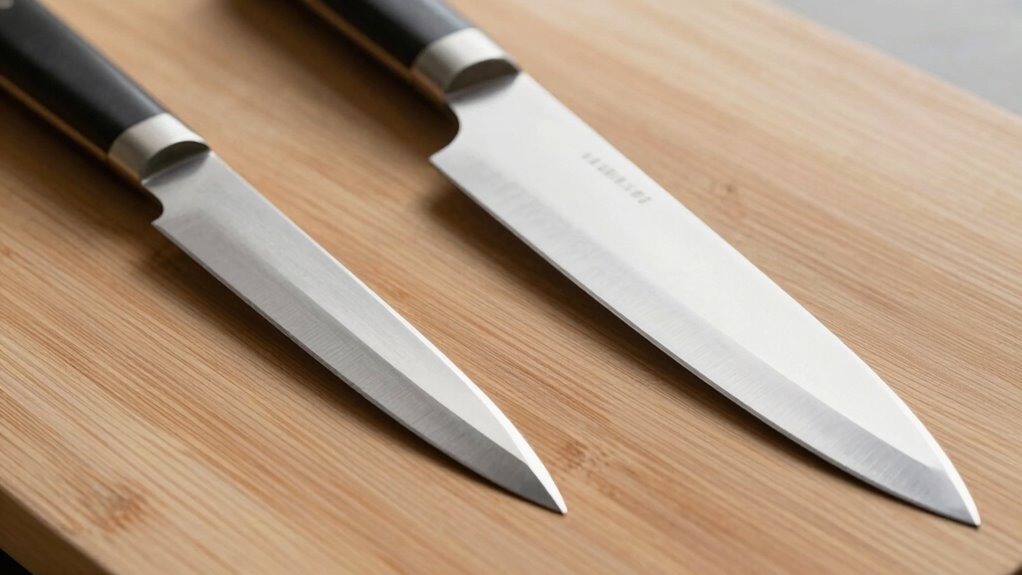
Japanese knives have straighter or gently curved blades, making precision cuts easier and ideal for delicate tasks like sashimi or thin vegetables. German knives feature a more pronounced curve, allowing you to rock the blade for forceful chopping and tackling tougher ingredients. Handle design also differs, with Japanese models emphasizing control and finesse, while German handles focus on strength and stability. Understanding these differences helps you choose the right tool for your cooking style—keep exploring to learn more details.

Get kitchen gear delivered free — and shop member deals
- Fast, free delivery on millions of items
- Access to Prime Big Deal Days deals on October 6–7
- Prime Video, Amazon Music and more included
Key Takeaways
- Japanese knives have a straighter or gently curved blade, enabling precise, controlled cuts, while German knives feature a more pronounced curve for rocking motions.
- Blade curvature influences cutting techniques: Japanese blades suit delicate, push/pull cuts; German blades facilitate forceful, rocking chopping.
- Japanese handles are thinner and lighter for finesse, whereas German handles are thicker and more robust for strength and stability.
- Blade geometry and handle design determine control, with Japanese tools emphasizing precision and German tools focusing on power.
- Properly matching knife design to specific tasks enhances efficiency, control, and overall cooking performance.

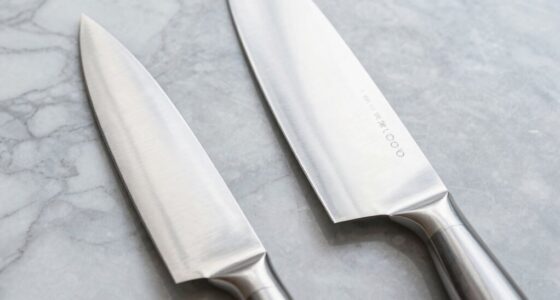
When choosing between Japanese and German knives, understanding their geometric differences can markedly impact your cutting experience. One of the key distinctions lies in blade curvature. Japanese knives typically feature a straighter or gently curved blade, which allows for precise, controlled cuts. This design is ideal for delicate tasks like slicing sashimi or thin vegetables, where you need to maintain a consistent, smooth motion. The minimal curvature means you can use a push or pull technique with less rocking, giving you greater control and finesse. Conversely, German knives often have a more pronounced curve along the blade, especially toward the tip. This curvature facilitates a rocking motion, making them well-suited for chopping and more robust cutting tasks. The pronounced curve helps you leverage the weight of the blade, allowing for quicker, more forceful cuts, which is advantageous when processing tougher ingredients or doing extensive chopping work. Additionally, the blade geometry influences how comfortable you feel during extended use, especially when performing repetitive tasks. Recognizing these differences can also inform your knife selection, ensuring you choose a tool that complements your specific cooking style. The handle design also plays a significant role in how these knives perform and feel in your hand. Japanese knives tend to feature thinner, often lighter handles that emphasize precision and control. They’re usually designed to fit comfortably in a pinch grip, giving you excellent maneuverability for intricate cuts. The handle shapes are often more streamlined, which can help reduce fatigue during extended use. Additionally, Japanese handle designs often focus on the balance and ergonomics to maximize control during delicate tasks. On the other hand, German knives generally incorporate thicker, more substantial handles that prioritize a secure grip and durability. These handles are often ergonomically shaped to fit your hand more fully, providing leverage and comfort during heavy-duty tasks. The difference in handle design influences your overall control, with Japanese handles favoring finesse and detail work, while German handles cater to strength and stability. Recognizing these differences in knife design can help you select a tool that aligns with your specific needs and cutting style.
Japanese chef knife for precision slicing
As an affiliate, we earn on qualifying purchases.
As an affiliate, we earn on qualifying purchases.
Frequently Asked Questions
How Do Knife Geometry Differences Affect Cutting Techniques?
Knife geometry differences, like blade curvature and edge bevel, directly influence your cutting techniques. A more pronounced blade curvature allows for rocking cuts, making slicing easier and more precise. Meanwhile, a thinner edge bevel on Japanese knives provides cleaner, finer cuts, ideal for delicate work. German knives, with a broader bevel, are better for chopping and heavy-duty tasks. Adjust your technique based on these features for maximum efficiency and control.
Are Japanese or German Knives Better for Beginner Cooks?
Japanese knives are better for beginner cooks because their lighter, precise design aligns with cultural preferences for craftsmanship and sharpness. They often feature thinner blades with a focused edge, making slicing easier. German knives, with their robustness and sturdiness, suit more experienced users handling tougher ingredients. Your choice depends on your comfort level, material preferences, and understanding of cultural design, but Japanese knives generally offer easier handling for those just starting out.
Do Different Geometries Impact Knife Maintenance or Sharpening?
Different geometries do impact knife maintenance and sharpening. You’ll notice that blades with a thinner edge angle, common in Japanese knives, require more frequent sharpening because they’re more delicate. The blade thickness also influences how easily you can resharpen the edge; thinner blades sharpen faster but are more fragile. Conversely, German knives with a more robust edge angle and thicker blades tend to need less frequent maintenance, offering durability.
Which Knife Type Is More Durable for Heavy Kitchen Use?
For heavy kitchen use, a German knife is more durable because of its thicker blade and robust construction, making it resistant to chipping and bending. The handle ergonomics of German knives also provide a secure grip, reducing fatigue during extended chopping sessions. Japanese knives, while sharper and more precise, typically have thinner blades that are more delicate and better suited for lighter, detailed work rather than heavy-duty tasks.
How Do Geometry Differences Influence Knife Safety?
A stitch in time saves nine, and understanding knife geometry can prevent accidents. Japanese knives, with their sharper angles, offer better blade stability, reducing slips. German knives, with more relaxed angles, often have ergonomic grips that enhance control. Both design differences directly influence safety; a well-balanced knife with proper grip minimizes the risk of cuts. Always choose a knife suited to your comfort and task to stay safe.
German chef knife for heavy chopping
As an affiliate, we earn on qualifying purchases.
As an affiliate, we earn on qualifying purchases.
Conclusion
So, next time you’re pondering which knife to wield, remember: the Japanese’s delicate, precise geometry might just make your chopping feel like art. Meanwhile, the robust German design could turn your kitchen into a battlefield of brute strength. Irony? The finer the edge, the more delicate it feels—yet it’s often the German workhorse that handles tough jobs with ease. Choose wisely; your culinary fate depends on those subtle geometric differences.
Japanese kitchen knife with lightweight handle
As an affiliate, we earn on qualifying purchases.
As an affiliate, we earn on qualifying purchases.
German kitchen knife with ergonomic handle
As an affiliate, we earn on qualifying purchases.
As an affiliate, we earn on qualifying purchases.
Evergreen bestsellers Picks
bestsellers
As an affiliate, we earn on qualifying purchases.