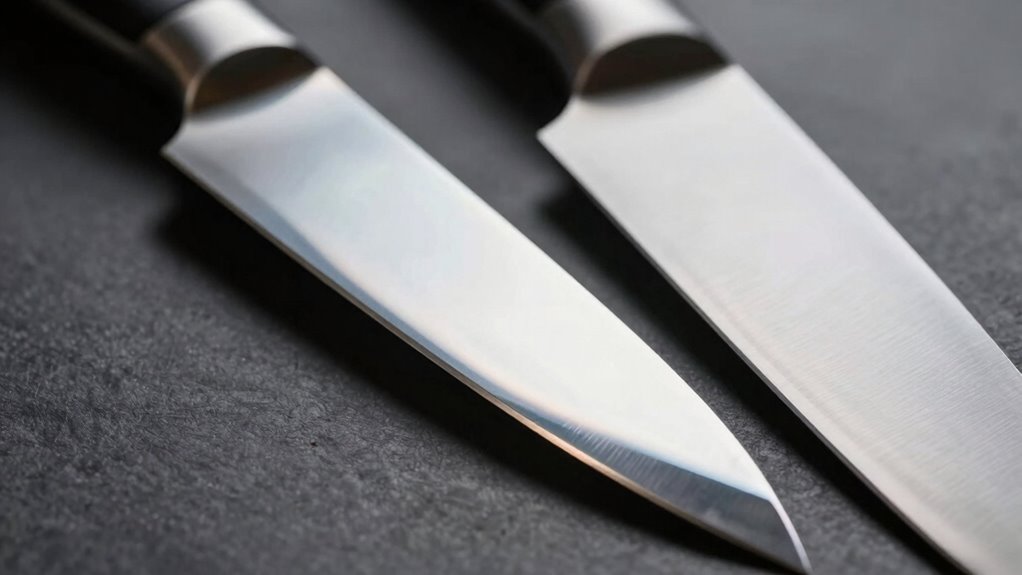

Some knives develop a mirror edge faster because they’re made from high-quality steels with fine grains, which polish more evenly and resist corrosion. These materials allow you to achieve a smooth, reflective surface more quickly with the right sharpening techniques. Proper tool selection, consistent angles, and finer abrasives also accelerate the process. If you want to understand how material and technique combine to speed up mirror finishes, keep exploring for more tips and insights.

Get kitchen gear delivered free — and shop member deals
- Fast, free delivery on millions of items
- Access to Prime Big Deal Days deals on October 6–7
- Prime Video, Amazon Music and more included
Key Takeaways
- High-quality steels with fine grain structures polish more evenly and quickly to a mirror finish.
- Premium steels like VG-10 and CPM-S35VN resist corrosion, maintaining their polished surface longer.
- Proper sharpening techniques with finer abrasives and consistent pressure accelerate mirror edge development.
- Smooth, uniform grain distribution reduces scratches, making polishing to a mirror faster.
- Skilled honing and the use of guiding tools help achieve a mirror edge more efficiently.

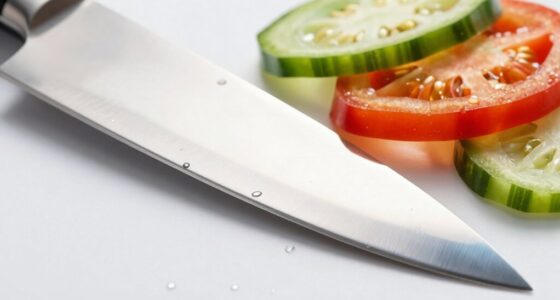
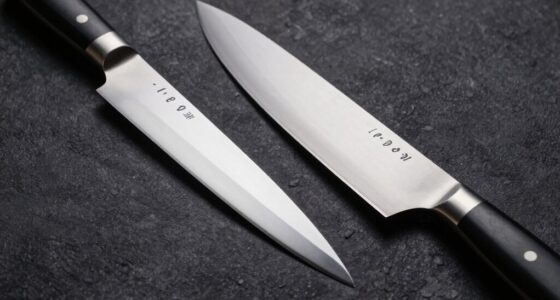
Knives with mirror edges captivate with their sleek, reflective surfaces that not only enhance their appearance but also demonstrate exceptional craftsmanship. When it comes to achieving that flawless, mirror-like finish, the choice of blade material plays a crucial role. High-quality steels, such as VG-10, CPM-S35VN, or Damascus, are often preferred because they contain refined alloys that polish more evenly and resist corrosion. These materials tend to have a fine grain structure, which makes it easier to hone a smooth, mirror finish. Conversely, lower-grade steels or those with more impurities can be more challenging to polish to that mirror shine, often requiring more patience and meticulous sharpening techniques.
High-quality steels like VG-10 and Damascus polish more evenly and resist corrosion, enabling a stunning mirror finish.
Your sharpening techniques greatly influence how quickly a knife develops and maintains a mirror edge. For instance, using progressively finer grit abrasives—starting from 1000 grit and moving up to 8000 grit or higher—allows you to refine the edge gradually, reducing scratches and creating a polished surface. When sharpening, consistent pressure and a steady angle help in achieving an even edge that reflects light uniformly. Many enthusiasts favor honing with a leather strop or a fine polishing compound after sharpening to remove microscopic burrs and enhance the mirror finish. This step isn’t just about aesthetics; it also results in a sharper, more durable edge that maintains its reflective quality longer.
The speed at which your knife takes a mirror edge depends on your technique and the tools you use. Proper alignment of the blade during sharpening ensures that every stroke removes material evenly, preventing dull spots or uneven scratches that can slow down the polishing process. Using a guided sharpening system or a sharpening stone with a consistent angle helps you stay precise, which is essential for a mirror finish. Additionally, maintaining cleanliness during sharpening prevents debris from scratching the blade, ensuring a smoother surface that reflects light beautifully.
Ultimately, the combination of blade material and sharpening techniques determines how quickly and effectively you can achieve a mirror edge. High-grade steels paired with meticulous, multi-step honing procedures will give you the best results, letting your knives shine with that perfect, mirror-like gleam. It’s a process that rewards patience and attention to detail, but once mastered, it transforms your everyday knife into a work of art that’s as functional as it is stunning. Understanding steel composition can greatly improve your ability to select and sharpen knives for optimal mirror finish results.
high carbon steel kitchen knives
As an affiliate, we earn on qualifying purchases.
As an affiliate, we earn on qualifying purchases.
Frequently Asked Questions
How Does Steel Composition Affect Mirror Edge Sharpening Speed?
Steel composition affects mirror edge sharpening speed mainly through steel hardness and alloy content. Harder steels, with higher hardness ratings, tend to take a mirror finish faster because they resist deformation during sharpening. Additionally, steels with specific alloy contents, like high carbon or chromium, influence how easily the blade can be polished to a mirror surface. So, choosing a steel with the right hardness and alloy balance helps you achieve a mirror edge more efficiently.
Do Different Sharpening Techniques Influence Mirror Finish Development?
You might notice that your sharpening technique directly influences the mirror finish. Precision in sharpening angles guarantees a smooth, reflective surface, while coating effects can either enhance or hinder mirror development. When you adopt consistent angles and fine-tune your approach, you create a more uniform polish. Sometimes, a simple adjustment to your technique release a stunning mirror edge, making your knife not just sharp, but also a beautiful masterpiece.
Can Handle Material Impact the Mirror Polishing Process?
Yes, handle material impacts the mirror polishing process. If your handle material has inconsistent polish or abrasive quality, it can cause uneven pressure on the blade, hampering the development of a mirror finish. You need to maintain polish consistency on the handle to guarantee smooth force transfer during polishing. Using high-quality abrasives with uniform abrasive quality helps achieve a flawless, reflective edge faster and more evenly.
Is There a Difference in Mirror Edge Durability Among Knife Types?
A mirror edge is like a delicate glass sculpture—beautiful but sometimes fragile. Different knife types vary in mirror edge durability due to factors like polish consistency and edge stability. High-quality steels with uniform polishing tend to hold a mirror finish longer, while softer steels or inconsistent polishing can cause quicker dulling or chipping. So, choose your knife wisely if you want that flawless, long-lasting mirror edge.
How Does Blade Thickness Affect Mirror Edge Formation?
Blade thickness considerably impacts mirror edge formation because thinner blades allow for more precise polishing, resulting in a smoother, more reflective edge. Your blade geometry influences how easily you can achieve this finish; a more refined edge enhances mirror-like qualities. Using quality polishing compounds can further refine the edge, but if your blade is too thick, it becomes harder to reach that perfect, mirror-like polish efficiently.
professional sharpening stones set
As an affiliate, we earn on qualifying purchases.
As an affiliate, we earn on qualifying purchases.
Conclusion
So, next time you’re marveling at that shiny mirror finish, remember: it’s not just about bragging rights or looking fancy. Some knives get there faster because of fancy steels or smarter techniques—probably not because they’re secretly magic. So, don’t get too obsessed with that perfect gleam; just enjoy the cut. After all, if your knife’s shining brighter than your future, maybe it’s time to reconsider your priorities.
As an affiliate, we earn on qualifying purchases.
As an affiliate, we earn on qualifying purchases.
Fall Picks
fall essentials
As an affiliate, we earn on qualifying purchases.