Carbon steel chef knives are often sought for sharp cutting performance, but this roundup includes a key distinction: all nine listed products are described as stainless or high-carbon stainless steel, not traditional non-stainless carbon steel. My best overall pick is the HOSHANHO 8-Inch Japanese High-Carbon Stainless Steel Chef Knife for cooks who want a single Japanese-style knife without committing to a set. The Babish 8-Inch Chef Knife stands out for its named German 1.4116 steel, while the HOSHANHO 9-Inch Kiritsuke suits cooks who prefer a longer blade and specialty profile. The main tradeoffs are blade length and shape, single knife versus set, and stainless convenience versus the patina and care routine associated with true carbon steel. Read on for the full comparison and guidance on choosing the right match.

Get kitchen gear delivered free with Prime
- Fast, free delivery on millions of items
- Prime Video, Amazon Music and more included
- Member-only deals all year
Complete the kit


Key Takeaways
- None of the nine listings is clearly a traditional carbon steel knife: each is identified as stainless or high-carbon stainless steel, so buyers seeking a reactive blade should verify the exact steel before ordering.
- The amazon.com/dp/B09Y91CSXD?tag=chefknifeclub-20&ascsubtag=dc-1274101″ target=”_blank” rel=”nofollow sponsored noopener”>HOSHANHO 8-inch knife is the strongest single-knife fit: it combines a familiar chef-knife length with a Japanese-style positioning, while the 9-inch Kiritsuke favors cooks who already want a longer, more specialized shape.
- The Babish listing gives the clearest steel specification: its German 1.4116 steel provides more concrete material information than product names that use broad terms such as high-carbon stainless.
- Sets solve a different problem than a chef knife: the PAUDIN and Brewin bundles offer multiple knives, but buyers should weigh the value of extra pieces against the simplicity of choosing one well-matched primary knife.
- The lineup spans practical entry points and specialty choices: Amazon Basics emphasizes a straightforward full-tang 8-inch format, while the Brewin Chefilosophi set and HOSHANHO Kiritsuke call for buyers with more specific preferences.
| MOSFiATA 8-Inch German Stainless Steel Chef’s Knife with Accessories |  | Best Accessory Bundle | Blade length: 8 inches | Blade material: EN1.4116 German high-carbon stainless steel | Edge: Plain, hand-sharpened to 16 degrees per side | VIEW LATEST PRICE | See Our Full Breakdown |
| HOSHANHO 8-Inch Japanese High-Carbon Stainless Steel Chef Knife |  | Best for a Fine, Sharp Edge | Blade length: 8 inches | Blade material: 10Cr15CoMoV high-carbon stainless steel | Construction: Forged | VIEW LATEST PRICE | See Our Full Breakdown |
| Amazon Basics 8-Inch Full Tang Stainless Steel Chef’s Knife |  | Best for Straightforward Everyday Prep | Blade length: 8 inches | Blade material: High-carbon stainless steel | Construction: Forged, full tang | VIEW LATEST PRICE | See Our Full Breakdown |
| PAUDIN 8-Inch High-Carbon Stainless Steel Chef Knife |  | Best Lightweight Pick | Blade length: 8 inches | Blade material: 5Cr15MoV high-carbon stainless steel | Construction: Stamped | VIEW LATEST PRICE | See Our Full Breakdown |
| PAUDIN 3-Piece High-Carbon Stainless Steel Kitchen Knife Set |  | Best Starter Knife Set | Set contents: 8-inch chef’s knife, 7-inch nakiri, 3.5-inch paring knife | Blade material: 5Cr15MoV high-carbon stainless steel | Construction: Stamped | VIEW LATEST PRICE | See Our Full Breakdown |
| Babish 8-Inch Chef Knife – High-Carbon German 1.4116 Steel Kitchen Knife – Professional Cutlery for Precise Slicing and Chopping | 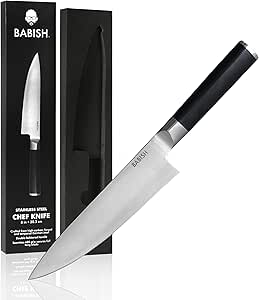 | Best Single-Knife Pick | Blade length: 8 inches | Blade material: High-carbon German 1.4116 steel | Construction: Forged from a single piece; full tang | VIEW LATEST PRICE | See Our Full Breakdown |
| Brewin Professional 3-Piece Chef Knife Set |  | Best Compact Starter Set | Set contents: Chef knife, santoku knife, utility knife | Blade material: High-carbon German stainless steel (1.4116) | Construction: Forged, full tang | VIEW LATEST PRICE | See Our Full Breakdown |
| Brewin Chefilosophi 5-Piece Japanese Chef Knife Set with Red Pakkawood Handles |  | Best for a Full Knife Upgrade | Set size: 5 knives | Included knives: Two 8-inch knives, santoku, 5-inch utility, paring knife | Blade material: 1.4116 German stainless steel | VIEW LATEST PRICE | See Our Full Breakdown |
| HOSHANHO 9-Inch Kiritsuke Chef Knife |  | Best for a Long, Precise Cutting Edge | Blade length: 9 inches | Overall length: 14.5 inches | Blade material: High-carbon steel with 10Cr15CoMoV core | VIEW LATEST PRICE | See Our Full Breakdown |
| carbon steel chef knife | Blade material | Construction | Handle material | Blade length |
|---|---|---|---|---|
| MOSFiATA 8-Inch German Stainle | EN1.4116 German high-carbon stainless steel | Forged, full tang | — | 8 inches |
| HOSHANHO 8-Inch Japanese High- | 10Cr15CoMoV high-carbon stainless steel | Forged | Pakkawood | 8 inches |
| Amazon Basics 8-Inch Full Tang | High-carbon stainless steel | Forged, full tang | Metal, stainless steel | 8 inches |
| PAUDIN 8-Inch High-Carbon Stai | 5Cr15MoV high-carbon stainless steel | Stamped | Wood | 8 inches |
| PAUDIN 3-Piece High-Carbon Sta | 5Cr15MoV high-carbon stainless steel | Stamped | Pakkawood | — |
| Babish 8-Inch Chef Knife | High-carbon German 1.4116 steel | Forged from a single piece; full tang | — | 8 inches |
| Brewin Professional 3-Piece Ch | High-carbon German stainless steel (1.4116) | Forged, full tang | ABS plastic and stainless steel | — |
| Brewin Chefilosophi 5-Piece Ja | 1.4116 German stainless steel | Forged | Pakkawood | — |
| HOSHANHO 9-Inch Kiritsuke Chef | High-carbon steel with 10Cr15CoMoV core | Forged, composite steel | Rosewood | 9 inches |
More Details on Our Top Picks
MOSFiATA 8-Inch German Stainless Steel Chef’s Knife with Accessories
The MOSFiATA is a practical pick for buyers who want an 8-inch forged stainless knife plus basic extras in one package. Its EN1.4116 blade and 16-degree-per-side edge suit everyday slicing, chopping, and mincing, while the full tang and Micarta handle point to a sturdier build than the stamped PAUDIN 8-inch knife. The included sharpener and blade protector add useful upkeep and storage pieces, though they do not make this a carbon steel knife: the blade is high-carbon stainless steel, so its care needs differ from non-stainless carbon steel. I also see conflicting handle-material details in the product description, which makes the exact grip material less certain. The engraved blade pattern is decorative, not Damascus, so buyers should choose it for its bundle and construction rather than its appearance.
Pros:- Forged full-tang construction
- 16-degree-per-side hand-sharpened edge
- Includes a blade protector, finger guard, and sharpener
- Micarta is listed as the handle material in the specifications
Cons:- High-carbon stainless steel is not the same as carbon steel
- Product details conflict about whether the handle is Micarta or Santoprene/polypropylene
- Laser-engraved blade pattern is decorative rather than Damascus
Best for: Home cooks who want a forged stainless-steel chef knife with a sharpener and blade guard included.
Not ideal for: Buyers specifically seeking non-stainless carbon steel, or anyone who wants clear, consistent information about the handle material.
- Blade length:8 inches
- Blade material:EN1.4116 German high-carbon stainless steel
- Edge:Plain, hand-sharpened to 16 degrees per side
- Construction:Forged, full tang
- Listed handle material:Micarta
- Weight:7.84 ounces
- Included components:Blade protector, finger guard, knife sharpener, gift box
- Model:CK0401
Our verdict“Choose the MOSFiATA if you want a forged stainless chef knife bundled with basic accessories, but skip it if non-stainless carbon steel is a requirement.”
HOSHANHO 8-Inch Japanese High-Carbon Stainless Steel Chef Knife
Among the stainless options here, this HOSHANHO is the pick for cooks drawn to a narrow 13-degree-per-side edge and a firmer blade. Its 10Cr15CoMoV steel is forged, ice tempered, and heat treated, with hardness listed up to 60 HRC; that combination is aimed at edge retention and corrosion resistance, not the patina of traditional carbon steel. The sloped bolster also leaves room for a pinch grip, a useful contrast with the MOSFiATA, whose selling point is its included accessories rather than a stated grip-focused bolster shape. The tradeoff is that a thin, sharp edge rewards careful handling and maintenance, and the product data does not include a sheath or sharpener. I’d choose this for controlled prep, not for someone who wants the most forgiving knife in the group.
Pros:- Hand-sharpened to 13 degrees per side
- Forged 10Cr15CoMoV stainless blade
- Ice-tempered and heat-treated steel is described as corrosion resistant
- Sloped bolster accommodates a pinch grip
Cons:- Sharp edge calls for careful handling
- No accessory bundle is listed, unlike the MOSFiATA
- High-carbon stainless steel is not traditional non-stainless carbon steel
Best for: Cooks comfortable with careful knife handling who want a forged stainless blade with a narrow edge and a pinch-grip-friendly bolster.
Not ideal for: Beginners seeking a forgiving blade, or buyers who specifically want non-stainless carbon steel and its patina.
- Blade length:8 inches
- Blade material:10Cr15CoMoV high-carbon stainless steel
- Construction:Forged
- Sharpening angle:13 degrees per side
- Hardness:Up to 60 HRC
- Handle material:Pakkawood
- Weight:350 g
- Bolster:Sloped bolster for pinch grip
Our verdict“Pick this HOSHANHO for a fine-edged forged stainless knife and pinch-grip control, provided you are comfortable handling a very sharp blade.”
Amazon Basics 8-Inch Full Tang Stainless Steel Chef’s Knife
This Amazon Basics knife makes the most sense for cooks who value a simple forged, full-tang build over a particularly fine edge or a bundle of extras. Its semi-bolster allows access along more of the blade, which can be useful as the edge is sharpened, and the three-rivet handle completes a familiar, practical layout. Compared with the HOSHANHO 8-inch knife, it has no stated 13-degree edge or hardness figure, so it is less clearly aimed at buyers chasing a finely sharpened feel. Its satin-finish high-carbon stainless blade is described as resisting stains, rust, and pitting, but that still does not make it a traditional carbon steel knife. Hand washing is required, and the metal handle may not suit cooks who prefer the wood or Micarta-style grips found on other picks.
Pros:- Forged full-tang construction
- Semi-bolster allows access to more of the blade edge
- Satin-finish blade is described as resisting stains, rust, and pitting
- Three-rivet handle design
Cons:- Hand wash only
- No specific sharpening angle or hardness is provided
- High-carbon stainless steel is not traditional carbon steel
Best for: Everyday home cooks who want a forged full-tang stainless chef knife with a semi-bolster and do not need a specialized edge specification.
Not ideal for: Buyers seeking traditional carbon steel, a wood-style handle, or a knife that can go in the dishwasher.
- Blade length:8 inches
- Blade material:High-carbon stainless steel
- Construction:Forged, full tang
- Handle material:Metal, stainless steel
- Design:Semi-bolster with three rivets
- Dimensions:13.28 × 1.85 × 0.87 inches
- Weight:0.23 kg
- Care:Hand wash only
Our verdict“Choose this for a straightforward forged stainless workhorse with full blade access, but look elsewhere if you want a specified fine edge or non-stainless steel.”
PAUDIN 8-Inch High-Carbon Stainless Steel Chef Knife
At 6.88 ounces, the PAUDIN is the lightest specified single knife in this group, making it a reasonable fit for cooks who prefer a less weighty feel during repeated prep. Its 5Cr15MoV blade and wood handle cover everyday chopping, slicing, and dicing, but its stamped construction sets it apart from the forged MOSFiATA and Amazon Basics knives. That distinction matters to buyers comparing build styles, even though the listed specs alone do not establish how either knife will feel in every hand. The waved pattern is decorative rather than Damascus, and the 2 mm blade is relatively thin by specification. Like the other PAUDIN options here, this is high-carbon stainless steel, not traditional carbon steel. I’d favor it over the PAUDIN three-piece set only when a single chef knife is all that’s needed.
Pros:- Light listed weight of 6.88 ounces
- Wood handle
- 8-inch blade suits a range of kitchen cutting tasks
- Hand-polished blade is described as retaining sharpness
Cons:- Stamped rather than forged construction
- Waved blade pattern is decorative, not Damascus
- High-carbon stainless steel is not traditional carbon steel
Best for: Cooks who want a lightweight, single 8-inch stainless chef knife for varied everyday prep and prefer a wood handle.
Not ideal for: Buyers who prioritize forged construction, want a set of task-specific knives, or are shopping specifically for non-stainless carbon steel.
- Blade length:8 inches
- Blade material:5Cr15MoV high-carbon stainless steel
- Construction:Stamped
- Blade thickness:2 mm
- Handle material:Wood
- Weight:6.88 ounces
- Item length:13 inches
- Warranty:24 months
Our verdict“Choose the PAUDIN single knife if a lighter stamped blade and wood handle matter more to you than forged construction or extra knives.”
PAUDIN 3-Piece High-Carbon Stainless Steel Kitchen Knife Set
This PAUDIN set is the most useful choice here for cooks who want three distinct blade shapes rather than one chef knife: an 8-inch chef’s knife, a 7-inch nakiri, and a 3.5-inch paring knife. The 13-degree-per-side edges are designed for sharp cutting, while pakkawood handles provide a different grip feel from the wood handle on the single-knife PAUDIN. That added coverage comes with a clear compromise: all three knives are stamped, not forged, and the 5Cr15MoV blades are high-carbon stainless steel rather than traditional carbon steel. The set’s decorative blade pattern should not be mistaken for Damascus construction. I’d choose this over buying the PAUDIN single knife only if the nakiri and paring knife would see regular use; otherwise, those extra blades may add clutter without improving your routine.
Pros:- Includes chef’s, nakiri, and paring knives for different prep tasks
- 13-degree-per-side edge specification
- Pakkawood handles are designed for a comfortable, non-slip grip
- Blade hardness is listed as 56+ HRC
Cons:- Stamped construction rather than forged
- High-carbon stainless steel is not traditional carbon steel
- Decorative blade pattern is not real Damascus
Best for: New home cooks building a basic knife collection who will use a chef’s knife, a nakiri, and a small paring knife.
Not ideal for: Buyers who need only one chef knife, prefer forged construction, or specifically want traditional non-stainless carbon steel.
- Set contents:8-inch chef’s knife, 7-inch nakiri, 3.5-inch paring knife
- Blade material:5Cr15MoV high-carbon stainless steel
- Construction:Stamped
- Edge angle:13 degrees per side
- Blade hardness:56+ HRC
- Blade thickness:2 mm
- Handle material:Pakkawood
- Set weight:1.1 pounds
- Model:NS2
Our verdict“Choose this PAUDIN set if you will use all three blade shapes; for a single everyday knife, the PAUDIN 8-inch chef knife is the simpler fit.”
Babish 8-Inch Chef Knife – High-Carbon German 1.4116 Steel Kitchen Knife – Professional Cutlery for Precise Slicing and Chopping
The Babish is the clearest fit here for someone who wants one full-size chef knife rather than a multi-knife set. Its forged 1.4116 German steel blade and gently tapered profile are intended to handle everyday chopping, slicing, and mincing, while the full-tang ABS handle keeps the design straightforward and balanced. Unlike the Brewin Professional set, it does not add a santoku and utility knife, but it also avoids asking buyers to choose among several blades. The tradeoff is care: the maker advises hand washing, prompt drying, and regular honing, so this is not a leave-it-in-the-sink tool. Compared with the HOSHANHO Kiritsuke, the Babish has a more conventional chef-knife shape and shorter blade, making it the easier all-purpose choice for cooks who do not want a specialized profile.
Pros:- Forged from a single piece of high-carbon 1.4116 German steel.
- Full-tang construction offers a balanced feel with the ABS handle.
- Conventional 8-inch chef-knife shape suits chopping, slicing, dicing, and mincing.
- Taper-ground, polished blade is designed for a fine, sharp edge.
Cons:- Requires hand washing and prompt drying; dishwasher use is discouraged.
- Needs routine honing and periodic sharpening to maintain its edge.
- Not intended for bones, frozen foods, or other hard materials.
Best for: Home cooks who want one familiar 8-inch carbon-steel chef knife for routine prep and are willing to wash and dry it by hand.
Not ideal for: Buyers seeking a complete knife set, dishwasher-safe convenience, or a blade intended for bones and frozen food.
- Blade length:8 inches
- Blade material:High-carbon German 1.4116 steel
- Construction:Forged from a single piece; full tang
- Handle:ABS
- Edge:Plain
- Item weight:320 g
- Care:Hand wash, dry promptly; dishwasher not recommended
Our verdict“Choose the Babish if you want a conventional, forged 8-inch workhorse without paying for extra knives you may not use.”
Brewin Professional 3-Piece Chef Knife Set
This set makes more sense than a lone blade for cooks building a basic knife lineup: it pairs an 8-inch chef knife with a santoku and utility knife, so everyday prep can be split among distinct blade shapes. The forged 1.4116 German stainless steel and stated 56+ Rockwell hardness give it a firmer edge profile than the Babish’s product details specify, though hardness alone does not remove the need for sharpening or careful handling. Its 14–16-degree-per-side edge is geared toward precise cutting, and full-tang handles provide a secure format across the set. Compared with Brewin’s five-piece Chefilosophi set, this one is less expansive and avoids duplicate 8-inch knives; the tradeoff is that it lacks a paring knife. Hand washing is recommended, so skip it if low-maintenance cleanup matters most.
Pros:- Three distinct blade types cover broad everyday prep tasks.
- Forged 1.4116 German stainless steel with a stated 56+ Rockwell hardness.
- Full-tang handles with triple rivets are designed for a secure grip.
- The 14–16-degree-per-side edge is suited to precise slicing and chopping.
Cons:- Hand washing is recommended, adding cleanup and drying work.
- No paring knife is included, unlike the five-piece Chefilosophi set.
- The sharper edge calls for careful handling and suitable storage.
Best for: Newly equipped home cooks who want a chef knife, santoku, and utility knife in one coordinated set without duplicate large blades.
Not ideal for: Cooks who need a paring knife, prefer dishwasher cleanup, or want a single knife instead of storing a set.
- Set contents:Chef knife, santoku knife, utility knife
- Blade material:High-carbon German stainless steel (1.4116)
- Construction:Forged, full tang
- Blade hardness:56+ Rockwell
- Edge angle:14–16 degrees per side
- Chef knife blade length:8 inches
- Handle material:ABS plastic and stainless steel
- Set weight:0.85 kg
- Care:Hand wash recommended
Our verdict“Pick this set if you want three useful blade shapes and do not need the extra knives or duplicate chef blade in Brewin’s larger set.”
Brewin Chefilosophi 5-Piece Japanese Chef Knife Set with Red Pakkawood Handles
The Chefilosophi set is the broadest choice in this group, combining five forged knives with red pakkawood handles: two 8-inch knives, a santoku, a utility knife, and a paring knife. That range suits cooks who want dedicated blades for larger prep and smaller detail work, while the reinforced handle anchor points add a sturdier construction detail than the Babish’s single-knife format can offer. Its 1.4116 German stainless steel is listed at 56+ Rockwell, matching the Brewin Professional set’s stated hardness, but this package includes more blade options and also duplicates the 8-inch size. That duplication may be useful for parallel prep or sharing, yet it takes more storage space and may be unnecessary for a small kitchen. Care instructions and a storage block are not provided, so buyers must plan their own safe storage and confirm preferred maintenance guidance.
Pros:- Five knives cover large-scale chopping through small paring tasks.
- Two 8-inch knives can help when preparing several ingredients at once.
- Forged 1.4116 German stainless steel is specified at 56+ Rockwell.
- Pakkawood handles have three reinforced anchor points.
Cons:- Two 8-inch knives may be redundant for many home kitchens.
- No storage block is included, so safe storage is an extra planning task.
- Care instructions are not provided in the product details.
Best for: Home cooks outfitting a larger kitchen who want dedicated chef, santoku, utility, and paring knives, plus a second 8-inch blade.
Not ideal for: Minimalist cooks, small-kitchen owners, or buyers who want supplied care instructions and an included storage block.
- Set size:5 knives
- Included knives:Two 8-inch knives, santoku, 5-inch utility, paring knife
- Blade material:1.4116 German stainless steel
- Blade hardness:56+ Rockwell
- Construction:Forged
- Handle material:Pakkawood
- Weight:2.6 pounds
- Color:Red handles; black and silver blades
Our verdict“Choose the Chefilosophi set if you need broad knife coverage and will use the second chef knife, but favor the smaller Brewin set if you want less duplication.”
HOSHANHO 9-Inch Kiritsuke Chef Knife
The HOSHANHO stands apart from the Babish and both Brewin sets with its 9-inch kiritsuke profile and 10Cr15CoMoV-core composite blade. Its longer reach and hand-sanded 12–15-degree-per-side edge suit cooks who favor controlled slicing, mincing, and dicing, while the 238 g weight is relatively light for a knife of this length. The rosewood octagonal handle is designed for an ambidextrous grip, giving it a different feel from the ABS-handled Babish. This is a more specialized pick, though: its length and profile may feel less familiar than a standard 8-inch chef knife, and the maker cautions against bones and frozen foods. It also calls for hand washing and thorough drying. Choose it for precision-oriented prep, not as the most forgiving first knife or a substitute for a broad, general-purpose set.
Pros:- Long 9-inch blade offers extra reach for slicing and larger ingredients.
- Hand-sanded 12–15-degree-per-side edge is designed for precise cutting.
- At 238 g, it is relatively light for its 14.5-inch overall length.
- Rosewood octagonal handle is designed for a comfortable ambidextrous grip.
Cons:- Kiritsuke shape and 9-inch length may feel less familiar than the Babish’s standard 8-inch chef knife.
- Not intended for bones or frozen foods.
- Requires hand washing and thorough drying after use.
Best for: Experienced home cooks who prefer a longer, light knife for precise slicing, mincing, and dicing and are comfortable with a kiritsuke profile.
Not ideal for: Beginners wanting a familiar 8-inch shape, cooks with limited counter space, or anyone seeking a knife for bones, frozen foods, or dishwasher cleanup.
- Blade length:9 inches
- Overall length:14.5 inches
- Blade material:High-carbon steel with 10Cr15CoMoV core
- Blade thickness:2.5 mm
- Edge angle:12–15 degrees per side
- Construction:Forged, composite steel
- Handle material:Rosewood
- Item weight:238 g
- Care:Hand wash and dry; avoid bones and frozen foods
Our verdict“Choose the HOSHANHO for a longer, precision-focused blade if you already know you like kiritsuke handling and can maintain it by hand.”

How We Picked
I compared the nine listings by steel disclosure, blade format, and intended use, then weighed how easily each could serve as a primary kitchen knife. A product described as high-carbon stainless steel is not automatically equivalent to a traditional carbon steel knife; that distinction matters for shoppers expecting a reactive blade, patina development, and more careful drying. I gave more weight to clear material descriptions and familiar, versatile blade sizes than to broad performance language.
Ranking also reflects single-knife usefulness, set practicality, and buyer fit. An 8-inch chef knife earns a different role from a 9-inch Kiritsuke or a multi-piece bundle, so the ranking favors options that make a clear case for their format rather than treating more pieces or a longer blade as an automatic advantage. Since the provided product details do not establish comparative sharpness, balance, or durability through testing, I avoid claims that depend on those qualities and call out where buyers should verify specifications before purchase.
| carbon steel chef knife | Construction | Handle material |
|---|---|---|
| MOSFiATA 8-Inch German Stainle | Forged, full tang | — |
| HOSHANHO 8-Inch Japanese High- | Forged | Pakkawood |
| Amazon Basics 8-Inch Full Tang | Forged, full tang | Metal, stainless steel |
| PAUDIN 8-Inch High-Carbon Stai | Stamped | Wood |
| PAUDIN 3-Piece High-Carbon Sta | Stamped | Pakkawood |
| Babish 8-Inch Chef Knife | Forged from a single piece; full tang | — |
| Brewin Professional 3-Piece Ch | Forged, full tang | ABS plastic and stainless steel |
| Brewin Chefilosophi 5-Piece Ja | Forged | Pakkawood |
| HOSHANHO 9-Inch Kiritsuke Chef | Forged, composite steel | Rosewood |
Factors to Consider When Choosing Carbon Steel Chef Knives
Before choosing among these listings, decide whether you want true carbon steel or high-carbon stainless steel. That material distinction affects care as much as cutting feel, and it changes what you should expect from the word “carbon” in a product title. The following checks can help you avoid buying a knife or set that does not match your cooking habits.
Check What the Steel Name Actually Means
“High-carbon” describes carbon content, but it does not by itself tell you whether a blade is stainless. Several knives here are explicitly labeled high-carbon stainless, which is a different care proposition from traditional carbon steel. If you want a blade that develops a patina, look for a clearly stated non-stainless steel rather than relying on the keyword in the product name. If rust resistance matters more, stainless steel may be the more practical fit. When a listing gives no precise steel designation, treat the material as unresolved and confirm it with the maker before buying.
Choose Blade Length for Your Board and Cutting Style
An 8-inch chef knife is a familiar middle ground for general prep, but it can feel long to cooks with small boards or limited counter space. A 9-inch blade can cover more ground on large ingredients, yet it asks for more room and control. Blade profile matters as much as length: a Kiritsuke-style knife has a more specialized shape than a conventional chef knife. A common mistake is choosing the longest blade because it sounds more capable, then finding it awkward for everyday tasks. Match the knife to the size of your workspace and the foods you cut most often.
Decide Whether a Set Earns Its Place
A set can make sense when you need several knife types at once or are equipping a kitchen from scratch. It can be a poor fit if you mainly need one dependable chef knife, since extra pieces may go unused and make storage harder. Compare the included knife roles, not just the number of pieces, and check whether the set covers tasks you actually perform. A three-piece bundle and a five-piece bundle should be judged by useful variety rather than quantity alone. If your main knife is the priority, put the budget and attention toward its steel, shape, and handle fit.
Treat Handle Fit and Balance as Personal Requirements
Steel and blade geometry get most of the attention, but the handle determines whether a knife feels secure during repeated prep. Handle material names alone do not establish comfort, grip, or suitability for wet hands. If possible, compare the handle dimensions and shape with a knife you already find comfortable. Full-tang construction, as stated for the Amazon Basics knife, describes how the blade steel extends through the handle, but it does not prove that the knife will feel balanced to every cook. Give ergonomics priority if you cook often or have hand fatigue.
Match Maintenance to Your Routine
Traditional carbon steel usually needs more attentive drying and storage than stainless steel, while high-carbon stainless is generally selected by shoppers seeking a more forgiving care routine. Either way, a knife should not be left wet or loose in a drawer where its edge can be damaged. Think about whether you are willing to clean and dry a blade promptly after use before choosing a reactive steel. Do not assume that “high-carbon” alone means extra maintenance; confirm whether the blade is stainless. The right knife is the one whose care requirements fit your habits, not only your preferred steel label.
Look for Specific, Verifiable Product Details
Broad claims such as “professional” or “Japanese” do not answer basic questions about steel grade, blade dimensions, or included accessories. The Babish listing names German 1.4116 steel, which gives buyers a more specific starting point than a generic high-carbon claim. Still, a named grade does not establish edge retention or overall performance on its own. Check the manufacturer’s specifications for hardness, sharpening guidance, warranty, and exact set contents when those details affect your decision. Where information is missing, avoid filling the gap with assumptions based on a product title.
Frequently Asked Questions
Are any of these knives traditional, non-stainless carbon steel?
Based on the supplied product names, none is clearly identified as a traditional non-stainless carbon steel knife. The listings use terms such as stainless, high-carbon stainless, or German stainless steel. That means shoppers seeking a reactive blade and patina should verify the exact steel with the seller or manufacturer before choosing one. Do not treat “high-carbon” by itself as proof that a knife is non-stainless. If the exact alloy is not stated, the product may not meet your material requirement.
Should I choose an 8-inch chef knife or the 9-inch HOSHANHO Kiritsuke?
Choose an 8-inch chef knife if you want a broadly familiar size for routine chopping and slicing, especially on a standard or smaller board. The 9-inch HOSHANHO Kiritsuke is a better match for cooks who specifically want a longer blade and are comfortable with its more specialized profile. Extra length can help when working through large ingredients, but it also needs more space and careful handling. If you are unsure, a conventional 8-inch format is the safer starting point. Select the Kiritsuke for its shape and length, not simply because it is larger.
Is a knife set a better buy than one chef knife?
A set is useful when you need several types of knives and have a plan for storing and using them. If your main goal is a dependable everyday chef knife, a single-knife option may be easier to evaluate and more relevant to your routine. The PAUDIN and Brewin sets differ in piece count, but that number alone does not show whether their included knives fill useful roles for you. Check the exact contents and compare them with the knives you already own. Avoid paying for extra pieces that would stay in a drawer.
Which listing provides the clearest information about its steel?
The Babish 8-inch knife names German 1.4116 steel, making its material description more specific than listings that only say high-carbon stainless steel. A named alloy helps you research the material, but it does not tell you everything about the knife’s performance or care needs. Look for additional manufacturer details such as hardness and sharpening instructions before drawing conclusions about edge life. The other product names still identify broad steel categories, but buyers who need a precise grade should confirm those specifications directly. Treat missing information as a reason to ask questions, not as evidence of a particular quality.
What should I prioritize if I want a low-maintenance knife?
Start by confirming that the blade is stainless rather than relying on the phrase “high-carbon.” Stainless steels are generally a more practical choice for cooks who do not want to manage patina or dry a reactive blade immediately after every wash. Among these listings, several explicitly identify stainless steel, including the MOSFiATA, Amazon Basics, and Babish models. Still, check the maker’s care instructions and avoid leaving any knife wet or unprotected. Handle comfort and a suitable blade length matter too, since ease of maintenance will not make an awkward knife a good fit.
Conclusion
For a best overall single-knife pick, I’d start with the HOSHANHO 8-inch Japanese high-carbon stainless model because its familiar length and Japanese-style positioning suit a broad range of home prep. The best value direction is the Amazon Basics 8-inch full-tang knife for shoppers who want a straightforward single knife, while the PAUDIN three-piece set is worth comparing if you need several knives at once. For beginners, the conventional 8-inch format is an easier starting point than the longer Kiritsuke or a multi-piece set. The Babish is my best pick for buyers who want a named steel specification, and the HOSHANHO 9-inch Kiritsuke is the specific-choice pick for cooks who want a longer, more specialized blade. I would not label any option the best premium carbon steel knife from the supplied details alone: none is clearly described as traditional non-stainless carbon steel, so buyers with that requirement should verify the alloy before purchasing.
Halloween Picks

Vexalify 11-Inch Halloween Pumpkin Fog Machine with 12-Color Lights

Jenaai 5.3-Foot Motion-Activated Halloween Animatronic Skeleton

Kalolary 11 ft Halloween Inflatable Archway Ghost House Tunnel
As an affiliate, we earn on qualifying purchases.