
Electric stand mixers range from compact models for occasional baking to large-bowl machines built for frequent or heavy mixing. I’d put the Cuisinart Precision Master 5.5-Quart first for its useful speed range and practical capacity, while the ZACME 8.4-Qt stands out for larger batches and the KitchenAid Classic 4.5-Quart for buyers who value a familiar, straightforward setup. The main tradeoffs are bowl capacity versus counter space, basic mixing versus extra attachments, and a lighter footprint versus heavier-duty batch needs. A larger bowl can be awkward when mixing small quantities, while a compact mixer may reach its limits with dense dough. Read on for the full breakdown and advice on matching a mixer to your kitchen and baking routine.

Get kitchen gear delivered free with Prime
- Fast, free delivery on millions of items
- Prime Video, Amazon Music and more included
- Member-only deals all year
Complete the kit


Key Takeaways
- The Cuisinart Precision Master 5.5-Quart is the clearest all-around choice in this group: it pairs a useful 12-speed range with a middle-sized bowl, avoiding the bulk of the largest machines and the tighter capacity of compact picks.
- The ZACME 8.4-Qt has the lineup’s largest stated bowl and is aimed at large batches, but its commercial-style size makes it a less natural fit for occasional baking or limited counter space.
- The two Kitchen in the Box 3.2-Qt mixers favor storage and small portions over batch size; their compact format is a real advantage only if users do not expect them to handle frequent dense doughs.
- The Hamilton Beach Classic Stand and Hand Mixer takes a different approach from conventional stand mixers, offering a hand-mixer option for tasks where setting up a full mixer feels unnecessary.
- The VEVOR 3-in-1 distinguishes itself with grinder and blender attachments, while simpler mixers in the roundup keep the focus on mixing and may suit buyers who prefer fewer accessories to store and clean.






| electric stand mixer | Speeds | Capacity | Bowl material | Dimensions |
|---|---|---|---|---|
| ZACME 8.4 Qt Commercial Stand | — | 8.4 qt | Stainless steel | — |
| Aucma 6.5-Quart 660W 6-Speed T | 6, plus pulse | — | Stainless steel | 15.2 x 9.4 x 12.4 in |
| Hamilton Beach 4-Quart Electri | 7 | 4 qt | Stainless steel | 17 x 11 x 15 in |
| Cuisinart SM-50BK 5.5-Quart St | 12 | — | Stainless steel | 14.17 x 7.87 x 14.13 in |
| Cuisinart Precision Master 5.5 | 12 | — | — | — |
| Hamilton Beach Classic Stand a | 6 | — | Stainless steel | 8.2 x 13.25 x 14.25 inches (D x W x H) |
| Martha Stewart 5.3-Quart Tilt- | 12 | 5.3 quarts | Stainless steel | — |
| Electactic 5.3-Quart Electric | 12, plus pulse function | 5.3 quarts | Stainless steel | 15.75 × 8.9 × 13.62 inches |
| ActiveTrail 7.5-Quart 660W 10- | 10 | 7.5 quarts | — | 14.76 × 13.98 × 9.45 inches |
| VIVOHOME 6-Quart Tilt-Head Sta | 10 plus pulse | 6 quarts | — | 15.2 × 8.8 × 18.8 inches |
| VEVOR 6.3 Qt 3-in-1 Tilt-Head | 6 speeds plus pulse | 6.3 quarts | Stainless steel | 18.11 x 9.84 x 21.65 inches |
| Kitchen in the Box 3.2 Qt Stan | 6 | 3.2 quarts | Stainless steel | 12.9 x 7 x 10.2 inches |
| KitchenAid Classic Series 4.5- | 10 | 4.5 quarts | Stainless steel | 14.1 x 8.7 x 13.9 inches |
| Kitchen in the Box Stand Mixer | 6 | 3.2 quarts | Stainless steel | 12.9 x 7 x 10.2 inches |
| Martha Stewart 5.3QT Tilt-Head | 12 | 5.3 quarts | — | — |
More Details on Our Top Picks
ZACME 8.4 Qt Commercial Stand Mixer, 800W
The ZACME 8.4 Qt is the capacity pick here: its bowl and stated maximum dough load of 3 kg (6.6 lb) suit large batches that would outgrow the 4-quart Hamilton Beach 63391. An 800W motor, planetary mixing, and three standard attachments cover a broad range of mixing jobs, while the timer lets you monitor a set mixing interval without hovering. Its 11 speeds offer more adjustment than the Aucma’s six, and the stainless steel bowl and attachments are dishwasher safe. The tradeoff is scale: this large-capacity machine will claim more counter space than the Cuisinart 5.5-quart models, and its highest speed can reach 68 dBA. I’d choose it for batch size, not for a compact kitchen or especially quiet operation.
Pros:- 8.4-quart bowl and stated 3 kg maximum dough capacity accommodate large batches
- 800W motor, planetary action, and 11 speeds support varied mixing tasks
- Digital display and countdown timer help track mixing time
- Bowl and included attachments are dishwasher safe
Cons:- Large capacity requires more counter and storage space than the 5.5-quart Cuisart mixers
- Noise can reach 68 dBA at the highest speed
- Its capacity may be excessive for routine small-batch baking
Best for: Home bakers who regularly make large batches of dough, cookies, or other mixtures and have room for a full-size mixer
Not ideal for: Small-kitchen bakers or anyone who usually makes modest batches and wants a compact, quiet mixer
- Capacity:8.4 qt
- Motor power:800W
- Maximum dough capacity:3 kg (6.6 lb)
- Speed settings:11
- Bowl material:Stainless steel
- Features:Digital display, countdown timer, tilt head, planetary mixing action
- Included accessories:Dough hook, flat beater, wire whip
- Noise level:≤48 dBA on first gear; ≤68 dBA on highest gear
- Warranty:2-year limited warranty
Our verdict“Choose the ZACME if your regular baking batches exceed what the 5.5-quart Cuisinart or 4-quart Hamilton Beach can comfortably handle.”
Aucma 6.5-Quart 660W 6-Speed Tilt-Head Stand Mixer
The Aucma 6.5-quart makes sense for bakers who want a roomy bowl without moving up to the ZACME’s 8.4-quart footprint. Its stainless steel bowl has handles, which can make lifting and pouring a full batch easier, and the splash guard with access hatch lets you add ingredients while mixing. A 660W motor, six speeds, and pulse cover everyday batters and doughs, though the controls offer less fine speed selection than the 11-speed ZACME or 12-speed Cuisart SM-50BK. At 11.7 pounds, it is also lighter than the 18.4-pound Cuisinart, but its ABS housing is a less substantial construction choice. The listed noise level is 76 dB, so I’d skip it if a quieter mixer matters.
Pros:- 6.5-quart stainless steel bowl has handles for easier lifting
- 660W motor, six speeds, and pulse function handle common mixing tasks
- Splash guard has an access hatch for adding ingredients
- Includes whisk, beater, and dough hook, with dishwasher-safe attachments
Cons:- Six speeds provide less control than the 11-speed ZACME or 12-speed Cuisinart models
- Listed noise level is 76 dB
- ABS housing is less substantial than the die-cast metal construction of the Cuisinart Precision Master
Best for: Home bakers who want a handled, 6.5-quart bowl for family-size batches and prefer straightforward speed controls
Not ideal for: Bakers who need precise speed adjustments, quieter operation, or a more substantial housing
- Bowl capacity:6.5 qt
- Motor power:660W
- Speeds:6, plus pulse
- Bowl material:Stainless steel
- Noise level:76 dB
- Dimensions:15.2 x 9.4 x 12.4 in
- Weight:11.7 lb
- Included components:Stainless steel whisk, beater, dough hook, splash guard
Our verdict“Pick the Aucma for a generous handled bowl and uncomplicated controls, but choose a Cuisinart if finer speed selection matters more.”
Hamilton Beach 4-Quart Electric Stand Mixer with 7 Speeds
For smaller households and occasional baking, the Hamilton Beach 63391 keeps capacity and power modest rather than competing with the large-batch ZACME or Aucma. Its 4-quart bowl is a better fit for routine cakes, frosting, and smaller dough recipes, while planetary mixing action moves the attachments around the bowl to cover more of the mixture. Seven speeds include a slow first setting to help reduce splatter, and a built-in handle makes the 8-pound mixer easier to move than the 18.4-pound Cuisinart SM-50BK. The compromise is clear: its 300W motor and smaller bowl are less suited to repeated heavy or large dough batches. I’d treat it as a manageable everyday mixer, not a bulk-baking machine.
Pros:- 4-quart bowl suits small and moderate recipes
- Planetary mixing action helps cover the bowl
- Seven speeds include a slow first setting to reduce splatter
- Eight-pound weight and built-in handle make it easier to move
Cons:- 4-quart capacity is limiting for large batches compared with the Aucma and ZACME
- 300W power is less suited to frequent heavy dough mixing
- One-year warranty is shorter than the Cuisart models’ three-year limited warranties
Best for: Occasional bakers in smaller households who make cakes, frosting, and modest dough batches and want a mixer that is easy to move
Not ideal for: Frequent bread bakers or families making large batches who need more bowl capacity and motor power
- Capacity:4 qt
- Power:300W
- Speeds:7
- Mixing action:Planetary
- Dimensions:17 x 11 x 15 in
- Weight:8 lb
- Bowl material:Stainless steel
- Included accessories:Splash guard, dough hook, whisk, flat beater
- Warranty:1 year
Our verdict“Choose this Hamilton Beach for manageable everyday batches and easy moving, not for large or demanding dough jobs.”
Cuisinart SM-50BK 5.5-Quart Stand Mixer, Onyx
The Cuisinart SM-50BK is a well-rounded choice for bakers who want a middle-sized bowl and broad speed control without the ZACME’s commercial-scale capacity. Its 12 speeds offer more adjustment than the Aucma’s six, which is useful when switching between gentler mixing and faster whipping. The 5.5-quart stainless steel bowl, tilt-back head, and included whisk, dough hook, paddle, and splash guard cover common kitchen jobs; dishwasher-safe bowl and accessories also simplify cleanup. At 18.4 pounds, it is heavier than the Hamilton Beach 63391, so it is less convenient to move in and out of storage. It also lacks the ZACME’s larger stated dough capacity. Optional attachments are sold separately, so the front-end package is best viewed as a capable mixer rather than an all-in-one appliance.
Pros:- 12 speeds offer more mixing adjustment than the six-speed Aucma
- 5.5-quart stainless steel bowl suits a broad range of household recipes
- Includes whisk, dough hook, paddle, and splash guard with pour spout
- Bowl and accessories are dishwasher safe
Cons:- At 18.4 pounds, it is less convenient to move than the 8-pound Hamilton Beach
- Optional attachments are sold separately
- Its bowl capacity is smaller than the Aucma and ZACME
Best for: Regular home bakers who want a versatile 5.5-quart mixer, multiple speed choices, and easy-clean included accessories
Not ideal for: Buyers who need a lightweight mixer to store between uses, bulk dough capacity, or included specialty attachments
- Bowl capacity:5.5 qt
- Motor power:500W
- Speeds:12
- Bowl material:Stainless steel
- Dimensions:14.17 x 7.87 x 14.13 in
- Weight:18.4 lb
- Included accessories:Chef’s whisk, dough hook, flat mixing paddle, splash guard with pour spout
- Voltage:110V
- Warranty:Limited 3-year warranty
Our verdict“Choose the SM-50BK for flexible everyday mixing and easy cleanup, provided you do not need a lightweight body or large-batch capacity.”
Cuisinart Precision Master 5.5-Quart 12-Speed Stand Mixer
The Cuisinart Precision Master shares the SM-50BK’s 500W motor, 5.5-quart capacity, and 12-speed range, so the choice between them is less about mixing basics and more about construction and cleanup priorities. Its die-cast metal construction gives it a more substantial build than the ABS-housed Aucma, while planetary action and the standard whisk, dough hook, paddle, and splash guard cover everyday baking. A front port also supports optional attachments, offering room to expand beyond mixing if you are willing to buy those tools separately. The bowl, paddle, and dough hook are dishwasher safe, but the whisk requires hand-washing. Like the SM-50BK, this is not the pick for extra-large dough batches; the ZACME is better suited to that workload.
Pros:- Die-cast metal construction offers a more substantial build than the ABS-housed Aucma
- 12 speeds and planetary mixing action support varied recipes
- Includes a 5.5-quart stainless steel bowl, whisk, dough hook, paddle, and splash guard
- Front port supports optional attachments
Cons:- Whisk requires hand-washing, unlike the dishwasher-safe bowl, paddle, and dough hook
- Optional attachments are not included
- 5.5-quart bowl is less suited to bulk batches than the ZACME’s 8.4-quart bowl
Best for: Home bakers who want a die-cast metal 5.5-quart mixer with 12 speeds and the option to add compatible attachments later
Not ideal for: Buyers who want every accessory included, fully dishwasher-safe cleanup, or a bowl sized for bulk baking
- Bowl capacity:5.5 qt
- Motor power:500W
- Speeds:12
- Construction:Die-cast metal
- Mixing action:Planetary
- Included accessories:Stainless steel bowl, chef’s whisk, dough hook, flat mixing paddle, splash guard with pour spout
- Attachment support:Front port for optional attachments
- Dishwasher-safe parts:Bowl, paddle, and dough hook
- Warranty:Limited 3-year warranty
Our verdict“Choose the Precision Master if metal construction and future attachment options matter more than fully dishwasher-safe cleanup or bulk capacity.”
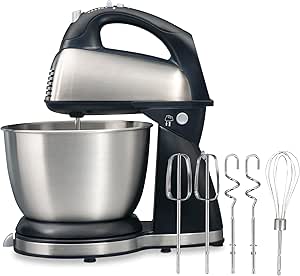
Hamilton Beach Classic Stand and Hand Mixer, 4-Quart, 6-Speed, Black and Stainless Steel
The detachable hand mixer is the defining advantage here: use it on the stand for hands-free mixing, then remove it for quick jobs or more direct control. That makes this a better fit for varied everyday tasks than the Martha Stewart 5.3-Quart Tilt-Head Stand Mixer, which offers a larger bowl and more speed settings but stays a dedicated stand mixer. The Hamilton Beach pairs a 4-quart stainless steel bowl with six speeds, a QuickBurst button, and side-to-side bowl movement, plus beaters, dough hooks, and a whisk. The bowl and attachments are dishwasher safe, which simplifies cleanup. Its smaller capacity is less suited to large batches, and the listed peak power is 290 watts, so I would choose a more robust, higher-capacity option for frequent heavy dough mixing.
Pros:- Detachable hand mixer adds flexibility for quick tasks and direct mixing.
- Includes a stainless steel bowl, beaters, dough hooks, and whisk.
- Dishwasher-safe bowl and attachments simplify cleanup.
- Six speeds and QuickBurst provide more control than a basic single-purpose mixer.
Cons:- The 4-quart bowl is smaller than the 5.3-quart Martha Stewart and Electactic mixers.
- The listed 290-watt peak power may be limiting for frequent heavy dough work.
- The supplied item weight is listed as 0.27 g, an implausibly low figure that cannot guide buyers reliably.
Best for: Bakers who want one appliance for small-to-medium stand-mixer batches and quick hand-mixing tasks.
Not ideal for: Households that regularly make large batches or knead heavy dough and want a dedicated, higher-capacity mixer.
- Type:Stand and hand mixer
- Bowl capacity:4 quarts
- Speeds:6
- Peak power:290 watts
- Bowl material:Stainless steel
- Attachments:2 beaters, 2 dough hooks, 1 whisk
- Dimensions:8.2 x 13.25 x 14.25 inches (D x W x H)
- Warranty:1 year
Our verdict“Choose this Hamilton Beach if you want a stand mixer that can also detach for hand-mixing, but pick a larger dedicated model for bigger batches.”
Martha Stewart 5.3-Quart Tilt-Head Stand Mixer with 12 Speeds
The 12 speed settings give this Martha Stewart mixer a wider adjustment range than the six-speed Hamilton Beach Classic, which can help when moving from gentle incorporation to whipping. Its 5.3-quart stainless steel bowl is also a step up in capacity from that 4-quart model, with room for batches stated to reach nine dozen cookies. A tilt head and removable splash shield make bowl access and less-messy mixing easier, while the silicone-edge flat beater, whisk, and dough hook cover common baking jobs. Compared with the Electactic 5.3-Quart Electric Stand Mixer, it has the same listed capacity and speed count but no stated motor power, pulse function, or suction feet. I would favor it for familiar everyday baking and a generous bowl, though small-batch bakers may find the capacity excessive.
Pros:- 5.3-quart stainless steel bowl accommodates sizable batches.
- 12 speeds offer fine adjustment across mixing and whipping tasks.
- Silicone-edge flat beater, whisk, and dough hook cover common recipes.
- Tilt head and removable splash shield support easier access and cleaner mixing.
Cons:- The bowl may be oversized for small portions and occasional use.
- No motor power or weight is provided in the supplied specifications, making capacity and handling comparisons harder.
- Unlike the Electactic 5.3-Quart mixer, no pulse function or anti-slip suction feet are listed.
Best for: Home bakers who regularly make family-size batches and want a broad choice of speeds and standard baking attachments.
Not ideal for: Solo cooks or occasional bakers who mostly mix small portions and would rather have a smaller, lighter-footprint machine.
- Capacity:5.3 quarts
- Speeds:12
- Bowl material:Stainless steel
- Design:Tilt-head
- Attachments:Stainless steel whisk, dough hook, silicone-edge flat beater
- Splash shield:Removable
- Color:Linen Cream
- Model number:CC010827-001
Our verdict“Pick the Martha Stewart for frequent, larger everyday baking batches and speed flexibility, but skip it if you mainly mix small quantities.”
Electactic 5.3-Quart Electric Stand Mixer with 12 Speeds
At 8 pounds and 15.75 inches long, the Electactic is the lightest listed choice among these larger-bowl mixers, making it easier to store or move than the VIVOHOME 6-Quart Tilt-Head Stand Mixer, which weighs 11 pounds. It still offers a 5.3-quart bowl, 12 speeds, and a pulse function, plus a splash guard and suction feet. That combination suits a small kitchen where countertop space and storage matter, while its whisk, dough hook, flat beater, and egg separator cover a variety of baking tasks. The tradeoff is that its light build may be less reassuring when working dense dough, and its capacity trails the VIVOHOME’s six quarts and the ActiveTrail’s 7.5 quarts. I would treat it as a flexible home-baking option, not a large-batch workhorse.
Pros:- 8-pound listed weight makes it easier to move than the heavier VIVOHOME.
- 5.3-quart stainless steel bowl balances capacity with a relatively compact listed footprint.
- 12 speeds and pulse function provide flexible mixing control.
- Includes a splash guard, suction feet, and four useful accessories.
Cons:- Light weight may reduce stability when mixing dense dough.
- Its 5.3-quart capacity is smaller than the VIVOHOME and ActiveTrail models.
- ABS body construction may be less appealing to buyers seeking a heavier-bodied mixer.
Best for: Apartment bakers who want a relatively light mixer with a mid-size bowl, multiple speeds, and accessories for varied recipes.
Not ideal for: Large households or frequent bread bakers who need greater capacity and a heavier machine for demanding batches.
- Capacity:5.3 quarts
- Power:300 watts
- Speeds:12, plus pulse function
- Weight:8 pounds
- Dimensions:15.75 × 8.9 × 13.62 inches
- Bowl material:Stainless steel
- Included accessories:Whisk, dough hook, flat beater, splash guard, egg white separator
- Body material:ABS
Our verdict“Choose the Electactic if storage and easy repositioning matter more than maximum batch size or heavy-duty dough handling.”
ActiveTrail 7.5-Quart 660W 10-Speed Tilt-Head Stand Mixer
The ActiveTrail’s 7.5-quart capacity gives it the largest bowl in this group, a practical advantage for large batches that the 5.3-quart Martha Stewart and Electactic cannot match. Its listed 660W copper motor and 10 speeds also make it the most explicitly power-focused option here, while a tilt head and suction feet support access and stability. A splash-proof cover and dishwasher-safe dough hook, beater, and whisk round out a useful baking setup. Compared with the VIVOHOME 6-Quart, the ActiveTrail offers more bowl capacity and a longer stated warranty, but it has fewer listed speed options and no pulse function. Its noise level is specified as up to 75 dB, so it may be noticeable during use. I would pick it for batch size, not for quiet operation or compact storage.
Pros:- 7.5-quart bowl offers more capacity than every other mixer in this batch.
- 660W copper motor is the highest stated power among these five models.
- Suction feet and tilt-head design support stability and easier bowl access.
- Includes three dishwasher-safe attachments and a splash-proof cover.
Cons:- Listed noise level reaches 75 dB, which may be noticeable in a quiet kitchen.
- Its large capacity can be inconvenient for small batches and takes up substantial counter space.
- No pulse function is listed, unlike the VIVOHOME and Electactic mixers.
Best for: Frequent batch bakers and larger households mixing substantial quantities of dough, batter, or whipped ingredients.
Not ideal for: Small kitchens, noise-sensitive homes, or bakers who mostly make modest batches and want a compact machine.
- Capacity:7.5 quarts
- Motor power:660W copper motor
- Speeds:10
- Noise level:≤75 dB
- Weight:14.8 pounds
- Dimensions:14.76 × 13.98 × 9.45 inches
- Included accessories:Dough hook, beater, stainless steel whisk, splash-proof cover
- Warranty:3 years
Our verdict“Choose the ActiveTrail when large batches and stated motor power matter most, but look elsewhere for quieter or smaller-scale mixing.”
VIVOHOME 6-Quart Tilt-Head Stand Mixer
The VIVOHOME pairs a 6-quart bowl with 10 speeds and pulse, giving it more capacity than the 5.3-quart Electactic and Martha Stewart mixers without reaching the ActiveTrail’s larger 7.5-quart scale. Its 660-watt motor and planetary mixing are listed for batters, cream, and dough, while suction cups help hold the 11-pound machine in place. The tilt head and splash guard make access and cleaner mixing more convenient, and the beater, dough hook, wire whip, and egg separator cover common jobs. Compared with the ActiveTrail, the VIVOHOME offers pulse control and a smaller bowl, but its listed noise level is higher at 80 dB. I would choose it for varied baking tasks and a middle-ground capacity, while noise-sensitive buyers should look elsewhere.
Pros:- 6-quart bowl offers more capacity than the 5.3-quart Martha Stewart and Electactic models.
- 10 speeds plus pulse support a range of mixing tasks.
- 660-watt motor and planetary mixing are specified for batters, cream, and dough.
- Tilt head, splash guard, suction cups, and included accessories support convenient use.
Cons:- Listed 80 dB noise level is higher than the ActiveTrail’s stated maximum of 75 dB.
- At 11 pounds, it is less convenient to move than the 8-pound Electactic.
- Its bowl is smaller than the ActiveTrail’s 7.5-quart capacity.
Best for: Home bakers who want a mid-to-large bowl, pulse control, and a broad set of baking accessories for varied recipes.
Not ideal for: Noise-sensitive households or people who need the largest available bowl for frequent extra-large batches.
- Capacity:6 quarts
- Motor power:660 watts
- Speeds:10 plus pulse
- Weight:11 pounds
- Noise level:80 dB
- Dimensions:15.2 × 8.8 × 18.8 inches
- Special features:Tilt head, planetary mixing, splash guard, suction cups
- Included components:Beater, dough hook, wire whip, egg separator
Our verdict“Pick the VIVOHOME for pulse control and a roomy but not extra-large bowl, unless quiet operation or maximum capacity matters more.”
VEVOR 6.3 Qt 3-in-1 Tilt-Head Stand Mixer, 400W Electric Dough Mixer with Stainless Steel Bowl, Meat Grinder and Blender Attachments
The VEVOR stands apart from the simpler mixers here by including a meat grinder and blender alongside the standard dough hook, whisk, and beater. That makes it a fit for cooks who want several countertop functions in one appliance, while its 6.3-quart bowl also offers more room than the compact Kitchen in the Box models. Six speeds plus pulse cover basic mixing adjustments, and the tilt head makes access to the bowl easier. The tradeoff is a large, heavy footprint: at 16.4 pounds and over 21 inches tall, it is less convenient to store than the small Kitchen in the Box. Its listed 85 dB noise level may also bother cooks who prefer quieter operation. I’d choose it for its included functions, not for a particularly compact or quiet setup.
Pros:- 6.3-quart stainless steel bowl accommodates larger batches than the 3.2-quart Kitchen in the Box mixers.
- Includes a meat grinder and blender as well as core mixing attachments.
- 400W motor and planetary mixing system are designed to distribute ingredients around the bowl.
- Tilt-head design gives access to the bowl and attachments.
Cons:- At 16.4 pounds and 21.65 inches tall, it is awkward to move or store.
- The listed 85 dB noise level can make high-speed use disruptive.
- Six speeds offer fewer adjustment steps than the 10-speed KitchenAid Classic.
Best for: Home cooks who want a larger mixer plus included meat-grinding and blending attachments, and have room to leave it on the counter.
Not ideal for: Apartment cooks with limited storage or anyone sensitive to appliance noise; its size, weight, and listed 85 dB operation are drawbacks.
- Capacity:6.3 quarts
- Motor power:400W
- Speeds:6 speeds plus pulse
- Bowl material:Stainless steel
- Included attachments:Dough hook, whisk, beater, meat grinder, blender
- Weight:16.4 pounds
- Dimensions:18.11 x 9.84 x 21.65 inches
- Noise level:85 dB
Our verdict“Choose the VEVOR if you want a roomy mixer with included grinding and blending functions and can accommodate its size and noise.”
Kitchen in the Box 3.2 Qt Stand Mixer – 6 Speeds with Whisk, Dough Hook & Flat Beater
For a kitchen where counter and cupboard space matter more than batch size, this compact 3.2-quart mixer is the most space-conscious choice in this group. Its listed dimensions are just 12.9 x 7 x 10.2 inches, and the seven-pound weight makes it easier to put away than the 22-pound KitchenAid Classic. A stainless steel bowl, tilt head, six speeds, and three attachments cover common small-batch jobs such as whipping, cake batter, and modest dough portions. The transparent anti-splash lid can help limit mess while mixing. The main compromise is capacity: it cannot match the larger VEVOR or Martha Stewart bowls for family-size batches. Its ABS plastic body also feels less substantial on paper than the KitchenAid’s metal construction, so I’d favor it for occasional, space-limited use rather than heavy routine mixing.
Pros:- Compact dimensions and seven-pound weight suit limited counters and storage.
- Stainless steel bowl and three core attachments support common mixing tasks.
- Six speed settings provide control for both whipping and slower mixing.
- Tilt head and transparent anti-splash lid make bowl access and mixing tidier.
Cons:- The 3.2-quart capacity limits batch size compared with larger mixers in this roundup.
- ABS plastic construction feels less substantial than the KitchenAid Classic’s metal body.
- The six-speed range offers fewer settings than the 10-speed KitchenAid Classic.
Best for: Apartment cooks, students, and occasional bakers who make small batches and need a mixer that is easy to store.
Not ideal for: Frequent bread bakers or households making large batches; the 3.2-quart bowl is smaller than the VEVOR and Martha Stewart options.
- Capacity:3.2 quarts
- Wattage:300W
- Speeds:6
- Bowl material:Stainless steel
- Included attachments:Whisk, dough hook, flat beater
- Weight:7 pounds
- Dimensions:12.9 x 7 x 10.2 inches
- Voltage:120V
Our verdict“Pick this Kitchen in the Box model if compact storage and small-batch baking matter more to you than capacity or a metal build.”
KitchenAid Classic Series 4.5-Quart Tilt-Head Stand Mixer, Onyx Black
The KitchenAid Classic is the pick for buyers who value a durable metal body and a path to expand beyond the included baking tools. Its 4.5-quart bowl lands between the compact Kitchen in the Box mixers and the larger Martha Stewart model, giving it a practical middle ground for everyday home baking. Compared with the VEVOR, it has fewer included functions—there is no meat grinder or blender in the box—but its power hub supports optional attachments, letting owners add compatible tools separately. Ten speeds offer more adjustment points than the six-speed compact mixers, though the stated 275 watts are lower than the VEVOR’s 400W. At 22 pounds, it is also the heaviest option among these five. I’d favor it for a stable, durable mixer and accessory ecosystem, not for easy lifting or a fully equipped package out of the box.
Pros:- Durable metal construction offers a more substantial build than the Kitchen in the Box models.
- Ten speeds provide more mixing adjustments than the six-speed compact mixers.
- Power hub supports compatible optional attachments for uses beyond the included baking tools.
- 4.5-quart stainless steel bowl suits everyday batches without the size of the VEVOR.
Cons:- At 22 pounds, it is difficult to move frequently or store in a cupboard.
- Optional attachments are sold separately, unlike the VEVOR’s included grinder and blender.
- Its 275W rating is lower than the VEVOR’s stated 400W.
Best for: Regular home bakers who want a metal-bodied mixer with a 4.5-quart bowl and the option to add compatible attachments later.
Not ideal for: Buyers who need a lightweight appliance or want specialty attachments included; the mixer weighs 22 pounds and optional tools are sold separately.
- Capacity:4.5 quarts
- Wattage:275W
- Speeds:10
- Bowl material:Stainless steel
- Included accessories:Bowl, coated flat beater, coated dough hook, 6-wire whip
- Weight:22 pounds
- Dimensions:14.1 x 8.7 x 13.9 inches
- Warranty:1-year limited
Our verdict“Choose the KitchenAid Classic if you want a durable everyday mixer with expansion options and do not mind its weight or separately purchased attachments.”
Kitchen in the Box Stand Mixer, 3.2 Qt Small Electric Food Mixer, 6 Speeds Portable Lightweight Kitchen Mixer for Daily Use with Egg Whisk, Dough Hook, Flat Beater (Black)
This black Kitchen in the Box shares the small footprint and core setup of the other 3.2-quart Kitchen in the Box model, making it a straightforward choice for small daily baking tasks rather than large batches. The six speeds and included whisk, dough hook, and flat beater cover the usual home-mixing jobs, while the tilt head and transparent splash lid help with access and mess control. Like the other compact Kitchen in the Box, it is far easier to store than the 22-pound KitchenAid Classic, but it gives up capacity and a more substantial body to do so. The listed ABS plastic, stainless steel, and aluminum construction is less metal-focused than the KitchenAid. The supplied details also list no timer or digital display, so buyers wanting extra controls should look elsewhere. Its best case is regular, modest mixing in a tight kitchen.
Pros:- Compact 12.9 x 7 x 10.2-inch footprint suits small kitchens.
- Seven-pound weight is much easier to store than the KitchenAid Classic.
- Includes whisk, dough hook, and flat beater for common baking tasks.
- Tilt head and transparent lid provide bowl access and help reduce splatter.
Cons:- The 3.2-quart bowl is not suited to large family-size batches.
- ABS plastic construction feels less substantial than the KitchenAid Classic’s metal body.
- No digital display or timer is listed.
Best for: Cooks with limited counter space who want an uncomplicated mixer for small batches of batter, whipped mixtures, and dough.
Not ideal for: Bakers making large batches or seeking digital timing features; its 3.2-quart bowl is small and its controls are a basic knob.
- Capacity:3.2 quarts
- Wattage:300W
- Speeds:6
- Bowl material:Stainless steel
- Included attachments:Whisk, dough hook, flat beater
- Weight:7 pounds
- Dimensions:12.9 x 7 x 10.2 inches
- Controls:Knob
Our verdict“Choose this compact Kitchen in the Box if you need a light, basic mixer for small batches and can live without digital controls or extra capacity.”
Martha Stewart 5.3QT Tilt-Head Stand Mixer, 12 Speeds, Stainless Steel Bowl
The Martha Stewart mixer offers a useful middle ground for bakers who need more bowl space than the 4.5-quart KitchenAid Classic but do not need the VEVOR’s grinder and blender extras. Its 5.3-quart capacity gives more room for larger batches, while 12 speeds provide finer adjustment than the six-speed Kitchen in the Box models. The included whisk, dough hook, and flat beater cover the standard mixing jobs, and the beater’s silicone edge is designed to sweep the bowl during mixing. A removable splash shield and handled stainless steel bowl add practical touches for ingredient additions and cleanup. The tradeoff is the larger footprint: it is a less natural fit for a very small kitchen than either compact Kitchen in the Box. The supplied data also gives no motor wattage or dimensions, so I would not choose it based on those figures.
Pros:- 5.3-quart bowl offers more capacity than the KitchenAid Classic’s 4.5-quart bowl.
- Twelve speeds provide finer adjustment than the six-speed Kitchen in the Box mixers.
- Silicone-edge flat beater is designed to sweep ingredients from the bowl.
- Removable splash shield and bowl handle support easier ingredient additions and handling.
Cons:- The larger bowl and base are less suited to very small kitchens than the compact Kitchen in the Box mixers.
- Motor wattage and product dimensions are not provided in the supplied specifications.
- It lacks the VEVOR’s included meat grinder and blender attachments.
Best for: Home bakers who routinely make larger batches and want more speed settings and a bowl handle for day-to-day mixing.
Not ideal for: Cooks with very limited counter or storage space, or shoppers who need stated motor power and dimensions before choosing.
- Capacity:5.3 quarts
- Speeds:12
- Attachments:Whisk, dough hook, flat beater with silicone edge
- Design:Tilt-head
- Splash shield:Removable
- Color:Caviar Gray
- Model number:CC010829-001
Our verdict“Pick the Martha Stewart if larger batches and 12 speed settings matter more than compact storage or all-in-one attachments.”

How We Picked
I compared these electric stand mixers by the factors that change day-to-day use: stated bowl capacity, speed range, mixer format, included tools or attachments, and how well each model’s design fits a likely household task. I treated capacity as a guide rather than a promise of performance; a large bowl does not, by itself, show how well a machine handles a small quantity or stiff dough. I also looked at footprint and flexibility, since tilt-head designs, compact bodies, hand-mixer modes, and add-on functions serve different kitchens.
The ranking favors useful balance over the biggest spec. The Cuisinart Precision Master leads for its middle-ground capacity and broad speed selection; the large-capacity ZACME and multi-function VEVOR rank for more specific needs rather than universal fit. Compact and simpler models remain worthwhile when storage, small batches, or ease of use matter more than volume. Product specifications can vary by listing or version, so I would verify included attachments and dimensions before buying.
Factors to Consider When Choosing Electric Stand Mixers
Choosing a mixer is less about finding the largest bowl or most speeds and more about matching the machine to the work you actually do. I’d weigh your batch sizes, storage, dough habits, and tolerance for extra parts before prioritizing add-ons or headline wattage.
Match Bowl Capacity to Your Usual Batch
Think about the size of your routine recipes, not the biggest batch you might make once a year. A roomy bowl gives space for doubled cookie dough or larger cake mixes, but it can be cumbersome to store and may not be as convenient for a single egg or a small amount of frosting. Compact bowls suit everyday small portions, though users who bake several loaves at once may need to work in batches. Bowl capacity also does not tell you how much dough a mixer can comfortably handle; dense mixtures place different demands on the motor and gears than whipped cream. Check the manufacturer’s guidance for dough limits when that task is central to your baking. If your recipes vary widely, a middle-sized bowl is often a more useful compromise than choosing by maximum capacity alone.
Treat Power Claims as One Clue, Not a Dough Guarantee
Wattage figures can help describe a machine, but they do not translate directly into a simple ranking of mixing strength. Design, gearing, mixing action, and the maker’s recommended batch limits all affect how a mixer handles thick dough. A mixer advertised for commercial-style use may still be a poor fit if it is too large for your counter or intended batches. For bread and pizza dough, look for clear guidance on kneading duration and capacity rather than relying on motor wattage alone. If you mostly make cakes, batters, and whipped mixtures, a smaller machine may be perfectly suited to your routine. Buyers who expect frequent heavy kneading should prioritize documented dough capability and a stable build over extra speeds.
Choose the Mixer Format for Your Kitchen
Tilt-head mixers make it easy to reach the bowl and swap tools, while their hinged head needs room to lift above the machine. A compact mixer can be easier to store, but a lightweight body may move more during demanding mixing, so stability matters alongside footprint. Some designs add a hand-mixer mode, which can be handy when you alternate between quick tasks and stand mixing. Multi-function models can replace other appliances, but their extra pieces need storage and cleaning space. Measure the counter area with the head raised and allow room to remove the bowl before deciding a model will fit. If the mixer will live in a cupboard, check its weight and whether you will realistically want to lift it in and out often.
Buy Speeds for Control, Not for the Number
A wider speed range can give finer control when a recipe calls for gently folding ingredients or gradually building volume, but speed counts are not directly comparable across brands. A lower setting that starts smoothly may be more useful than a long list of speeds that are hard to distinguish. Think about the tasks you repeat: whipping benefits from a range of speeds, while basic cake mixing may not call for many adjustments. Check whether the controls are easy to reach and whether the mixer has a suitable slow-start behavior for flour and powdered sugar. More settings can add flexibility, but they should not outweigh a poor fit in capacity or storage. The best control scheme is the one that makes your common recipes easier to manage.
Count Attachments—and the Work They Add
Most mixers are built around a whisk, flat beater, and dough hook, but the exact tools and their materials can differ. Before buying, confirm what comes with the specific version and whether any parts are dishwasher-safe; listing photos may not show every included item. Grinder or blender attachments broaden a mixer’s role, yet each accessory adds storage, setup, and cleaning. If you already own those appliances, extra functions may be redundant rather than useful. Buyers who want a simple machine should favor a clear, well-matched set of mixing tools over a long accessory list. If an attachment is central to your choice, verify its compatibility and availability before purchase.
Factor in Maintenance and Long-Term Fit
A mixer that is easy to clean is more likely to be used regularly. Removable bowls and tools simplify cleanup, while crevices around controls or attachment hubs can collect splashes and flour. Check care instructions before putting coated beaters or specialty parts in a dishwasher, since cleaning guidance varies. Also think about replacement parts and attachment compatibility if you expect the mixer to stay in your kitchen for years. A familiar brand ecosystem may matter more to someone planning to add accessories, while a basic model may be the better choice for a buyer who only needs standard mixing. Build your decision around the ownership routine—not just the first batch you plan to make.
Frequently Asked Questions
Is a 5- to 6-quart mixer enough for baking bread at home?
It may be enough, but bowl size alone cannot tell you whether a mixer suits your bread recipes. Check the manufacturer’s stated dough capacity and instructions for kneading time, then compare those limits with the size and frequency of your batches. Dense dough can strain a mixer more than cake batter, so a model that works well for occasional loaves may not suit frequent large batches. If you bake only one loaf at a time, a very large bowl may add bulk without helping much. For regular bread baking, prioritize documented dough guidance and a stable machine over the largest capacity figure.
Should I choose a compact mixer if I have limited counter space?
A compact model can make sense when storage is tight and your usual recipes are modest in size. Measure the mixer’s full footprint, including room to raise a tilt head and remove the bowl, rather than checking only its height with the head down. Consider the weight as well: a machine that is technically small may still be inconvenient if you need to move it often. If you bake large batches or dense dough, confirm the maker’s limits before choosing a smaller model. For occasional cakes, cookies, or whipped toppings, compact capacity may be a worthwhile trade for easier storage.
Do I need 10 or 12 speeds for home baking?
Most buyers do not need to choose by speed count alone. A broad range can offer more control for gradual mixing, but the usefulness depends on how the controls behave and whether the low settings are practical for adding dry ingredients. For routine cakes and cookies, a handful of well-spaced speeds may be sufficient. If you make recipes with varied mixing stages or frequently whip ingredients, additional settings can be convenient. Compare the control layout and available guidance for each model rather than assuming more numbered speeds always mean better results.
Is a mixer with grinder or blender attachments worth the extra complexity?
It can be worthwhile if you will use those functions regularly and have room to store the attachments. A multi-function mixer may reduce the need for separate appliances, but it also introduces more parts to assemble, clean, and keep track of. If you already own a blender or grinder, the added functions may not improve your kitchen setup. Check which attachments are included in the exact version you plan to buy, since packages can differ. For buyers focused mainly on baking, a simpler mixer with suitable bowl capacity and standard tools may be easier to live with.
How can I tell whether a mixer will handle my usual dough recipes?
Start with the manufacturer’s dough-capacity guidance and compare it with your recipe’s flour weight or batch size. Look for operating instructions that specify kneading limits, recommended speeds, or rest periods; these offer more practical evidence than wattage alone. Reviews and product pages may use broad claims such as heavy-duty, so seek concrete limits before relying on them. If you make stiff dough frequently, favor a model with explicit support for that workload and a stable construction. When the guidance is unclear, choosing a smaller batch size or a mixer designed around heavier mixing is safer than assuming a large bowl guarantees capacity.
Conclusion
For most home bakers, I’d start with the Cuisinart Precision Master 5.5-Quart as the best overall balance of capacity and speed choice. The Hamilton Beach 4-Quart is a practical value-oriented option for everyday mixing, while the ZACME 8.4-Qt is the better fit for buyers who regularly make large batches and have room for a bigger machine. Beginners who want a straightforward setup can look to the KitchenAid Classic 4.5-Quart or a basic Hamilton Beach model, depending on their capacity needs. For tight storage, choose one of the Kitchen in the Box 3.2-Qt mixers; for added appliance functions, consider the VEVOR 3-in-1. I’d pay for extra size or attachments only when they match tasks you expect to do often.