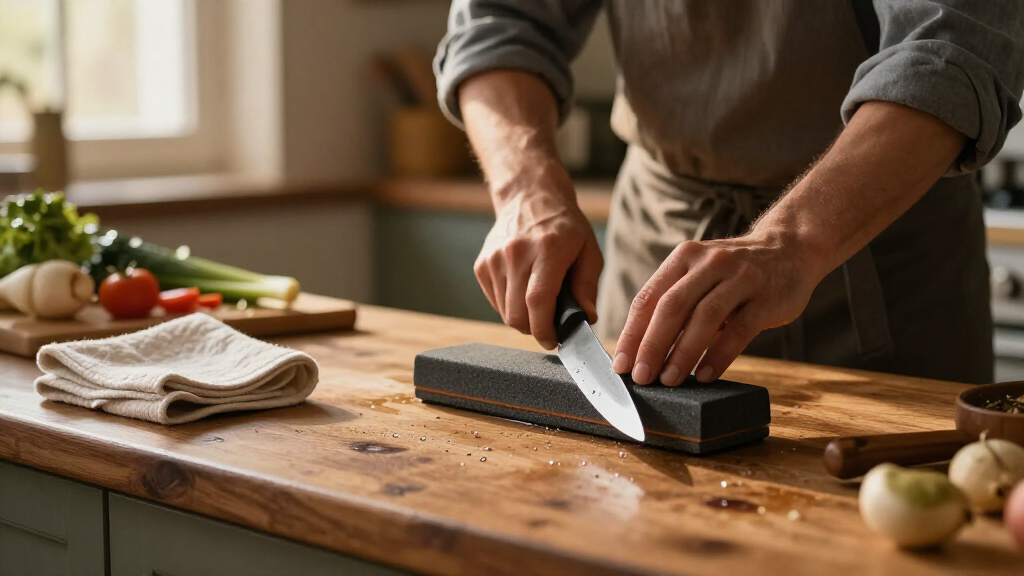

The right knife sharpening system for kitchen knives removes the guesswork from angle control and keeps your blades consistently sharp without sending them to a professional. My top pick is the Work Sharp Precision Adjust Elite, which combines repeatable angle settings, a wide abrasive range, and a clamp design that handles both thin paring knives and taller chef’s blades. If budget leads your decision, the Sharpal 202H Precision System delivers true adjustable-angle sharpening at a fraction of the cost, while the AIERILAN Rolling Sharpener Kit suits cooks who prefer a freehand feel with guided consistency. The core tradeoff in this category is precision versus convenience: fixed-angle pull-through sharpeners take seconds but remove more steel, while guided rod and whetstone systems take longer but preserve your knives longer. Read on for the full breakdown of all 13 systems and which one fits your kitchen.

Get kitchen gear delivered free — and shop member deals
- Fast, free delivery on millions of items
- Access to Prime Big Deal Days deals on October 6–7
- Prime Video, Amazon Music and more included
Complete the kit


Key Takeaways
- Guided clamp systems like the Work Sharp Precision Adjust family dominated the middle of my ranking because they hold a consistent angle across the entire blade, which matters more than abrasive count for kitchen knives.
- Electric pull-through sharpeners (the Work Sharp E2 and 3-Stage models) sharpen fastest but grind more steel per pass, making them better for inexpensive knives than for Japanese blades or premium hardened steel.
- The three Work Sharp Precision Adjust tiers differ mainly in abrasive quality and build material — the base kit suits occasional sharpening, while the Elite’s diamond plates justify the step up for weekly maintenance.
- Whetstone sets like the Intelitopia Complete set offer the finest finish and total angle flexibility but carry the steepest learning curve; they reward patience more than any clamped system in this lineup.
- Rolling sharpeners and V-style systems (AIERILAN and Warthog) sit between freehand and fully guided — faster than rod systems, gentler than pull-throughs, but with less angle adjustability than clamp-style picks.
| Warthog V-Sharp Curve Knife Sharpener with 325-Grit Diamond Hones, Red |  | Best Compact Simplicity | Brand: Warthog Sharpeners | Model: CVRD | Abrasive: 325-grit diamond rods | VIEW LATEST PRICE | See Our Full Breakdown |
| SHARPAL 202H Precision Knife Sharpening System, 10°–35° Adjustable Angle |  | Best Complete Kit | Brand: SHARPAL | Model: 202H | Adjustable angle: 10°–35° | VIEW LATEST PRICE | See Our Full Breakdown |
| XARILK GEN3 Guided Knife Sharpening System |  | Best Build Quality | Brand: XARILK | Model: US-KN-300 | Body material: Aluminum alloy | VIEW LATEST PRICE | See Our Full Breakdown |
| AIERLIAN Rolling Knife Sharpener Kit with Diamond and Ceramic Discs |  | Best for Japanese-Style Edges | Abrasives: #400 diamond and #3000 ceramic discs | Sharpening angles: 15° and 20° | Base material: Natural wood | VIEW LATEST PRICE | See Our Full Breakdown |
| Work Sharp Ken Onion Edition Mk.2 Knife and Tool Sharpener |  | Best Powered Option | Model: Ken Onion Edition Mk.2 | Sharpening method: Flexible abrasive belts | Controls: Precision sharpening guides and electronic speed control | VIEW LATEST PRICE | See Our Full Breakdown |
| Intelitopia Complete Knife Sharpening Stone Set, 400/1000 and 3000/8000 Grit |  | Best Whetstone Set for Polished Edges | Whetstone grits: 400/1000 and 3000/8000 | Whetstone material: Corundum (aluminum oxide) | Included accessories: Flattening stone, leather strop, bamboo base, 3 non-slip rubber bases, angle guide, instruction manual | VIEW LATEST PRICE | See Our Full Breakdown |
| Work Sharp Precision Adjust Elite Knife Sharpener |  | Best for Serrated and Curved Blades | Brand: Work Sharp | Model: WSBCHPAJ-ELT-ATL | Adjustable sharpening angles: 15° to 30° | VIEW LATEST PRICE | See Our Full Breakdown |
| Work Sharp Precision Adjust Knife Sharpener Kit |  | Best Value Guided System | Brand: Work Sharp | Model: WSBCHPAJ | Sharpening angle: 15–30 degrees in 1-degree increments | VIEW LATEST PRICE | See Our Full Breakdown |
| Work Sharp Professional Precision Adjust Knife Sharpener Kit |  | Best Premium Guided Kit | Brand: Work Sharp | Model: WSBCHPAJ-PRO-ATL | Material: Metal | VIEW LATEST PRICE | See Our Full Breakdown |
| Work Sharp E2 Electric Kitchen Knife Sharpener |  | Best for Effortless Kitchen Maintenance | Sharpening type: Electric, guided sharpening | Abrasives: Premium abrasives | Honing wheel: Built-in ceramic | VIEW LATEST PRICE | See Our Full Breakdown |
| Lansky Deluxe 5-Stone Knife Sharpening System |  | Best Guided Clamp System | Brand: Lansky | Model: LKCLX | Included stones: Extra-coarse, coarse, medium, fine alumina oxide, extra-fine ceramic | VIEW LATEST PRICE | See Our Full Breakdown |
| 3-Stage Kitchen Knife Sharpener with Cut-Resistant Glove |  | Best Budget Starter Pick | Brand: KITCHELLENCE | Model: KS37 P | Stages: 3 (repair, sharpen, polish) | VIEW LATEST PRICE | See Our Full Breakdown |
| Sharp Pebble Precision Adjust 3-Stage Knife Sharpener |  | Best Angle-Adjustable Manual Pick | Brand: Sharp Pebble | Model number: 4KS | Type: Manual knife sharpener | VIEW LATEST PRICE | See Our Full Breakdown |
| knife sharpening systems for kitchen knife | Brand | Model |
|---|---|---|
| Warthog V-Sharp Curve Knife Sh | Warthog Sharpeners | CVRD |
| SHARPAL 202H Precision Knife S | SHARPAL | 202H |
| XARILK GEN3 Guided Knife Sharp | XARILK | US-KN-300 |
| AIERLIAN Rolling Knife Sharpen | — | — |
| Work Sharp Ken Onion Edition M | — | Ken Onion Edition Mk.2 |
| Intelitopia Complete Knife Sha | — | — |
| Work Sharp Precision Adjust El | Work Sharp | WSBCHPAJ-ELT-ATL |
| Work Sharp Precision Adjust Kn | Work Sharp | WSBCHPAJ |
| Work Sharp Professional Precis | Work Sharp | WSBCHPAJ-PRO-ATL |
| Work Sharp E2 Electric Kitchen | — | — |
| Lansky Deluxe 5-Stone Knife Sh | Lansky | LKCLX |
| 3-Stage Kitchen Knife Sharpene | KITCHELLENCE | KS37 P |
| Sharp Pebble Precision Adjust | Sharp Pebble | — |
More Details on Our Top Picks
Warthog V-Sharp Curve Knife Sharpener with 325-Grit Diamond Hones, Red
For cooks who want zero setup and repeatable results, this is the most frictionless option in the lineup. The spring-loaded diamond rods sharpen both sides of the blade simultaneously at a fixed 25-degree angle, which removes the skill barrier that makes systems like the SHARPAL 202H intimidating for casual users. Compared with the AIERLIAN rolling kit, it trades fine polishing control for speed and a footprint small enough to live in a drawer. The tradeoff is real, though: that fixed 25-degree angle is steeper than what many kitchen knives prefer, and there’s no path to a refined, polished edge. It’s a maintenance tool, not a restoration system.
Pros:- Sharpens both blade sides at once for fast, even results
- Spring-loaded rods keep the angle consistent without practice
- Very compact for drawer or camp kit storage
- Handles serrated as well as smooth blades
Cons:- Fixed 25-degree angle doesn’t suit every kitchen knife geometry
- Single 325-grit abrasive limits how refined the edge can get
Best for: Home cooks who want a fast, foolproof touch-up sharpener that stores anywhere
Not ideal for: Enthusiasts chasing polished, low-angle edges — the fixed 25 degrees and single grit can’t deliver that
- Brand:Warthog Sharpeners
- Model:CVRD
- Abrasive:325-grit diamond rods
- Sharpening angle:25 degrees (fixed)
- Compatible blades:Smooth and serrated knives
- Dimensions:7 × 5 × 4 in
- Weight:0.18 kg
- Color:Red
Our verdict“Buy this if you want the quickest path from dull to serviceable; skip it if you care about edge refinement.”
SHARPAL 202H Precision Knife Sharpening System, 10°–35° Adjustable Angle
This is the most complete package in the roundup: a 10°–35° adjustable angle range, dual sliding clamps, four diamond plates, two fine whetstones, and a leather strop with polishing compound — all in a carry case. Where the Warthog V-Sharp locks you into one angle, the 202H covers everything from steep Western edges to acute 10-degree Japanese profiles. Compared with the Lansky Deluxe 5-Stone System, the wider angle range and included strop give it the edge for kitchen knives specifically. The cost is complexity: there’s real setup, learning curve, and storage bulk here, and over-clamping thin blades requires care. Buyers wanting grab-and-go convenience should look elsewhere.
Pros:- 10°–35° angle range suits both Western and Japanese kitchen knives
- Six abrasive grits plus a strop take a blade from dull to mirror-polished
- Dual sliding clamps fit varying blade widths and lengths
- Carry case keeps the many components organized
Cons:- Most involved setup in this batch, with a real learning curve
- The multi-piece kit demands more storage space than simple sharpeners
Best for: Sharpening hobbyists who want one kit covering kitchen knives, outdoor blades, and full polish work
Not ideal for: Cooks who just want a quick edge between meals — the setup time won’t fit a busy routine
- Brand:SHARPAL
- Model:202H
- Adjustable angle:10°–35°
- Diamond plates:220, 325, 600, 1000 grit
- Whetstone plates:3000 and 6000 grit
- Polishing:Leather strop with compound
- Construction:Heavy-duty metal
- Included:System, abrasives, compound, carry case
Our verdict“The most versatile kit here — ideal if sharpening is a hobby, excessive if it’s a chore.”
XARILK GEN3 Guided Knife Sharpening System
The GEN3 stands out for its precision-machined aluminum alloy body, which feels more rigid and repeatable than plastic-bodied guided systems like the Work Sharp Precision Adjust line. Its three diamond stones (320/800/2000) cover restoration through polishing, though it lacks the ultra-fine 6000-grit finishing stones and strop of the SHARPAL 202H — so the ceiling on polish is lower. Adjustable angle and pressure control let you tune the approach for thin kitchen blades versus thick outdoor knives, something the Warthog V-Sharp simply can’t do. Assembly requires the included Allen wrench and screws, so it’s less of an open-the-box experience, and the kit skips a case for organization.
Pros:- Machined aluminum alloy construction is sturdier than plastic rivals
- Adjustable angle and pressure suit both kitchen and outdoor knives
- 320/800/2000 diamond grits handle dull repair through polish
- Versatile across kitchen, folding, and hunting blades
Cons:- Requires partial assembly before first use
- No carrying case or storage for the stones
Best for: Buyers who prioritize a rigid, metal-built guided system and mainly sharpen and refine rather than mirror-polish
Not ideal for: Anyone wanting a fully finished edge out of the box — no strop or ultra-fine stones are included
- Brand:XARILK
- Model:US-KN-300
- Body material:Aluminum alloy
- Abrasive type:Diamond
- Grits:320, 800, 2000
- Angle:Adjustable
- Suitable for:Kitchen, outdoor, folding, and hunting knives
- Included:3 diamond stones, Allen wrench, body, self-tapping screws
Our verdict“A sturdy, no-nonsense guided system for buyers who value rigidity over accessory count.”
AIERLIAN Rolling Knife Sharpener Kit with Diamond and Ceramic Discs
Rolling sharpeners have a devoted following because the long, controlled strokes produce cleaner edges than short rod strokes, and this kit makes the format affordable. The four N42 magnets hold blades at 15° or 20°, hitting the low angles Japanese kitchen knives favor — angles the Warthog V-Sharp’s fixed 25 degrees can’t reach. The #3000 ceramic disc and leather strop deliver a finish close to the SHARPAL 202H, with far less hardware. The tradeoff is narrow compatibility: no serrated knives, no scissors, and only two angle choices. The wooden base is handsome on a counter but won’t survive a garage workbench the way the XARILK’s metal body will.
Pros:- 15° and 20° angles suit Japanese and thin Western kitchen blades
- #3000 ceramic disc plus leather strop produce a refined edge
- Four strong N42 magnets keep the blade securely positioned
- Wooden base looks at home on a kitchen counter
Cons:- Cannot sharpen serrated knives or scissors
- Only two fixed angles, with no adjustability between them
Best for: Owners of Japanese or thin-profile kitchen knives who want polished low-angle edges with minimal gear
Not ideal for: Households with serrated bread knives or scissors in the mix — this kit can’t touch them
- Abrasives:#400 diamond and #3000 ceramic discs
- Sharpening angles:15° and 20°
- Base material:Natural wood
- Magnetic support:Four N42 magnets
- Included accessory:Leather strop
- Not suitable for:Serrated knives and scissors
Our verdict“The most elegant path to sharp Japanese-style kitchen edges, provided serrated blades aren’t on your list.”
Work Sharp Ken Onion Edition Mk.2 Knife and Tool Sharpener
When speed matters most, this belt-driven sharpener reprofiles a dull blade faster than any manual system here. The flexible abrasive belts conform to the blade curve, and precision guides with electronic speed control reduce the freehand risk that electric sharpeners usually carry. Compared with the Work Sharp E2 Electric Kitchen Sharpener, the Ken Onion edition adds variable speed and versatility beyond kitchen knives. But that speed cuts both ways: belts remove metal aggressively, and an inattentive moment can over-grind a thin kitchen blade — something the slow, fixed-angle SHARPAL 202H makes nearly impossible. Belt replacement is also an ongoing cost manual stones avoid, and the exact tool compatibility beyond knives is vague.
Pros:- Belt sharpening restores very dull blades quickly
- Flexible belts follow curved blades better than rigid rods
- Electronic speed control and precision guides add safety
- 3-year warranty and US-based design and calibration
Cons:- Aggressive belt removal can over-grind thin kitchen blades if rushed
- Abrasive belts are a recurring replacement cost
Best for: Busy cooks and tool owners who want fast, powered sharpening across knives and bladed tools
Not ideal for: Beginners with expensive thin knives — the learning curve on powered belts risks over-grinding
- Model:Ken Onion Edition Mk.2
- Sharpening method:Flexible abrasive belts
- Controls:Precision sharpening guides and electronic speed control
- Designed and calibrated:Ashland, Oregon
- Warranty:3 years
Our verdict“The fastest route to sharp in this lineup — best for confident users, risky for cautious beginners.”
Intelitopia Complete Knife Sharpening Stone Set, 400/1000 and 3000/8000 Grit
Unlike the guided clamp systems elsewhere in this roundup, the Intelitopia set is a traditional freehand water stone kit, and it rewards patience with a finer edge than most fixed-angle tools can produce. The four-grit progression from 400 up to 8000 lets you move from repairing a chipped chef’s knife to polishing a mirror finish on a paring blade. What sets this option apart from budget stone sets is completeness: a flattening stone keeps the whetstones true, a genuine cowhide strop refines the final edge, and an angle guide helps beginners approximate the correct bevel. Compared with the Work Sharp E2, this demands real technique and a water soak, so the learning curve is steep. If the goal is edge quality rather than speed, this is the strongest choice.
Pros:- Four grits cover repair, sharpening, and mirror polishing in one kit
- Flattening stone keeps whetstones flat for consistent results
- Genuine leather strop lets you finish and maintain edges
- Works for kitchen knives, scissors, pocket knives, and straight razors
Cons:- Requires water soaking and developed freehand technique
- Sharpening sessions are slower than electric or guided systems
- No published dimensions or detailed care instructions
Best for: Home cooks willing to learn freehand sharpening who want a complete stone-to-strop workflow for razor-sharp kitchen knives
Not ideal for: Anyone who wants fast, foolproof results — water soaking and consistent hand angles take practice
- Whetstone grits:400/1000 and 3000/8000
- Whetstone material:Corundum (aluminum oxide)
- Included accessories:Flattening stone, leather strop, bamboo base, 3 non-slip rubber bases, angle guide, instruction manual
- Strop material:Genuine cowhide leather
- Intended use:Sharpening and polishing knives, scissors, and straight razors
- Sharpening method:Freehand water stone
Our verdict“Choose this if you prioritize the finest possible edge and accept a learning curve in exchange.”
Work Sharp Precision Adjust Elite Knife Sharpener
The Elite sits in the middle of Work Sharp’s Precision Adjust line, and its reason for existing is blade coverage. Where the standard Precision Adjust kit handles plain edges well, the Elite adds a dedicated serrated blade rod and a tri-brasive attachment for curved blades, so bread knives, boning knives, and clip-point blades are all in play. The 15° to 30° angle range covers Western and Japanese kitchen knives, with diamond plates for cutting and a ceramic rod for finishing. Compared with the Intelitopia stone set, this model trades the finest polish for repeatable, clamped consistency. The tradeoff is hands-on effort: you clamp and sharpen manually, and the coarsest included plate is 320 grit, so heavily damaged blades will take longer to restore than on systems with a coarser option.
Pros:- Serrated blade rod handles bread and tomato knives
- Tri-brasive attachment supports curved blades
- Adjustable 15°–30° angles suit Western and Japanese kitchen knives
- Includes leather strop for edge refinement
Cons:- Manual clamping and sharpening takes time and attention
- Coarsest abrasive is 320 grit, limiting heavy repair work
- Fixed angle range may not suit every blade geometry
Best for: Cooks with mixed cutlery including serrated bread knives and curved boning blades who want one guided system for everything
Not ideal for: Those with badly chipped knives — no abrasive coarser than 320 grit means repairs are slow
- Brand:Work Sharp
- Model:WSBCHPAJ-ELT-ATL
- Adjustable sharpening angles:15° to 30°
- Included components:320-grit diamond plate, 600-grit diamond plate, ceramic finishing rod, serrated blade rod, tri-brasive attachment, leather strop
- Item length:14.5 inches
- Unit count:1
- Sharpening method:Guided manual clamp system
Our verdict“This pick makes the most sense for households whose knife block includes serrated and curved blades alongside standard kitchen knives.”
Work Sharp Precision Adjust Knife Sharpener Kit
This is the base model of Work Sharp’s Precision Adjust family, and it delivers the core benefit of the line — 1-degree angle increments from 15° to 30° — without the extra abrasives that push the Elite and Professional versions upmarket. For kitchen knives specifically, that fine adjustment matters: a Japanese santoku at 15° and a German chef’s knife at 20° each get the bevel they actually need, something fixed-slot tools like the 3-Stage Kitchen Knife Sharpener cannot match. The kit includes a benchtop base and knife clamp that keep the blade steady for repeatable strokes, plus 320/600 diamond plates and a ceramic stone. Compared with the Elite, you give up the serrated rod and curved-blade attachment; compared with the Professional, you lose the finer 220–800 grit progression. For plain-edge kitchen knives, though, little of practical value is lost.
Pros:- Fine 1-degree angle adjustment from 15° to 30°
- Diamond and ceramic abrasives cover sharpening through finishing
- Benchtop base and clamp produce repeatable results
- 3-year warranty
Cons:- No serrated blade tool or curved-blade attachment
- Manual sharpening requires more effort than electric sharpeners
- Compatibility with very large or unusual blades is not specified
Best for: Budget-minded cooks who want precise, repeatable bevels on plain-edge kitchen knives without paying for extra abrasives
Not ideal for: Owners of many serrated knives — this base kit lacks a dedicated serrated sharpening rod
- Brand:Work Sharp
- Model:WSBCHPAJ
- Sharpening angle:15–30 degrees in 1-degree increments
- Abrasives:320- and 600-grit diamond; fine ceramic
- Included components:Sharpening chassis, benchtop base, knife clamp, sharpening slide rod, user’s guide
- Warranty:3 years
- Made and calibrated:Ashland, Oregon
Our verdict“The smart buy if you mainly sharpen standard kitchen knives and want guided precision at the lowest entry point in this line.”
Work Sharp Professional Precision Adjust Knife Sharpener Kit
The Professional version is the top of Work Sharp’s Precision Adjust line, and the differences from the base Precision Adjust kit are tangible rather than cosmetic. The build shifts to metal construction, which means less flex during sharpening strokes and more consistent bevels over years of use. Where the base kit offers three abrasives, this one includes seven: a 220-grit diamond plate for genuine repair work, a progression through 800 grit, fine ceramic, and a leather strop for finishing. The digital angle indicator removes guesswork when switching between a 15° santoku and a 20° chef’s knife — you set the number and trust it. Compared with the Elite, the Professional adds the coarse 220 grit the Elite lacks, making it the better repair platform. The cost is real money and a bulkier bench footprint, and it still handles serrations less directly than the Elite’s dedicated rod.
Pros:- Seven abrasives span heavy repair through polished finishing
- Digital angle indicator gives exact, repeatable settings
- Full metal chassis resists flex for consistent bevels
- Handles kitchen, pocket, hunting, and small pen knives
Cons:- Highest cost in the Precision Adjust line
- Larger bench footprint than simpler pull-through sharpeners
- Still a manual, hands-on process despite the precision
Best for: Enthusiast cooks and knife hobbyists who repair, sharpen, and finish blades and want machine-repeatable precision
Not ideal for: Casual users who sharpen a few knives occasionally — the extra abrasives and metal build are overkill
- Brand:Work Sharp
- Model:WSBCHPAJ-PRO-ATL
- Material:Metal
- Adjustable angle:15–30 degrees
- Abrasives:220, 320, 400, 600, and 800-grit diamond; fine ceramic; leather strop
- Warranty:3 years
- Designed and calibrated:Ashland, Oregon
Our verdict“Worth it only if you maintain a large or valuable knife collection and want full repair-to-finish capability in one metal-bodied kit.”
Work Sharp E2 Electric Kitchen Knife Sharpener
If every other pick in this lineup asks you to learn something, the E2 asks almost nothing. It is an electric, guided sharpener: you draw the blade through guided slots and the machine holds the angle for you, which makes it the natural choice for cooks who want sharp knives without any technique investment. It also handles more than knives — scissors and shears are supported, which none of the clamp-style kits here address. The built-in ceramic hone wheel is the practical standout for kitchen use, letting you touch up edges weekly in seconds before they degrade. The honest tradeoff versus the Work Sharp Precision Adjust base kit is control: fixed angles mean you cannot match a specific factory bevel, and powered abrasives remove metal faster, so careless passes can shorten a blade’s life. Compared with freehand stones like the Intelitopia set, the ceiling on edge quality is simply lower.
Pros:- Automated guided sharpening requires no technique
- Built-in ceramic hone wheel makes quick edge maintenance easy
- Also sharpens serrated knives, scissors, and shears
- 3-year warranty
Cons:- Fixed angle settings prevent matching specific factory bevels
- Powered abrasives remove metal quickly, demanding careful passes
- Edge quality ceiling is lower than stone or guided-rod systems
Best for: Busy home cooks who want fast, consistent sharpening and frequent quick touch-ups with zero learning curve
Not ideal for: Owners of premium Japanese knives or custom bevels — fixed angles and fast stock removal limit precision
- Sharpening type:Electric, guided sharpening
- Abrasives:Premium abrasives
- Honing wheel:Built-in ceramic
- Compatible tools:Kitchen knives, serrated knives, scissors, and shears
- Warranty:3 years
- Designed and calibrated:Ashland, Oregon
Our verdict“The right pick if convenience and speed matter more to you than achieving the sharpest possible edge.”
Lansky Deluxe 5-Stone Knife Sharpening System
The Lansky Deluxe 5-Stone System stands out as the most fully equipped guided kit in this batch. Its precision clamp holds the blade at a fixed angle while color-coded stones—ranging from extra-coarse to extra-fine ceramic—progressively repair damaged edges and refine them to a polished finish. That grit range matters: a dull or chipped chef’s knife needs coarse stock removal before a fine stone can do anything, and most simple pull-through units like the Kitchellence 3-Stage simply can’t reprofile a blade.
The tradeoff is effort. Compared with the Sharp Pebble Precision Adjust, which sharpens in seconds with fixed slots, the Lansky demands patience, stone changes, and technique. At 8 pounds with oil, a clamp, and a case, it’s also a bench project rather than a drawer gadget. This pick makes the most sense for cooks who view sharpening as a deliberate skill rather than a chore.
Pros:- Five grits from extra-coarse to extra-fine ceramic handle everything from edge repair to polishing
- Precision clamp keeps a consistent angle, removing the guesswork of freehand sharpening
- Works on kitchen, outdoor, hobby, and garden knives, unlike kitchen-only pull-throughs
- Includes honing oil and a storage/carrying case to keep the kit organized
Cons:- At 8 pounds with a full stone set, it’s the least portable option in this batch
- Slow, multi-step process with stone changes between grits
- Requires learning curve and practice to get consistent results
Best for: Home cooks and hobbyists who want to learn true angle-controlled sharpening and restore badly dulled or damaged kitchen knives
Not ideal for: Anyone wanting a quick pull-through touch-up before dinner — this is a multi-step process, not a 30-second fix
- Brand:Lansky
- Model:LKCLX
- Included stones:Extra-coarse, coarse, medium, fine alumina oxide, extra-fine ceramic
- Included components:Knife clamp, honing oil, storage/carrying case
- Blade compatibility:Kitchen, outdoor, hobby, and garden knives
- Weight:8 pounds
- Warranty:1 year
Our verdict“Buy this if you want the most complete guided sharpening setup in the batch and are willing to invest time in technique; skip it if speed matters more than precision.”
3-Stage Kitchen Knife Sharpener with Cut-Resistant Glove
Where the Lansky Deluxe asks you to learn a craft, this Kitchellence 3-Stage sharpener asks for about thirty seconds and a few gentle pulls. Its three-stage system—repair, sharpen, polish—covers the full maintenance cycle in one palm-sized tool, which is unusual at this simplicity level. The non-slip base and ergonomic handle keep things stable on a counter, and it works for both left- and right-handed users, a small inclusivity detail many pull-throughs overlook.
The included cut-resistant glove is a thoughtful touch for nervous beginners. But this is a kitchen-only tool: unlike the Sharp Pebble Precision Adjust, it offers no angle adjustment, so you’re locked into one factory geometry. It also won’t handle pocket or hunting knives, and it can’t reprofile a seriously damaged blade the way a stone system can. This option stands out for convenience, not control.
Pros:- Three distinct stages repair, sharpen, and polish in one compact tool
- Ambidextrous design works equally well for left- and right-handed users
- Non-slip base keeps the unit planted during use
- Included cut-resistant glove adds safety for first-time sharpeners
Cons:- No adjustable angle — you’re stuck with one preset blade geometry
- Limited to kitchen knives; other blade types aren’t supported
- Fixed abrasive slots remove more steel over time than precision guided systems
Best for: Beginners and casual cooks who want a safe, dead-simple sharpener for everyday kitchen knives without learning technique
Not ideal for: Knife enthusiasts who want angle control or need to sharpen pocket, hunting, or heavily damaged blades
- Brand:KITCHELLENCE
- Model:KS37 P
- Stages:3 (repair, sharpen, polish)
- Material:ABS plastic
- Included components:Cut-resistant glove
- Handedness:Left- and right-handed compatible
- Color:Black
Our verdict“The right choice for a first-time sharpener buyer who values speed and safety over precision; enthusiasts should look elsewhere.”
Sharp Pebble Precision Adjust 3-Stage Knife Sharpener
The Sharp Pebble Precision Adjust sits in a smart middle ground: it keeps pull-through ease but adds five selectable angles from 12° to 24°. Why does that matter for kitchen knives? Thin Japanese-style blades cut best at 12°–15°, while tougher German blades hold up better at 20°-plus—so one tool can match both instead of forcing a compromise. Compared with the Kitchellence 3-Stage, this model offers real edge customization; compared with the Lansky Deluxe, it trades some refinement for radical speed and convenience.
Its versatility extends beyond the kitchen drawer to pocket and hunting knives, which the Kitchellence can’t touch. The compromises are real, though: it handles straight-edge blades only, so serrated bread knives and scissors are off the table, and the ABS plastic build feels less durable than metal guided systems.
Pros:- Five adjustable angles (12°–24°) let you match edge geometry to blade style
- Works on kitchen, pocket, and hunting knives for cross-use value
- Three sharpening stages in a quick pull-through format
- Ergonomic ABS design is lightweight and easy to handle daily
Cons:- Not suitable for serrated knives or scissors
- ABS plastic construction is less robust than clamp-based metal systems
- Angle settings are preset increments, not continuously variable like the SHARPAL 202H
Best for: Cooks who own a mix of thin Japanese and thicker Western kitchen knives and want angle-matched results without a full guided kit
Not ideal for: Households with serrated knives or scissors to maintain — this model only accepts straight-edge blades
- Brand:Sharp Pebble
- Model number:4KS
- Type:Manual knife sharpener
- Sharpening stages:3
- Adjustable angles:12°, 15°, 18°, 21°, 24°
- Blade compatibility:Straight-edge kitchen, pocket, and hunting knives
- Material:ABS plastic
- Included components:Knife sharpener
Our verdict“The best balance of speed and precision in this batch—buy it if you sharpen multiple blade types and care about matching angles; skip it for serrated edges.”
How We Picked
I evaluated each system against five buyer-relevant criteria. Angle consistency came first, because kitchen knives live or die by a repeatable edge angle — a system that drifts mid-stroke produces a convex edge that dulls unevenly. Steel compatibility came second: premium Japanese knives at 60+ HRC need diamond or ceramic abrasives, so systems limited to standard stones ranked lower for enthusiasts even if they excelled for softer German steel. Ease of use, speed to a sharp edge, and long-term value (replacement abrasive cost, build durability) rounded out the scoring.
The ranking favors systems that balance all five criteria over one-trick performers. That’s why the Work Sharp Precision Adjust line holds three of the top slots — its clamp-and-rod architecture is the most forgiving path to professional-looking results — while faster electric sharpeners rank lower despite their convenience, and the budget pull-through and 3-stage units land near the bottom for their coarse, fixed-angle grinding that shortens blade life. Beginner-friendliness boosted picks like the Sharpal 202H and Sharp Pebble 3-Stage; skill requirements pushed the whetstone set down despite its superior finish quality.
Factors to Consider When Choosing Knife Sharpening Systems For Kitchen Knives
Before settling on a system, step back and think about the knives you own, how often you cook, and how much of the sharpening process you actually want to own. The factors below shaped my ranking and will shape your decision differently depending on your knife collection.Match the System to Your Knife Hardness
Hardness is the single most overlooked factor when buying a knife sharpening system. Budget pull-through sharpeners and systems with soft composite stones struggle on Japanese steel above 60 HRC — they cut slowly, load up, or simply skip across the edge, which is why a $30 sharpener can ruin a $200 gyuto. Diamond and CBN abrasives, found on the Warthog’s diamond hones and the Work Sharp Elite’s plates, cut any steel on the market but leave a slightly rougher scratch pattern than ceramic or water stones. A common mistake is assuming one system fits every knife in the drawer; households mixing soft German serrated bread knives with hard Japanese chef’s knives often need a primary system plus a cheap ceramic rod for touch-ups. If your knives cost more than $150 each, treat abrasive type as a gate, not a feature. Softer steel owners have far more freedom and can prioritize speed and simplicity.
Fixed-Angle Convenience vs. Adjustable Precision
Fixed-angle sharpeners (pull-through slots, V-style jigs) lock you into one geometry, usually around 15–20 degrees per side. That works fine for Western kitchen knives but over-grinds thinner Japanese blades that perform best at 10–15 degrees. Adjustable-angle systems like the Sharpal 202H, with its 10°–35° range, let you match factory geometry or deliberately reprofile a knife to cut better — a real advantage if you cook daily. The tradeoff is setup time: clamping a blade and dialing an angle takes minutes versus seconds for a pull-through. My advice for most home cooks is a simple decision rule: if you sharpen fewer than four times a year, fixed-angle convenience wins; if you maintain an edge monthly, adjustability pays for itself in blade longevity. Skipping this decision and buying on price alone is the most common regret I hear about from sharpening buyers.
Steel Removal: The Hidden Cost of Speed
Every sharpening pass removes metal, and fast systems remove dramatically more of it. Electric and multi-stage pull-through sharpeners can strip away in ten seconds what a guided rod system removes in ten minutes — meaning a favorite chef’s knife can lose years of usable life through habitual quick sharpening. For a $40 supermarket knife this hardly matters, which is exactly why I ranked electric sharpeners as sensible for budget cutlery. For anything you care about, minimal steel removal should guide your purchase toward whetstones, rolling systems, or guided rod kits with fine-grit progression. Think of it this way: sharpening frequency compounds. Touching up a knife monthly with a fine stone removes less steel annually than twice-yearly sessions on an aggressive electric grinder. Buyers who understand this tradeoff rarely regret choosing the slower system.
Learning Curve and How Much Effort You’ll Actually Invest
Abrasive Grit Progression and Refill Costs
The path from dull to razor-sharp runs through grit progression: coarse to reshape, medium to refine, fine to polish. Systems that stop at a single medium grit — most pull-throughs and V-jigs — produce a serviceable working edge but never the push-cut sharpness that makes kitchen prep enjoyable. Kits with genuine progression, like the Intelitopia’s 400-through-8000 stones or the Lansky’s five-stone set, can take a knife to hair-splitting sharpness but demand more time and technique per session. Also check refill pricing before buying: proprietary abrasive belts and branded stones sometimes cost nearly as much as the original system. A $60 kit with cheap standard-sized stones often beats an $80 kit locked into expensive proprietary consumables over a five-year horizon. Grit range and consumable cost together determine real long-term value far better than sticker price alone.
Blade Size, Clamp Design, and Kitchen-Specific Fit
Not every sharpening system handles every kitchen knife shape. Clamp-style guided systems need enough flat blade to grip — very short paring knives and blades that taper heavily near the handle can sit crooked or slip mid-session. Taller chef’s knives pose the opposite problem on narrow-jig systems, where the stone may not clear the bolster. Serrated bread knives are a category of their own: most guided systems cannot sharpen them at all, and you’ll want a tapered ceramic rod as a companion tool. Rolling sharpeners sidestep clamping entirely, which makes them more forgiving of odd blade shapes but slightly less angle-consistent on long strokes. Before buying, mentally walk your sharpest, shortest, and tallest knives through the system’s mechanics — that ten-second exercise prevents the most common fit-related returns in this category.
Frequently Asked Questions
Is a guided sharpening system better than an electric sharpener for kitchen knives?
It depends on what your knives are worth to you. Electric sharpeners like the Work Sharp E2 produce a sharp edge in under a minute with zero technique, which makes them ideal for inexpensive knives, busy households, or anyone who simply will not sit down for a sharpening session. Guided systems take five to fifteen minutes per knife but hold an exact angle, remove far less steel, and can match or refine the factory geometry of premium blades. If you own Japanese knives or anything above roughly $100, the guided route protects your investment; the electric route gradually regrinds it into a thicker, shorter blade. Many enthusiasts own both — electric for quick touch-ups on beater knives, guided for serious maintenance.
Can these systems sharpen serrated kitchen knives?
Most cannot, and this is a frequent source of returns. Clamp-based guided systems, whetstones, and rolling sharpeners all work on the flat edge of a plain blade and simply skip over serrations, leaving the scallops untouched or worse, flattening their tips. Pull-through sharpeners with a serrated slot only address the tips briefly and rarely restore the recessed curves properly. The correct tool is a tapered ceramic or diamond rod, worked along each individual scallop’s bevel side — tedious but effective, and these rods typically cost far less than any full system. My suggestion: choose your main system for your plain-edge knives and add a tapered rod separately for bread and tomato knives.
What sharpening angle should I use for kitchen knives?
Western kitchen knives in softer steel traditionally ship at 20 degrees per side, which is durable and forgiving on cutting boards and the occasional bone contact. Japanese knives and thinner blades usually come at 10 to 15 degrees per side, which slices dramatically better but chips more easily under twisting or hard use. If your system offers adjustable angles — like the Sharpal 202H’s 10°–35° range — match the existing factory angle rather than imposing your own; you can check it with a marker test, coloring the bevel and adjusting until your strokes remove the ink evenly. Recreating the factory angle preserves steel; changing angles requires regrinding the entire bevel and removes a lot of metal. Only reprofile deliberately, when you want a knife to perform differently than it did new.
How often do kitchen knives actually need sharpening?
Most home cooks overestimate how rarely, and underestimate how gently, knives need attention. A quality kitchen knife used daily typically needs a full sharpening only two to four times a year — but a honing rod touch-up weekly, or a few light passes on a fine stone monthly, keeps the edge functional between sessions. Waiting until a knife crushes a tomato instead of slicing it means you’ve let the edge degrade past the touch-up stage, and restoring it then removes more steel than monthly maintenance would have. This frequency question should influence your system choice too: if the answer is ‘twice a year,’ prioritize ease of setup; if you enjoy monthly maintenance rituals, a progressive stone set or a high-end guided system rewards you with noticeably sharper results.
Is a whetstone set better than a guided rod system for a beginner?
For most beginners, no — and the difference comes down to error tolerance. Freehand whetstone sharpening demands you hold a consistent angle by hand across hundreds of strokes, and early sessions typically produce wavy, uneven edges that frustrate people into quitting. A guided rod or clamp system mechanically holds the angle for you, so even a first attempt produces a respectable edge, which builds the confidence to keep maintaining your own knives. That said, whetstones teach feel and offer unlimited angle flexibility, so cooks who enjoy skill-building may prefer starting there and accepting a few rough months. A reasonable middle path: start with a budget guided system like the Sharpal 202H, then add stones later once your hands understand what a correct bevel feels like.
Conclusion
After comparing all 13 systems, my recommendations split cleanly by buyer type. For best overall, the Work Sharp Precision Adjust Elite earns the top spot with its adjustable angle range, quality diamond abrasives, and clamp design that handles nearly any kitchen knife — the rare system that serves both beginners and serious cooks. The Sharpal 202H takes best value, proving that real angle control doesn’t require a premium budget, and it’s also my best for beginners pick thanks to its intuitive dial and forgiving operation. At the premium end, the Work Sharp Professional Precision Adjust adds professional-grade build and abrasives for cooks who sharpen weekly and want a system that outlasts their knife collection.
For specific needs: the Intelitopia whetstone set is the right choice if you want the finest possible polished edge and don’t mind a learning curve; the AIERILAN rolling kit suits cooks who dislike clamping but still want guidance; the Work Sharp E2 and Sharp Pebble 3-Stage fit households with inexpensive knives and zero patience for technique; and the Warthog V-Sharp rewards those who want fast, repeatable diamond-hone sharpening with minimal setup. Whatever you choose, the biggest gain comes from simply sharpening regularly — a modest system used monthly beats a premium system gathering dust in a drawer.
Fall Picks
fall essentials
As an affiliate, we earn on qualifying purchases.