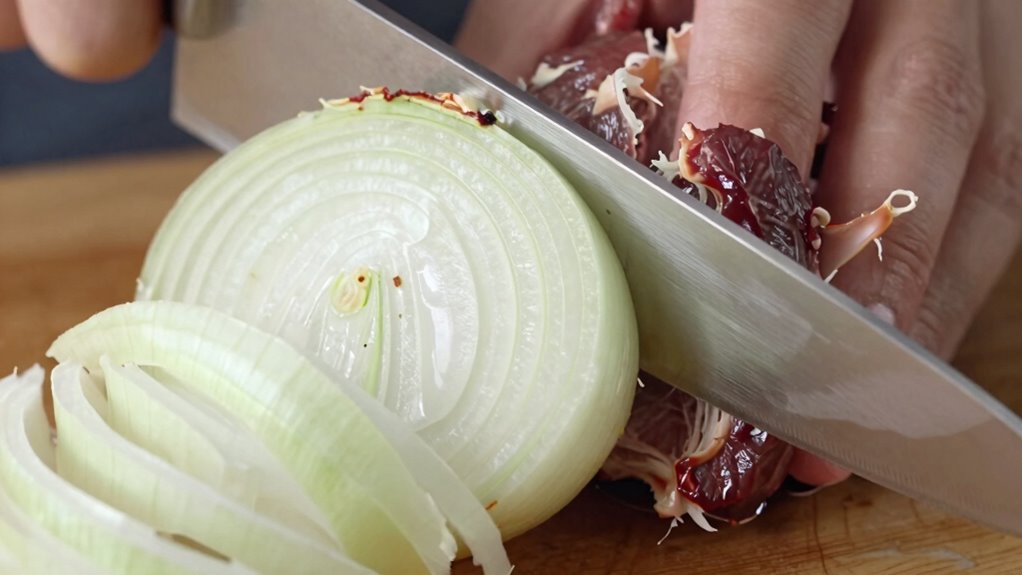

You’ll notice your knife feels great on onions because their soft, fibrous texture offers little resistance, allowing for smooth slicing. In contrast, meat is denser and tougher, with connective tissues that make cutting harder and rougher. A sharp knife helps on both, but tougher ingredients like meat require specific techniques to cut cleanly. Keep exploring, and you’ll discover how to optimize your knife skills for every ingredient you encounter.

Get kitchen gear delivered free with Prime
- Fast, free delivery on millions of items
- Prime Video, Amazon Music and more included
- Member-only deals all year
Key Takeaways
- Onions are fibrous and soft, allowing a sharp knife to slice smoothly without resistance or tearing.
- Meat is denser and tougher, requiring more force and proper technique; dull knives cause tearing and uneven cuts.
- A sharp knife glides through onions effortlessly, while it struggles with tougher meat, leading to poor cutting experience.
- Proper maintenance keeps knives sharp, ensuring comfortable slicing of onions but highlighting difficulties with dense meat if dull.
- The food’s texture influences how the knife interacts, making slicing onions feel easy and meat feel resistant or frustrating.

You might notice that a knife slices through onions effortlessly, leaving behind a clean cut, but struggles or feels uncomfortable when cutting into meat. This difference largely comes down to the nature of the food and how you’re applying your cooking techniques. Onions are fibrous but relatively soft, so a sharp, well-maintained knife glides through them smoothly. When your knife is sharp and properly cared for, it reduces the force needed and makes slicing onions feel effortless. It’s a clear sign that your knife maintenance plays an essential role in your overall kitchen performance. Regular honing and occasional sharpening keep your blades in prime condition, ensuring they cut cleanly through softer ingredients without tearing or crushing.
On the other hand, meat presents a different challenge. It’s denser, often tougher, and contains connective tissues that resist easy slicing. When you try to cut into meat with a dull or poorly maintained knife, you’ll notice resistance, tearing, and uneven cuts. That’s because a dull blade doesn’t cut cleanly; instead, it crushes the fibers, making the process more frustrating. To improve your experience, you need to adapt your cooking techniques—using proper slicing angles, applying consistent pressure, and sometimes choosing the right type of knife, such as a slicing or carving knife designed for meat. Proper knife maintenance is especially important for ensuring safety and efficiency in your kitchen. Additionally, understanding the material properties of different foods can help you select the most effective cutting tools. Recognizing the food structure can help you anticipate how your knife will interact with various ingredients. Knowing how the food’s texture influences your cutting approach can make your prep work much smoother.
The key difference lies in how your knife interacts with the food’s structure. With onions, a sharp knife slices through the soft layers with ease, requiring minimal effort. For meat, however, your technique needs to compensate for the tougher texture. You might need to make longer, smoother strokes, or adjust your grip to maintain control. Ensuring your knife is sharp and well-maintained makes a significant difference in how effectively you can cut through different foods. Dull knives not only make prep work harder but can also be dangerous, increasing the risk of slips and accidents. Maintaining a sharpness level that is appropriate for each task can greatly improve your cutting experience and safety.
In essence, your success in the kitchen hinges on understanding these distinctions. Keep your knives sharp and in good condition, and learn the appropriate cooking techniques for each ingredient. Doing so transforms what feels like a chore into a seamless process, whether you’re slicing onions or carving meat. Proper knife maintenance combined with tailored techniques allows you to work smarter, cutting with confidence and precision every time.
Products Worth Considering

Cuisinart Chef's Classic 11-Piece Stainless Steel Cookware Set

Breville Grind Control BDC650BSS Thermal Carafe Coffee Maker – Brushed Stainless Steel

Breville Bambino Espresso Machine, Brushed Stainless Steel (BES450BSS)
As an affiliate, we earn on qualifying purchases.
Frequently Asked Questions
Why Do Onions Make Knives Feel Smoother to Cut?
Onions contain natural oils and a slightly moist surface, which help reduce friction when you cut with your knife, making it feel smoother. This contrasts with meat, which can be tougher and may dull your knife faster. Proper cooking methods, like soaking or chilling onions before chopping, can enhance this effect. Regular knife sharpening also guarantees your blade stays sharp, making slicing through onions more effortless and comfortable.
How Does Meat’s Texture Affect Knife Performance?
Meat’s dense, fibrous texture increases cutting resistance, putting more strain on your knife’s blade durability. This can cause the blade to dull faster or even chip if it’s not designed for heavy-duty use. When cutting meat, you need a knife with strong blade durability to handle the tougher fibers, ensuring it maintains sharpness longer. Without it, your cutting experience becomes frustrating and less effective.
Can Knife Material Influence Onion and Meat Cutting Differently?
Yes, knife material can influence cutting onions and meat differently. A high-quality, durable blade made from sharp, corrosion-resistant material allows for precise cuts and less sticking, especially with onions. Proper knife maintenance guarantees it stays sharp, maintaining an ideal cutting angle. For meat, a well-maintained knife with the right cutting angle penetrates easier, reducing tearing. Different materials handle these tasks uniquely, impacting your overall cutting experience.
Does the Knife’s Blade Shape Impact Cutting Onions Versus Meat?
Think of your knife as a dancer, gracefully flowing through onions with its curved blade, making slicing effortless and reducing tears. The blade curvature enhances control and precision on softer foods, but can hinder meat cutting, where a straighter edge provides better edge durability and clean cuts. So, yes, the blade shape impacts performance: curved blades excel on onions, while straight blades shine on meat, ensuring your cuts are smooth and efficient.
Are There Specific Knife Techniques Better for Onions Than Meat?
You’ll find that a pinch grip enhances precision when chopping onions, allowing better control of your cutting angle for fine slices. For meat, a more secure grip, like a handle grip, helps maintain stability, especially with a steeper cutting angle to avoid slipping. Adjust your knife technique based on the task: a gentle rocking motion for onions, and a steady, downward cut for meat, ensuring safety and efficiency.
Conclusion
Remember, the right knife makes all the difference. Onions give way easily under a sharp edge, feeling almost like cutting through butter, while meat tests your patience and skill. Think of it like sailing: a smooth breeze makes the voyage enjoyable, but a rough storm can turn it into a nightmare. So, choose your tools wisely, and enjoy the process rather than fight against it. After all, a well-chosen knife transforms the kitchen into a place of pleasure, not frustration.