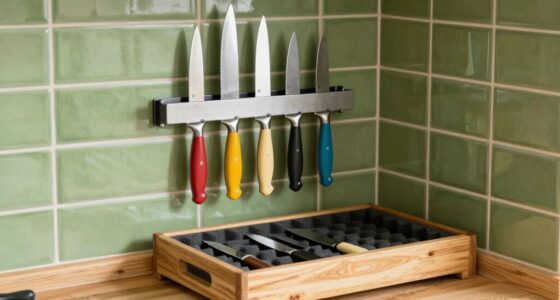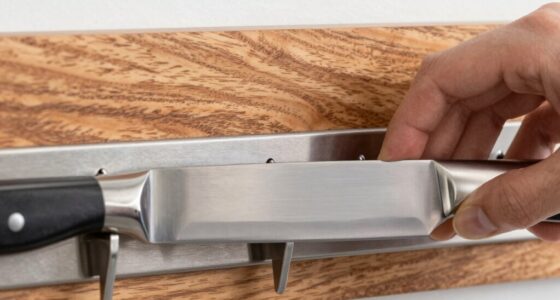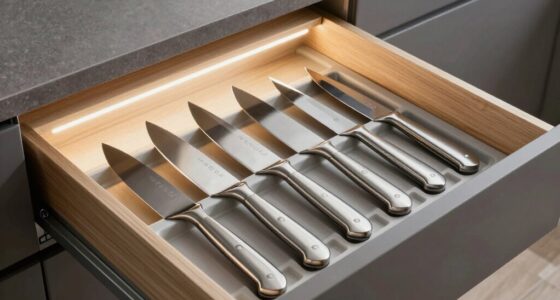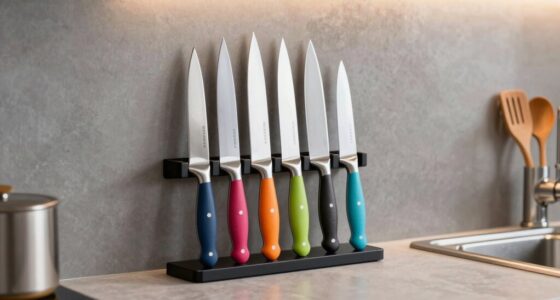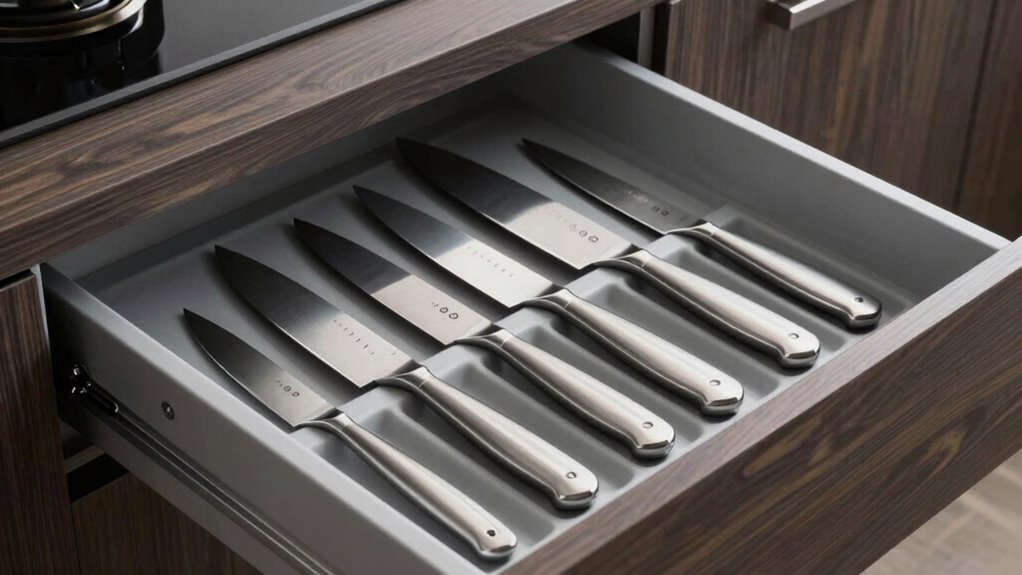
To create a better drawer layout for knife safety and speed, you should use custom or adjustable organizers with individual compartments for different blade types and sizes. Position your most-used knives at the front for quick access, and store less-used or specialty knives separately. Make certain blades are stored securely with protected edges and handles accessible, avoiding loose piling. A well-organized system minimizes clutter, reduces risks, and makes your workflow more efficient. Keep exploring for more tips to improve your kitchen safety and speed.
Key Takeaways
- Use adjustable, compartmentalized organizers to separate knife types and sizes for quick access and safety.
- Position frequently used knives at the front for easy reach, minimizing retrieval time.
- Protect sharp edges with covers or face blades away from users to prevent accidental cuts.
- Label compartments clearly to promote safe handling and organized storage for multiple users.
- Avoid stacking or loose placement; ensure smooth sliding and separation to maintain blade sharpness and safety.

A well-structured drawer layout is essential for knife safety in any kitchen. When you consider knife storage, it’s not just about keeping your blades out of the way; it’s about creating a system that allows quick access while minimizing risks. The right drawer layout helps you follow safety guidelines by reducing clutter and preventing accidental cuts. Instead of tossing knives haphazardly, you can designate specific spots for different types of blades, ensuring each one is stored securely and separately. This approach not only keeps your knives sharp but also makes it safer to grab the right tool quickly when you need it.
To optimize your drawer for knife safety and speed, start by investing in a custom or adjustable knife drawer organizer. These inserts typically have compartments tailored for various knife sizes, which keeps blades separated and prevents them from knocking into each other. When you store knives properly, you avoid dulling edges and reduce the risk of injury. Plus, knowing exactly where each knife is located saves time during meal prep. You won’t waste precious minutes rummaging through clutter, which can lead to accidental cuts or dropped blades.
Following safety guidelines means guaranteeing that blades are always stored with their edges protected and handles accessible. You should avoid stacking knives or leaving them loose in a drawer, as this increases the risk of cuts. Instead, opt for a layout that allows you to slide knives in smoothly, with the sharp edges protected or facing away from you. Labeling compartments can also be helpful if you have multiple cooks in your kitchen, so everyone knows where to find the right knife and return it safely. This habit not only promotes safety but also maintains organization over time.
Speed is another key factor in designing your drawer layout. When knives are stored systematically, you can grab what you need without hesitation. Position the most frequently used knives toward the front or in easily accessible compartments, so they’re ready at a moment’s notice. Keep specialty or rarely used knives in a separate section to prevent clutter and confusion. This setup ensures that your workflow remains smooth and that safety is never compromised for the sake of convenience.
In the end, a well-thought-out drawer layout combines safety guidelines with practical design. By prioritizing proper knife storage, you protect yourself and prolong the life of your blades. When organized efficiently, your kitchen becomes safer, and your cooking process more streamlined, allowing you to focus on creating delicious meals without worry. Additionally, understanding biodiversity in your environment can inspire eco-friendly choices in your kitchen practices, promoting sustainability alongside safety.
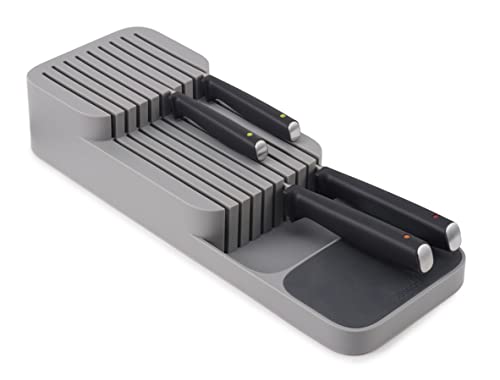
Joseph Joseph DrawerStore Knife Organizer, holds up to 9 knives, Kitchen Organization & Drawer Storage – Compact, Gray
Safe, organized storage for up to 9 knives. Non-slip feet.
As an affiliate, we earn on qualifying purchases.
As an affiliate, we earn on qualifying purchases.
Frequently Asked Questions
What Materials Are Best for Knife Drawer Dividers?
For knife storage and drawer organization, you’ll want dividers made of wood, plastic, or foam. Wooden dividers are sturdy, gentle on blades, and look sleek, making them a popular choice. Plastic ones are lightweight, easy to clean, and affordable, perfect for a busy kitchen. Foam inserts provide cushioned protection, reducing blade damage. Choose materials that suit your style, durability needs, and ease of cleaning to keep your knives safe and organized.
How Often Should Knife Drawer Organizers Be Cleaned?
You should clean your knife drawer organizer at least once a month—because who doesn’t love a good hygiene tip? Regular cleaning prevents gunk buildup, keeps blades sharp, and avoids that dreaded “eww” factor. Skip it, and you risk cross-contamination and dull knives. So, set a reminder, embrace the ritual, and keep your knives safe and your drawer fresher than your grandma’s cookies. Cleanliness is next to cuteness!
Can Custom Drawer Inserts Improve Safety?
Yes, custom drawer inserts can considerably improve safety by providing dedicated spaces for your knives, reducing the risk of accidental cuts. They enhance drawer organization, keeping knives securely separated and easily accessible. With proper knife storage, you avoid clutter and potential hazards. Custom inserts also protect your blades from damage, ensuring they stay sharp longer. Overall, they create a safer, more organized kitchen environment, making your cooking experience both safer and more efficient.
What Is the Average Cost of a Knife-Safe Drawer System?
The average cost of a knife-safe drawer system ranges from $50 to $200, depending on the quality and features. When you’re looking into kitchen organization and storage solutions, investing in a dedicated, secure drawer can substantially improve safety and efficiency. Custom inserts or modular storage options tend to be more expensive but offer tailored solutions that keep knives safely separated, making your kitchen both safer and more organized.
Are There Specific Drawer Layouts for Different Knife Types?
Think of your kitchen as a bustling city; different neighborhoods need specific layouts. Yes, there are specialized drawer layouts for various knife types—paring knives in one zone, chef’s knives in another—to optimize knife storage and drawer organization. This approach enhances safety and speed, ensuring each knife type has its own designated space. Customizing drawer layouts like this helps you access the right tool quickly while keeping your knives safe.

Utoplike In-drawer Knife Block Bamboo Kitchen Knife Drawer Organizer Large, handle Steak knife Holder without Knives, Fit for 16 Knife and 1 Sharpening Steel (Knives & Sharpening Not Included)
Check Your Drawer Dimensions: This product is suitable for drawers with an inner size larger than 17.1"D x…
As an affiliate, we earn on qualifying purchases.
As an affiliate, we earn on qualifying purchases.
Conclusion
Choosing the right drawer layout is like sharpening your skills; it makes everything easier and safer. By organizing your knives properly, you prevent accidents and improve your speed in the kitchen. A well-designed layout is like a well-tuned instrument—smooth, efficient, and reliable. Remember, safety and efficiency go hand-in-hand, so take the time to set up your drawer wisely. With the right setup, you’ll handle your knives with confidence, just like a pro.
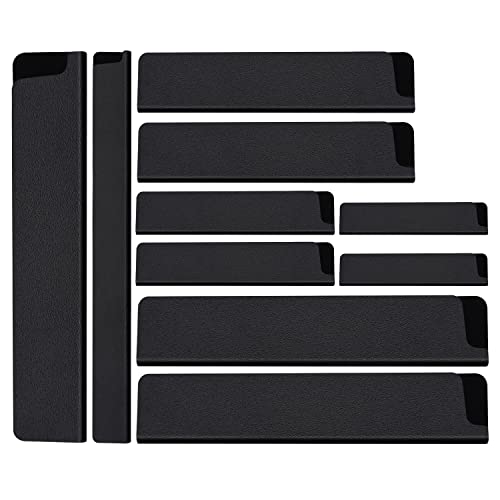
10pcs Universal Knife Edge Guards Set, Non-BPA Knife Sheath
【Size and Quantity】- The package includes 2pcs of 4.7" x 1", 2pcs of 6.3" x 1.3", 2pcs of…
As an affiliate, we earn on qualifying purchases.
As an affiliate, we earn on qualifying purchases.
Utoplike In-drawer Knife Block Bamboo Kitchen Knife Drawer Organizer Large, handle Steak knife Holder without Knives, Fit for 16 Knife and 1 Sharpening Steel (Knives & Sharpening Not Included)
Check Your Drawer Dimensions: This product is suitable for drawers with an inner size larger than 17.1"D x…
As an affiliate, we earn on qualifying purchases.
As an affiliate, we earn on qualifying purchases.