To slice raw meat thin without a deli slicer, start by chilling the meat until it’s firm but not frozen solid. Use a sharp, long-bladed knife and hold the meat securely with your fingers curled inward. Guide the knife at a slight angle with smooth, steady strokes, using a sawing motion for very thin slices. Practice maintaining consistent pressure and angle, and guarantee your workspace is stable for the best results. Keep going to discover more tips for perfect slices.

Get kitchen gear delivered free — and shop member deals
- Fast, free delivery on millions of items
- Access to Prime Big Deal Days deals on October 6–7
- Prime Video, Amazon Music and more included
Key Takeaways
- Chill the meat until firm but not frozen solid to facilitate easier, even slicing.
- Use a sharp, long-bladed knife, regularly honing it for clean, precise cuts.
- Place the meat on a stable cutting board with a damp towel underneath to prevent slipping.
- Hold the meat securely with fingers curled inward and slice at a 30-45 degree angle with a gentle sawing motion.
- Work slowly and consistently, adjusting pressure and angle to achieve thin, uniform slices.
Slicing raw meat thin can be challenging, but with the right technique, you can achieve perfect, even slices every time. The key lies in proper meat preparation and mastering effective slicing techniques. Before you start, verify your meat is well-chilled. Cold meat is firmer and easier to cut evenly, reducing the risk of slipping or uneven slices. Wrap the meat tightly in plastic wrap or place it in the freezer for about 30 minutes—just enough to firm it up without freezing solid. This step makes a significant difference in your ability to control your cuts precisely.
Once your meat is chilled, prepare your workspace. Use a sharp, long-bladed knife, such as a chef’s knife or slicing knife, to ensure clean cuts. Dull blades tug at the meat instead of slicing through smoothly, leading to uneven or jagged edges. Keep your knife sharp by regularly honing or sharpening it. When you’re ready to slice, position the meat on a stable cutting board. To help maintain control and prevent slipping, you can use a damp towel underneath the board.
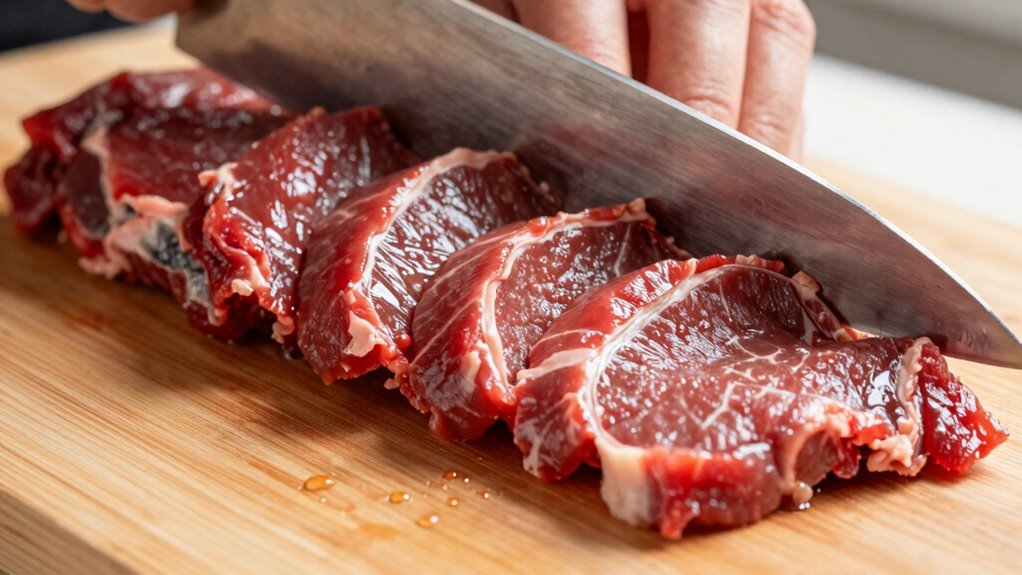
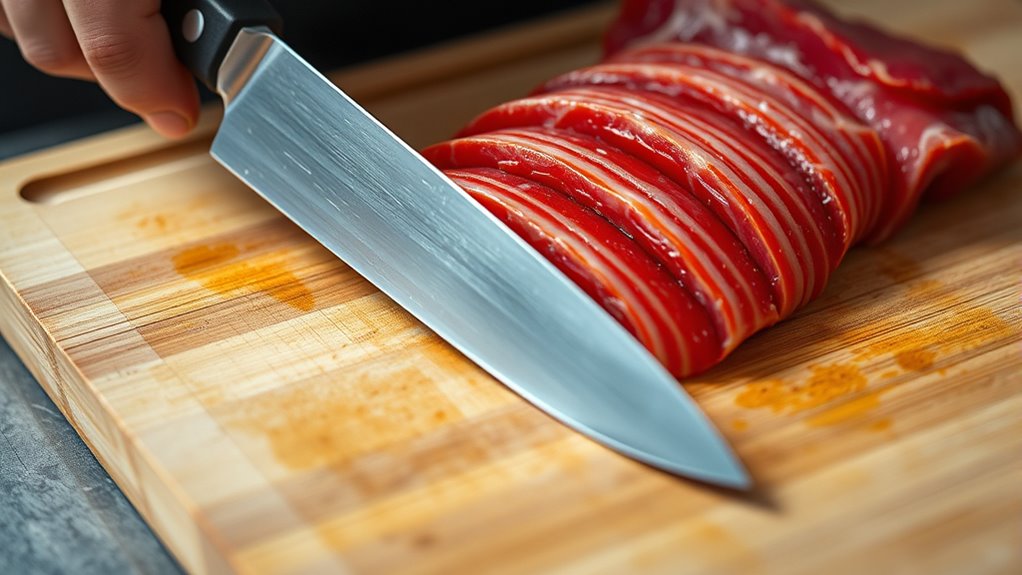
Use a sharp knife and stable cutting surface for clean, even meat slices.
The technique for slicing involves a gentle, steady motion. Hold the meat with your non-dominant hand, curling your fingers inward to protect them from the blade. Use your dominant hand to guide the knife, making smooth, even strokes through the meat. Aim to cut at a slight angle, about 30 to 45 degrees, which allows you to create thin, even slices. Keep the knife level and avoid pressing down too hard—let the blade do the work. If you need very thin slices, use a sawing motion, gently rocking the knife back and forth. Properly chilled meat also helps maintain consistent texture and makes slicing easier.
Controlling the thickness of your slices depends on your hand pressure and the angle of your knife. Take your time, especially with tougher cuts of meat. If you find it difficult to get uniform slices, try slicing in a single, continuous motion rather than stopping and starting. For larger pieces, work slowly and methodically, adjusting your grip and angle as needed. Practice makes perfect—over time, you’ll develop a feel for how much pressure and angle produce the thinnest slices.
sharp chef's knife for meat slicing
As an affiliate, we earn on qualifying purchases.
As an affiliate, we earn on qualifying purchases.
Frequently Asked Questions
Can I Use a Regular Knife for Slicing Meat Thin?
Yes, you can use a regular knife for slicing meat thin. Focus on proper knife techniques, like keeping your knife sharp and using a smooth, steady motion. Meat preparation is key—partially freezing the meat helps achieve cleaner, thinner slices. Hold the meat firmly, and slice against the grain to get even, delicate pieces. With patience and technique, your regular knife can produce professional-looking thin slices.
What Type of Knife Is Best for Slicing Raw Meat?
The best knife for slicing raw meat is a sharp, flexible fillet knife or a carving knife. These types of knives excel at precision cutting and allow you to master the art of slicing thin with ease. Use proper cutting techniques, like slicing against the grain and maintaining a steady, gentle motion. Forget the fancy gadgets—your trusty knife and a bit of patience turn raw meat into culinary magic.
How Do I Prevent the Meat From Slipping?
To prevent meat from slipping while slicing, stabilize it by placing a damp cloth or paper towel underneath. Use a firm, controlled slicing technique, keeping your fingers curled back to avoid slips. Adjust your knife angle to match the meat’s texture, slicing slowly and evenly. This helps maintain control, ensuring clean, thin slices without the meat sliding around, especially with tougher or more delicate textures.
Is Freezing the Meat Beforehand Safer?
Freezing the meat beforehand can be safer because it firms up the meat, making it easier to slice thinly and reducing the risk of slipping. Use proper freezing techniques, like wrapping the meat tightly and freezing it for a few hours, until it’s firm but not fully frozen. This improves the meat texture, allowing you to cut clean, consistent slices without accidents, ensuring better control and safety.
How Thin Can I Realistically Slice Raw Meat?
You can realistically slice raw meat as thin as a few millimeters, like slicing through butter when your knife is sharp. To achieve this, make certain your knife is well sharpened for better meat tenderness and precision. Keep in mind, the thinner you go, the more delicate the meat becomes, so work slowly and steadily. With patience and a sharp blade, you’ll get those paper-thin slices that look like they came from a pro.
As an affiliate, we earn on qualifying purchases.
Conclusion
Now that you know how to slice raw meat thin without a deli slicer, you can imagine both the precision of a chef and the simplicity of home. Like a razor-sharp sword cutting through silk, your knife becomes an extension of your hand, turning tough meat into delicate, paper-thin slices. With patience and practice, you’ll transform everyday ingredients into culinary art, proving that sometimes, the simplest tools and the sharpest skills create the most impressive results.
As an affiliate, we earn on qualifying purchases.
As an affiliate, we earn on qualifying purchases.
Fall Picks
fall essentials
As an affiliate, we earn on qualifying purchases.