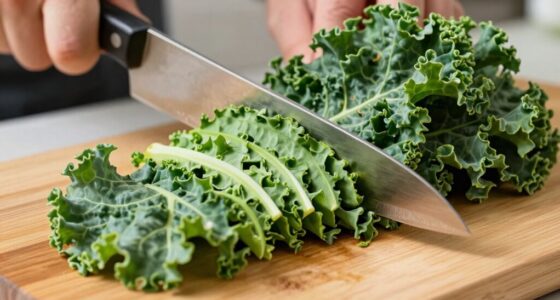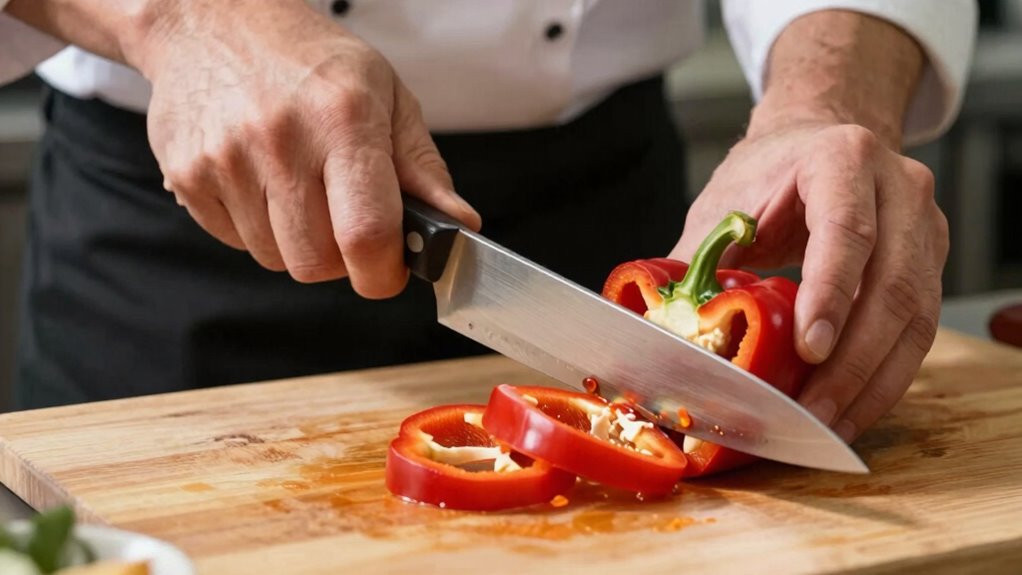

To build muscle memory for cleaner knife work, focus on practicing consistently with proper grip and technique. Use simple ingredients to develop controlled, repetitive motions that reinforce correct habits. Pay attention to your form and keep your movements smooth and deliberate, gradually increasing speed as you gain confidence. Repetition is key—over time, these consistent efforts will make your cuts instinctive, safer, and more precise. Keep practicing, and you’ll discover even more ways to refine your skills.

Get kitchen gear delivered free — and shop member deals
- Fast, free delivery on millions of items
- Access to Prime Big Deal Days deals on October 6–7
- Prime Video, Amazon Music and more included
Key Takeaways
- Practice proper grip and technique consistently to reinforce correct movements.
- Use controlled, repetitive cuts on simple ingredients to develop ingrained habits.
- Maintain focus and slow down to ensure precision, gradually increasing speed over time.
- Establish a regular practice routine to build muscle memory through repetition.
- Focus on confidence-building by practicing daily and emphasizing correct form.
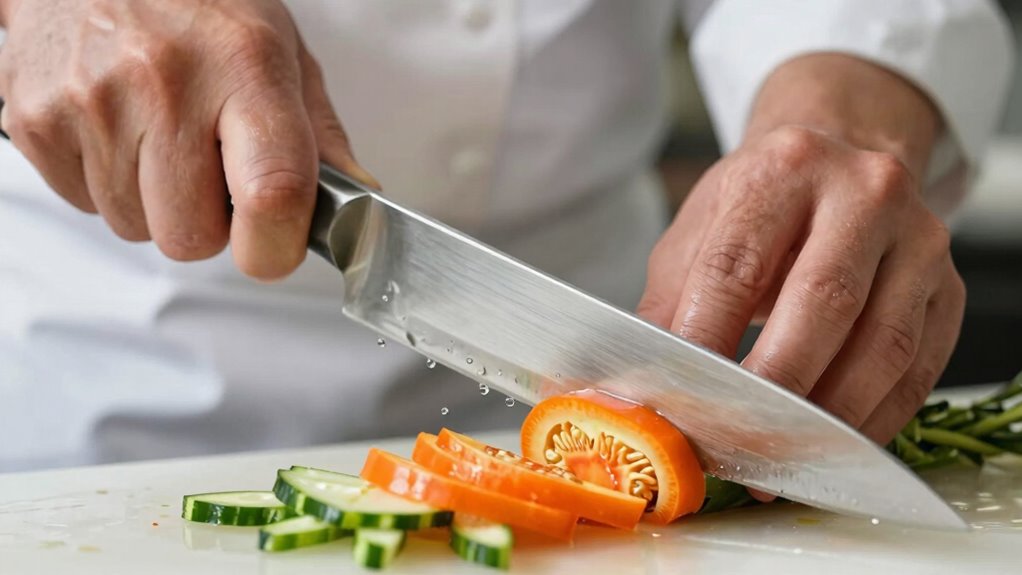
Mastering knife skills isn’t just about practice; it’s about developing muscle memory that allows you to cut confidently and efficiently. When you focus on your knife grip and perfect your cutting techniques, you create ingrained habits that make every slice smoother and safer. When you intentionally focus on technique accuracy, you reinforce the correct movements in your muscles, making each cut more precise over time. The way you hold your knife—the grip you develop—plays an essential role in building muscle memory. A proper knife grip, whether it’s the pinch grip or the handle grip, ensures stability and control. By consistently using the same grip, your hand and wrist learn the correct movements, reducing hesitation and improving precision over time.
Consistent knife grip and technique build muscle memory for safer, more confident cutting.
Your cutting techniques should become second nature. Start with simple, controlled motions, and focus on maintaining a steady rhythm. Consistent repetition is key; every time you practice, your muscles become more familiar with the motion. Over time, this reduces the mental effort needed to perform each cut, allowing you to work faster and more accurately. Pay attention to details like the angle of your knife and the pressure you apply. Maintaining a consistent angle not only results in cleaner cuts but also trains your muscles to execute the same motion effortlessly. Developing muscle memory through deliberate repetition creates lasting habits that translate to better performance in the kitchen. Incorporating kinesthetic learning techniques, such as mindful movement focus, can further enhance this process.
Another way to build muscle memory is to set up a dedicated practice routine. Use simple ingredients like carrots or celery to hone your skills. As you become more comfortable, increase the complexity or speed of your cuts. Always pay attention to your form—maintaining a stable knife grip and consistent technique—because habits formed during practice carry over to real cooking scenarios. The importance of repetition cannot be overstated, as it cements the correct movements into your muscle memory. The more you repeat a movement, the more natural it becomes, reducing fatigue and increasing efficiency. Additionally, understanding the fundamentals of proper technique can help accelerate your progress. The goal is to make your movements seamless, reducing the chances of slips or uneven cuts. Consistent practice not only improves technique but also builds confidence in the kitchen.
Ultimately, developing muscle memory for knife work is about repetition, focus, and consistency. By consciously practicing your grip and cutting techniques daily, your muscles will learn the correct motions, transforming your skills from tentative to confident. With time, those precise, clean cuts will become second nature, making your kitchen work safer, faster, and more enjoyable.
As an affiliate, we earn on qualifying purchases.
Frequently Asked Questions
How Long Does It Take to Establish Muscle Memory for Knife Skills?
It typically takes about 3 to 4 weeks of consistent practice to establish muscle memory for knife skills. During this time, you focus on your knife grip and maintaining a steady cutting rhythm. By practicing daily, you’ll develop automatic movements, making your cuts cleaner and more precise. Be patient and deliberate, and you’ll notice improvements as your muscle memory strengthens, leading to more confident and efficient knife work.
Can Muscle Memory Be Lost if I Stop Practicing Temporarily?
Think of your muscle memory as a well-tended garden. If you pause your practice temporarily, some of that skill might fade like wilting plants, but it’s not lost forever. Muscle memory retention is resilient; with a bit of effort, you can revive your skills quickly. Temporary skill loss doesn’t mean failure—just a pause. When you return, your muscle memory will sprout back stronger, ready for fresh growth.
What Are Common Mistakes That Hinder Muscle Memory Development?
You might hinder muscle memory development if you use an incorrect grip or practice with inconsistent speed. An incorrect grip can create bad habits that are hard to correct later, while inconsistent speed prevents your muscles from adapting smoothly to the motion. To build muscle memory effectively, focus on maintaining a proper grip and practicing at a consistent, controlled pace. This helps your muscles learn the correct technique faster and more reliably.
How Do I Adjust My Technique to Improve Muscle Memory?
To improve your muscle memory, focus on maintaining grip consistency and proper hand positioning. Keep your grip steady, avoiding unnecessary adjustments during cuts, and guarantee your hand placement is correct for each technique. Practice slowly and deliberately, paying attention to these details. Over time, your muscles will adapt, making your movements more natural and precise. Consistent grip and correct positioning are key to developing reliable muscle memory for cleaner knife work.
Is There a Recommended Practice Schedule for Building Muscle Memory?
Think of your practice schedule as planting seeds of mastery. Dedicate daily sessions, starting with 10-15 minutes of visualization techniques and mental rehearsal, imagining each precise cut. Gradually increase to consistent, focused practice, emphasizing smooth, deliberate movements. Consistency is key; by regularly engaging your mind and muscles, you’ll nurture muscle memory. Over time, the skill will become second nature, like a well-tended garden blossoming into effortless, cleaner knife work.
As an affiliate, we earn on qualifying purchases.
Conclusion
Building muscle memory for knife skills is like planting seeds in a garden—you need patience, repetition, and consistent care. As you practice, your movements become more natural and precise, turning skill into second nature. Keep at it daily, and soon your knife work will feel as smooth as a well-choreographed dance. With time and dedication, you’ll chop, slice, and dice with confidence, making every cut effortless—just like a pro in the kitchen.
As an affiliate, we earn on qualifying purchases.
As an affiliate, we earn on qualifying purchases.
Fall Picks
fall essentials
As an affiliate, we earn on qualifying purchases.