For home baristas, the Breville Barista Pro is my best overall pick: its built-in grinder and hands-on controls support a more involved espresso routine without requiring a separate grinder. The Breville Bambino is a strong fit for buyers who want a compact machine and simpler setup, while the De’Longhi La Specialista Touch suits those who want more guided preparation. The main tradeoff is between hands-on control, convenience, counter space, and how much equipment you want to manage. Built-in grinders and touchscreens can simplify some steps, but they do not suit every budget or workflow. Read on for the full breakdown of all 15 espresso machines for home baristas and how to choose among them.

Get kitchen gear delivered free with Prime
- Fast, free delivery on millions of items
- Prime Video, Amazon Music and more included
- Member-only deals all year
Complete the kit


Key Takeaways
- The Barista Pro stands out as the most balanced enthusiast option in this lineup, combining a built-in grinder with manual preparation controls.
- The Bambino favors a compact, simpler setup over an integrated grinder, so buyers may need to choose and manage a separate grinder.
- Touchscreen models trade tactile control for guided operation: the Barista Touch and La Specialista Touch are better suited to buyers who value a more assisted workflow.
- Built-in grinders reduce counter clutter but add complexity; the AMZCHEF grinder models and Breville Barista range should be compared on usability and control, not just convenience.
- Several 20-bar machines share an entry-level, milk-frothing focus, but a pressure figure alone does not show how well a machine matches a barista’s workflow.
| CASABREWS 3700 Essential Stainless Steel Espresso Machine with Steam Wand |  | Best Value for Straightforward Milk Drinks | Operation mode: Semi-automatic | Pump pressure: 20 bar | Wattage: 1350 watts | VIEW LATEST PRICE | See Our Full Breakdown |
| AMZCHEF Semi-Automatic Espresso Machine with Built-In Grinder |  | Best for Grind and Brew Flexibility | Model: CM1626 | Type: Semi-automatic espresso machine | Grind settings: 44 | VIEW LATEST PRICE | See Our Full Breakdown |
| AERCANA 20 Bar Semi-Automatic Espresso Machine with Milk Frother (Silver) |  | Best Compact Pick for Quick Mornings | Operation mode: Semi-automatic | Pump pressure: 20 bar | Wattage: 1450 watts | VIEW LATEST PRICE | See Our Full Breakdown |
| CASABREWS CM5418 Compact Espresso Machine with Milk Frothing Wand |  | Best Compact Machine with a Pressure Gauge | Model: CM5418 | Machine type: Semi-automatic espresso machine | Pump pressure: 20 bar | VIEW LATEST PRICE | See Our Full Breakdown |
| Breville BES450BSS Bambino Espresso Machine |  | Best for Precise, Fast Espresso | Model: BES450BSS | Heating system: ThermoJet | Heat-up time: 3 seconds | VIEW LATEST PRICE | See Our Full Breakdown |
| 20-Bar Espresso Machine with Milk Frother and Touchscreen |  | Best for Guided Customization | Operation: Semi-automatic | Pump pressure: 20 bar | Power: 1350 watts | VIEW LATEST PRICE | See Our Full Breakdown |
| De’Longhi Classic Signature Espresso Machine with Adjustable Milk Frother |  | Best for Simple Daily Shots | Operation: Fully automatic | Pump pressure: 15 bar | Power: 1350 watts | VIEW LATEST PRICE | See Our Full Breakdown |
| Breville Barista Pro Espresso Machine with Grinder, Brushed Stainless Steel |  | Best for Hands-On Barista Practice | Model: BES878BSS | Operation: Manual | Grinder: Integrated precision conical burr | VIEW LATEST PRICE | See Our Full Breakdown |
| Breville Barista Touch Espresso Machine (BES880BSS), Brushed Stainless Steel |  | Best Premium Guided Workflow | Model: BES880BSS | Operation: Semi-automatic | Grinder: Integrated conical burr | VIEW LATEST PRICE | See Our Full Breakdown |
| AMZCHEF Espresso Machine with Grinder, 1500W, 40 Grind Settings |  | Best for Grind and Portafilter Control | Model: FC3102 | Operation: Semi-automatic | Grinder: 40 settings, 40mm conical burr | VIEW LATEST PRICE | See Our Full Breakdown |
| Neretva 20 Bar Espresso Machine |  | Best for Guided, Compact Brewing | Operation: Semi-automatic | Pressure: 20 bar | Power: 1350 watts | VIEW LATEST PRICE | See Our Full Breakdown |
| De’Longhi La Specialista Touch Espresso Machine with Coffee Grinder |  | Best for Guided Drink Variety | Type: Semi-automatic espresso machine | Grinder: Italian-made conical burr grinder | Grind settings: 15 | VIEW LATEST PRICE | See Our Full Breakdown |
| Breville Barista Express Espresso Machine with Built-In Grinder, Brushed Stainless Steel |  | Best for Hands-On Skill Building | Type: Manual espresso machine | Grinder: Integrated precision conical burr grinder | Water tank: 67 ounces | VIEW LATEST PRICE | See Our Full Breakdown |
| Neretva Retro Espresso Machine with 58 mm Portafilter, Green |  | Best for Traditional Portafilter Control | Operation: Semi-automatic | Pump pressure: 15 bar | Temperature control: 198°F | VIEW LATEST PRICE | See Our Full Breakdown |
| Gevi 20 Bar Compact Espresso Machine with Milk Frother | 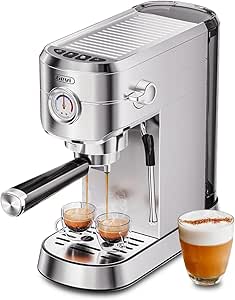 | Best for Narrow Counters | Model: ECMG0 | Operation: Semi-automatic | Pump pressure: 20 bar | VIEW LATEST PRICE | See Our Full Breakdown |
| espresso machines for home barista | Dimensions | Pump pressure | Operation | Weight |
|---|---|---|---|---|
| CASABREWS 3700 Essential Stain | — | 20 bar | — | — |
| AMZCHEF Semi-Automatic Espress | 12.5 × 10.82 × 13.38 inches | — | — | — |
| AERCANA 20 Bar Semi-Automatic | 12.2 × 5.32 × 11.5 inches | 20 bar | — | — |
| CASABREWS CM5418 Compact Espre | — | 20 bar | — | — |
| Breville BES450BSS Bambino Esp | 13.7 × 6.3 × 12 inches | — | — | — |
| 20-Bar Espresso Machine with M | 13.2 x 6.65 x 12 inches | 20 bar | Semi-automatic | 9 pounds |
| De’Longhi Classic Signature Es | 11.22 x 13.98 x 15.94 inches | 15 bar | Fully automatic | 9.3 pounds |
| Breville Barista Pro Espresso | 13 x 14 x 16 inches | — | Manual | 19.5 pounds |
| Breville Barista Touch Espress | 12.7 x 15.5 x 16 inches | — | Semi-automatic | 10.3 kg |
| AMZCHEF Espresso Machine with | 12.5 x 10.4 x 14.75 inches | 20 bar | Semi-automatic | 13 pounds |
| Neretva 20 Bar Espresso Machin | 11 x 12 x 9.1 inches | — | Semi-automatic | 17 pounds |
| De’Longhi La Specialista Touch | — | — | — | — |
| Breville Barista Express Espre | 13.8 x 12.5 x 15.9 inches | — | — | 22.1 pounds |
| Neretva Retro Espresso Machine | 11.5 x 9 x 11.2 inches | 15 bar | Semi-automatic | — |
| Gevi 20 Bar Compact Espresso M | 12.3 x 5.5 x 12 inches | 20 bar | Semi-automatic | 8.6 pounds |
More Details on Our Top Picks
CASABREWS 3700 Essential Stainless Steel Espresso Machine with Steam Wand
The CASABREWS 3700 is a practical fit for home baristas who want to learn espresso basics without adding a built-in grinder to the counter. Its semi-automatic controls leave room to practice dosing and tamping, while the steam wand lets you make milk drinks and work on latte art. Compared with the Breville Bambino, it lacks the Bambino’s three-second heat-up and PID temperature control, but the 3700 includes a larger 43.9-ounce removable tank and one- and two-cup filters. That capacity can mean fewer refills for a household making several drinks a day. The tradeoff is a more hands-on routine: plan for an initial setup cycle, and clean the steam wand after each use. I’d choose it for accessible manual brewing, not for speed or minimal upkeep.
Pros:- Steam wand supports milk frothing and latte-art practice.
- 43.9-ounce removable tank reduces refill frequency.
- Includes one-cup and two-cup brewing filters.
- Removable drip tray makes routine cleanup easier.
Cons:- Requires a first-use cycle before brewing.
- Steam wand needs cleaning after each use.
- No built-in grinder, so whole-bean users need separate equipment.
Best for: New home baristas who already have ground coffee and want a removable tank, a steam wand, and both single- and double-shot filters.
Not ideal for: Buyers who want rapid heat-up, temperature adjustment, or a low-maintenance milk system; the Bambino offers faster warm-up and PID control.
- Operation mode:Semi-automatic
- Pump pressure:20 bar
- Wattage:1350 watts
- Voltage:120 volts
- Water tank capacity:43.9 fluid ounces
- Coffee input:Ground coffee
- Milk frother:Steam wand
- Included filters:One-cup and two-cup brewing filters
Our verdict“Choose the CASABREWS 3700 if you want an approachable manual machine with a relatively large tank and are comfortable handling grind preparation and wand cleanup.”
AMZCHEF Semi-Automatic Espresso Machine with Built-In Grinder
The AMZCHEF suits a home barista who wants more control over coffee preparation without buying a separate grinder. Its 44 grind settings and adjustable 190°F–201°F brewing temperature give more room to tune a shot to different beans than the CASABREWS 3700, which takes ground coffee. Hot and cold brew modes also broaden its use beyond espresso-style drinks, while the 60-ounce tank helps when several people share the machine. The touch screen and descaling function make daily operation more guided, but this remains semi-automatic: grinding and brewing still call for user attention. Its broader feature set also means it is not the simplest choice for someone who only wants a basic espresso-and-milk routine. I’d pick it for variety and adjustability, rather than for the smallest footprint or fewest decisions.
Pros:- 44 grind settings let users adjust coffee preparation across different brewing styles.
- Adjustable brewing temperature supports experimentation with beans and roasts.
- Hot and cold brew modes offer more drink options than espresso alone.
- 60-ounce removable tank and descaling function support shared, regular use.
Cons:- Semi-automatic brewing still requires hands-on preparation and monitoring.
- The 12.5 × 10.82 × 13.38-inch body needs more counter space than narrow machines.
- A 60-ounce tank may still need refilling when making larger batches.
Best for: Home baristas who want an integrated grinder, adjustable brewing temperature, and the option to make both hot and cold drinks.
Not ideal for: Buyers seeking a compact, simple espresso-only setup; the CASABREWS CM5418 has a narrower feature set and a compact stainless-steel design.
- Model:CM1626
- Type:Semi-automatic espresso machine
- Grind settings:44
- Brewing temperature:190°F–201°F
- Water tank capacity:60 ounces
- Steam wand:8 mm stainless steel
- Wattage:1500 watts
- Dimensions:12.5 × 10.82 × 13.38 inches
Our verdict“Pick the AMZCHEF if you want an integrated grinder and broad brewing adjustments, and are willing to manage a more involved semi-automatic workflow.”
AERCANA 20 Bar Semi-Automatic Espresso Machine with Milk Frother (Silver)
The AERCANA is the space-conscious pick for a home barista who wants manual espresso and milk drinks without giving up much counter space. At 5.32 inches wide, it is markedly narrower than the Breville Bambino, though the Bambino counters with a three-second ThermoJet warm-up and PID temperature control. AERCANA’s listed 20-second preheat is still useful for a faster morning routine, and its 1450-watt heating system pairs with a steam wand for microfoam practice. The 34-ounce tank is removable, and the machine also lists a hot-water dispenser and cup warmer. Those features do not remove the manual work: you still need to grind, tamp, and monitor brewing. It also requires a cool-down period between steaming and brewing, so back-to-back milk drinks take more planning.
Pros:- 5.32-inch width fits narrow countertop spaces.
- Listed 20-second preheat helps shorten the wait before brewing.
- Steam wand supports microfoam and latte-art practice.
- Removable tank and drip tray simplify refilling and cleaning.
Cons:- Requires a cool-down period between steaming milk and brewing coffee.
- Semi-automatic operation calls for manual grinding, tamping, and monitoring.
- 34-ounce tank is smaller than the CASABREWS 3700’s 43.9-ounce tank.
Best for: Apartment dwellers and home baristas with narrow counters who want a manual machine, quick preheating, and a steam wand.
Not ideal for: People who regularly make several milk drinks in sequence or want fast switching between brewing and steaming; this model needs a cool-down period after steaming.
- Operation mode:Semi-automatic
- Pump pressure:20 bar
- Wattage:1450 watts
- Preheat time:20 seconds
- Water tank capacity:34 ounces (1 liter)
- Dimensions:12.2 × 5.32 × 11.5 inches
- Coffee input:Ground coffee
- Special features:Auto shut-off, cup warmer, hot-water dispenser, milk frother, removable tank
Our verdict“Choose the AERCANA when counter width and a short warm-up matter more than a larger tank or uninterrupted milk-drink preparation.”
CASABREWS CM5418 Compact Espresso Machine with Milk Frothing Wand
The CM5418 gives a home barista a compact, manual setup with one useful piece of feedback: a built-in pressure gauge for watching extraction pressure. That makes it a more instructive choice than the similarly compact AERCANA if learning to read the brewing process is a priority. Both have 20-bar pumps, steam wands, and 34-ounce removable tanks, but the CM5418’s brushed stainless-steel finish and included one- and two-cup filters make its basic workflow clear. The limitation is that a gauge does not correct grind or tamping; the supplied guidance notes that low pressure may call for finer grounds, more coffee, or firmer tamping. Like the AERCANA, this machine also needs to cool after frothing before brewing, so its small footprint does not mean a quick sequence of milk drinks.
Pros:- Built-in pressure gauge offers visual feedback during extraction.
- Compact brushed stainless-steel design suits home or office counters.
- Removable 34-ounce tank makes refilling easier.
- Includes one-cup and two-cup filters, portafilter, and tamper with spoon.
Cons:- Must cool down after frothing milk before brewing.
- Low pressure may require adjustments to grind size, dose, or tamping.
- Ground-coffee input means whole-bean users need a separate grinder.
Best for: Space-limited beginners who want to learn how grind and tamping affect extraction with help from a pressure gauge.
Not ideal for: Home baristas who frequently switch from steaming to brewing or want temperature and grind controls; the AERCANA adds a listed rapid preheat, while the Bambino offers PID control.
- Model:CM5418
- Machine type:Semi-automatic espresso machine
- Pump pressure:20 bar
- Wattage:1350 watts
- Water tank capacity:34 ounces, removable
- Milk frother:Steam wand
- Material and finish:Brushed stainless steel
- Included components:One-cup filter, two-cup filter, portafilter, tamper with spoon, instruction manual
Our verdict“Choose the CM5418 if you want a compact manual machine that makes extraction pressure visible and can accept its cooling pause and hands-on adjustments.”
Breville BES450BSS Bambino Espresso Machine
The Bambino is the strongest fit here for a home barista who values quick starts and more controlled extraction. Its ThermoJet system reaches extraction temperature in three seconds, while PID control helps manage temperature during brewing—an advantage over the simpler CASABREWS CM5418, which has a pressure gauge but no listed PID control or rapid-heating system. At just 6.3 inches wide, the Bambino also fits a narrow counter, and its 47-ounce tank holds more than the CM5418’s 34 ounces. The tradeoff is that this is still a hands-on machine: the manual steam wand asks for milk-texturing skill, and semi-automatic brewing means grinding and tamping are your job. Its 54 mm portafilter and compact format make it an appealing focused espresso setup, not an all-in-one grinder-and-brewer.
Pros:- Three-second ThermoJet warm-up limits waiting before brewing.
- PID temperature control supports more consistent extraction conditions.
- 6.3-inch width suits narrow counters.
- 47-ounce tank and included milk jug, tamper, and filter baskets support a ready-to-use setup.
Cons:- Manual steam wand requires practice to texture milk well.
- Grinding and tamping remain the user’s responsibility.
- The 47-ounce tank may need refilling during heavier multi-person use.
Best for: Home baristas who want a fast warm-up, temperature control, and a narrow machine for practicing espresso and manual milk texturing.
Not ideal for: Buyers who want a built-in grinder or a more guided milk process; the AMZCHEF includes an integrated grinder and touch screen.
- Model:BES450BSS
- Heating system:ThermoJet
- Heat-up time:3 seconds
- Wattage:1560 watts
- Voltage:110–120 volts
- Dimensions:13.7 × 6.3 × 12 inches
- Water tank capacity:47 fluid ounces
- Portafilter size:54 mm
Our verdict“Choose the Bambino if fast warm-up and temperature control matter more than an integrated grinder or an automated milk routine.”
20-Bar Espresso Machine with Milk Frother and Touchscreen
This machine suits home baristas who want to adjust espresso without starting with an integrated grinder or a more involved control layout. PID temperature control and low-pressure pre-infusion give you tools to support more even extraction, while the touchscreen lets you set coffee volume. Compared with the De’Longhi Classic Signature, it offers more explicit brewing adjustments and a cold brew function; the De’Longhi counters with straightforward single- and double-shot presets. The steam wand opens the door to milk drinks, but this is still a semi-automatic machine, so you remain involved in brewing and frothing. Its 45-ounce tank is also smaller than the 67-ounce tanks on the Breville Barista Pro and Barista Touch, meaning more frequent refills for regular use.
Pros:- PID temperature control and pre-infusion provide useful extraction adjustments.
- Touchscreen allows customizable coffee volume.
- Steam wand supports cappuccinos, lattes, and milk texturing.
- Removable water tank and detachable drip tray simplify refilling and cleanup.
Cons:- Semi-automatic brewing requires the user to stay involved.
- The 45-ounce tank may need frequent refilling with regular use.
Best for: Ground-coffee users who want touchscreen volume control, adjustable extraction features, and the option to make milk drinks or cold brew.
Not ideal for: Households making several drinks a day or buyers who want a built-in grinder; the tank is relatively small and coffee must be supplied pre-ground.
- Operation:Semi-automatic
- Pump pressure:20 bar
- Power:1350 watts
- Water tank:45 fluid ounces, removable
- Coffee input:Ground coffee
- Controls:Touchscreen with customizable coffee volume
- Dimensions:13.2 x 6.65 x 12 inches
- Weight:9 pounds
Our verdict“Choose it if you want touchscreen-controlled adjustments with ground coffee, but skip it if you need a built-in grinder or a larger water reserve.”
De’Longhi Classic Signature Espresso Machine with Adjustable Milk Frother
The De’Longhi Classic Signature favors a quick, repeatable routine over extensive recipe control. One-touch single- and double-shot presets make it easier to get a drink started than with the manual Breville Barista Pro, while its visual pressure gauge gives curious beginners a way to monitor brewing. The adjustable dual-mode frother adds flexibility for different milk textures, and the double-height drip tray accommodates taller cups without making the machine a full-size café setup. Compared with the touchscreen 20-Bar Espresso Machine in this roundup, the De’Longhi has fewer listed customization options and no cold brew function, but its preset-based operation is a better fit for someone who values a simpler workflow. It uses ground coffee rather than a built-in grinder, so fresh grinding requires a separate appliance.
Pros:- One-touch single- and double-espresso presets simplify routine brewing.
- Thermoblock temperature control supports quick, stable brewing.
- Adjustable dual-mode frother handles dairy and plant-based milk.
- Double-height drip tray accommodates a range of cup sizes.
Cons:- Ground-coffee input means a separate grinder is needed for whole beans.
- The listed controls offer less brewing customization than the touchscreen 20-Bar machine.
Best for: New home baristas who want preset single or double espresso, a pressure gauge, and a milk frother without managing an integrated grinder.
Not ideal for: Buyers who want to grind beans inside the machine or closely customize brew volume and extraction settings.
- Operation:Fully automatic
- Pump pressure:15 bar
- Power:1350 watts
- Coffee input:Ground coffee
- Espresso presets:Single and double
- Milk frother:Adjustable dual-mode
- Dimensions:11.22 x 13.98 x 15.94 inches
- Weight:9.3 pounds
Our verdict“Pick the De’Longhi for a preset-led espresso and milk routine, not for integrated grinding or hands-on recipe development.”
Breville Barista Pro Espresso Machine with Grinder, Brushed Stainless Steel
The Barista Pro is the strongest match here for someone who wants to learn the full espresso routine while keeping grinding and brewing in one machine. Its integrated conical burr grinder, PID temperature control, and manual steam wand offer more direct involvement than the touchscreen-led Barista Touch. The ThermoJet system reaches extraction temperature in three seconds, which cuts waiting without removing the hands-on steps that define this pick. Its LCD shows grinding and extraction progress, helping connect adjustments to what the machine is doing. Compared with the AMZCHEF FC3102, the Barista Pro lists more detailed temperature control and a faster stated heat-up, while the AMZCHEF offers a 58mm portafilter and more grind settings. The tradeoff is real: manual dosing, shot control, and milk texturing take practice, and the half-pound hopper can run short for frequent brewing.
Pros:- Integrated precision conical burr grinder supports on-demand grinding.
- ThermoJet heating system reaches extraction temperature in three seconds.
- PID temperature control is specified at +/- 2°C.
- Manual steam wand lets users develop milk-texturing technique.
Cons:- Manual grinding, brewing, and milk texturing require hands-on effort.
- The 1/2-pound bean hopper may need frequent refilling for heavier use.
- At 19.5 pounds, it is heavier than the compact machines in this batch.
Best for: Aspiring home baristas who want an integrated grinder and manual control over espresso and milk texture.
Not ideal for: People who want automated milk texturing or a low-effort drink routine; its manual workflow calls for practice and attention.
- Model:BES878BSS
- Operation:Manual
- Grinder:Integrated precision conical burr
- Heating system:ThermoJet; reaches extraction temperature in 3 seconds
- Temperature control:PID, +/- 2°C
- Water tank:67 ounces
- Bean hopper:1/2 pound
- Dimensions:13 x 14 x 16 inches
- Weight:19.5 pounds
Our verdict“Choose the Barista Pro if learning manual espresso and milk skills matters more than automated convenience.”
Breville Barista Touch Espresso Machine (BES880BSS), Brushed Stainless Steel
The Barista Touch pairs an integrated grinder with a more guided interface, making it the convenience-focused alternative to the manual Barista Pro. Its touchscreen supports saved drink settings, while the automatic microfoam wand handles milk texture with less technique than the Pro’s manual wand. Both models have a grinder and ThermoJet heating with a three-second heat-up, so the choice comes down to how much control you want over milk and workflow: choose the Pro to practice texturing yourself, or the Touch to simplify repeat drinks. The Touch still gives users milk customization, rather than forcing every drink into one preset. Its 67-ounce tank and half-pound hopper support regular use, but the machine needs routine cleaning around the grinder and steam wand. Its footprint and weight also call for a dedicated counter spot.
Pros:- Integrated conical burr grinder provides fresh, on-demand coffee.
- Automatic microfoam wand simplifies milk texturing and customization.
- Touchscreen can save up to eight personalized coffee settings.
- ThermoJet heating system reaches extraction temperature in three seconds.
Cons:- The integrated grinder and steam wand require regular cleaning.
- Its footprint and 10.3 kg weight make it less suited to tight counters.
- The 54mm portafilter may limit compatibility with some third-party accessories.
Best for: Frequent latte and cappuccino drinkers who want an integrated grinder, saved touchscreen drink settings, and less manual milk work.
Not ideal for: Baristas seeking a compact machine or maximum hands-on control of milk texturing; the Touch takes counter space and automates that step.
- Model:BES880BSS
- Operation:Semi-automatic
- Grinder:Integrated conical burr
- Heating system:ThermoJet; 3-second heat-up
- Water tank:67 fluid ounces
- Bean hopper:0.5 pound
- Interface:Touchscreen; saves up to eight personalized settings
- Dimensions:12.7 x 15.5 x 16 inches
- Weight:10.3 kg
Our verdict“Choose the Barista Touch for guided, repeatable espresso and automated milk texturing, and choose the Barista Pro if manual technique is the point.”
AMZCHEF Espresso Machine with Grinder, 1500W, 40 Grind Settings
The AMZCHEF FC3102 gives hands-on home baristas a broad set of grinder adjustments and a 58mm portafilter in one machine. Its 40 grind settings invite more dialing-in than the ground-coffee De’Longhi Classic Signature, and the 1.8-liter tank holds more water than the 45-ounce tank on the touchscreen 20-Bar model. The listed functions also reach beyond espresso: it can prepare cold brew and hot water, and it includes a rotating steam wand for milk drinks. That range makes it a flexible countertop choice, though its semi-automatic workflow means the user still controls dosing, tamping, and extraction. Unlike the brushed stainless Breville Barista Pro, this model has a plastic exterior; buyers choosing on materials may prefer the Breville, while those prioritizing 58mm equipment and multiple drink functions may favor AMZCHEF.
Pros:- Built-in 40-setting conical burr grinder offers a wide range of grind adjustments.
- 58mm portafilter and adjustable temperature support hands-on brewing control.
- Makes espresso, cold brew, hot water, and milk-based drinks.
- Removable components and a 1.8-liter tank support routine use and cleaning.
Cons:- Plastic exterior may disappoint buyers seeking a predominantly metal build.
- Semi-automatic operation leaves dose, tamp, and extraction control to the user.
- Its 13-pound weight and countertop dimensions need dedicated space.
Best for: Home baristas who want a built-in grinder with many adjustment steps, a 58mm portafilter, and options beyond espresso.
Not ideal for: Buyers who prefer a metal exterior or want the machine to automate dosing, tamping, and extraction.
- Model:FC3102
- Operation:Semi-automatic
- Grinder:40 settings, 40mm conical burr
- Portafilter:58mm
- Power:1500 watts
- Water tank:1.8 liters
- Pump pressure:20 bar
- Dimensions:12.5 x 10.4 x 14.75 inches
- Weight:13 pounds
Our verdict“Pick the AMZCHEF if grinder range, a 58mm portafilter, and drink variety outrank a metal exterior or automated brewing.”
Neretva 20 Bar Espresso Machine
The Neretva pairs a compact stainless steel body with useful brewing controls, making it a practical choice for a home barista who wants room to learn without a built-in grinder taking up counter space. Its pre-infusion and temperature control give you more say over extraction than a basic entry-level machine, while the LED display helps keep brewing and steaming settings visible. Compared with the Gevi 20 Bar Compact Espresso Machine, it has a larger water tank, but it is also substantially heavier and wider. The tradeoff is hands-on preparation: you supply ground coffee and manage dosing, tamping, and milk texturing yourself. Its pressurized filters offer a more forgiving starting point, though they provide less control than the non-pressurized setup on the Neretva Retro Espresso Machine.
Pros:- Pre-infusion and temperature control support more consistent brewing.
- LED display makes brewing and steaming settings easier to monitor.
- 1.31-liter removable tank reduces refill interruptions compared with the Gevi compact model.
- Pressurized filters offer a more forgiving option for ground-coffee beginners.
Cons:- No built-in grinder, so fresh-bean preparation requires separate equipment.
- At 17 pounds, it is heavy for a compact machine.
- Manual dosing, tamping, and frothing require practice and attention.
Best for: Home baristas with limited counter space who want temperature feedback, pre-infusion, and a larger tank than the Gevi compact model.
Not ideal for: Buyers seeking an all-in-one grinder and automatic milk preparation, or anyone who needs a lightweight machine they can move often.
- Operation:Semi-automatic
- Pressure:20 bar
- Power:1350 watts
- Water tank:1.31 liters, removable
- Dimensions:11 x 12 x 9.1 inches
- Weight:17 pounds
- Material:Stainless steel
- Coffee input and filters:Ground coffee; reusable filters, including two pressurized filters
Our verdict“Choose the Neretva if you want guided temperature control and a relatively generous tank in a compact manual setup, and skip it if you expect automation or a built-in grinder.”
De’Longhi La Specialista Touch Espresso Machine with Coffee Grinder
The La Specialista Touch is the most guided and recipe-oriented option in this group: its integrated conical burr grinder and touch display bring grinding, dosing, brewing, and milk preparation into one workflow. That makes it a more self-contained choice than the Breville Barista Express, which also has a grinder but leans more heavily on manual technique. Ten presets, saved bean profiles, and adjustable milk settings give experienced home baristas room to tailor drinks while reducing guesswork between steps. Its cold-extraction feature also broadens the menu beyond espresso and hot milk drinks. The tradeoff is a more involved interface and a learning curve for buyers who want simple controls. Compared with the Neretva 20 Bar Espresso Machine, this De’Longhi takes up a more feature-rich role, but its guidance does not remove the need for user involvement in a semi-automatic workflow.
Pros:- Integrated conical burr grinder with 15 grind settings keeps bean-to-shot preparation together.
- Touch display guides users through grinding, dosing, brewing, and frothing.
- Ten preset recipes and saved bean profiles support repeatable drink customization.
- Adjustable automatic milk frothing and cold-extraction capability expand drink options.
Cons:- The many settings and guided features can create a steeper learning curve than the Neretva machines.
- Semi-automatic operation still calls for user participation rather than push-button preparation.
- Integrated grinder and touch controls make this a more feature-dependent choice than a simpler manual machine.
Best for: Home baristas who want an integrated grinder, guided espresso preparation, adjustable milk drinks, and several recipes in one machine.
Not ideal for: Minimalists who prefer straightforward manual controls, or beginners who may find multiple profiles and settings distracting.
- Type:Semi-automatic espresso machine
- Grinder:Italian-made conical burr grinder
- Grind settings:15
- Display:3.5-inch high-resolution touch display
- Preset recipes:10
- Milk settings:5 frothing levels and 4 temperature settings
- Pre-infusion temperatures:4
- Saved bean profiles:6
Our verdict“Pick the La Specialista Touch if you want a guided all-in-one workflow and varied drink settings, but choose a simpler machine if you value a short learning curve.”
Breville Barista Express Espresso Machine with Built-In Grinder, Brushed Stainless Steel
The Barista Express suits a home barista who wants to control the steps between whole beans and finished espresso without buying a separate grinder. Its integrated conical burr grinder doses into the portafilter, while PID temperature control and low-pressure pre-infusion support a more deliberate approach to extraction. The manual steam wand also gives you room to practice microfoam rather than relying on automatic milk settings. Compared with the De’Longhi La Specialista Touch, the Breville offers a more direct, less screen-led routine, but it lacks that model’s guided recipes and adjustable automatic frothing. Its 67-ounce tank is larger than the Neretva 20 Bar’s, though the 22.1-pound body and manual workflow are not especially convenient for quick, unattended drinks. This is a skill-building machine, not a shortcut to them.
Pros:- Integrated grinder delivers fresh grounds directly into the portafilter.
- PID temperature control and low-pressure pre-infusion support controlled extraction.
- Manual steam wand allows practice making microfoam for milk drinks.
- 67-ounce water tank supports more brewing between refills than the Neretva 20 Bar.
Cons:- Manual grinding, extraction, and milk texturing require more time and skill than the De’Longhi La Specialista Touch workflow.
- At 22.1 pounds, it is a substantial machine to move or store.
- The half-pound hopper and 67-ounce tank still need periodic refilling.
Best for: Home baristas who want to learn grinding, extraction, and milk texturing on an integrated-grinder machine.
Not ideal for: Buyers who want guided touchscreen recipes, automatic milk frothing, or a lightweight machine for a small or frequently rearranged counter.
- Type:Manual espresso machine
- Grinder:Integrated precision conical burr grinder
- Water tank:67 ounces
- Bean hopper:1/2 pound
- Power:1600 watts
- Dimensions:13.8 x 12.5 x 15.9 inches
- Weight:22.1 pounds
- Warranty:1-year limited
Our verdict“Choose the Barista Express if learning the full espresso workflow matters more than automation, and favor the De’Longhi if guided preparation and milk settings matter more.”
Neretva Retro Espresso Machine with 58 mm Portafilter, Green
The Retro stands apart from the pressurized-filter Neretva 20 Bar: it uses a 58 mm portafilter and non-pressurized filters, giving a home barista more direct control over how grind size, dose, and tamp affect the shot. A visible pressure gauge and temperature display make those variables easier to follow, while pre-infusion and the 198°F setting provide a defined starting point for dialing in. Compared with the Gevi 20 Bar Compact Espresso Machine, this model is less focused on squeezing into a narrow counter footprint and more focused on a traditional espresso workflow. It also includes a pitcher and dosing ring, useful additions for milk drinks and cleaner puck preparation. The tradeoff is that it expects suitable ground coffee and careful preparation; poor grind or tamp choices can show up in the pressure and the cup. It is less forgiving than the other Neretva listed here.
Pros:- 58 mm portafilter and non-pressurized filters allow direct control over extraction variables.
- Pressure gauge and temperature display provide useful feedback while dialing in.
- Pre-infusion and 198°F temperature control offer a defined brewing setup.
- Included dosing ring, tamper, and milk pitcher support espresso and milk-drink preparation.
Cons:- Requires careful control of grind size, dose, and tamping to manage brewing pressure.
- Uses ground coffee and has no built-in grinder.
- Less forgiving than the Neretva 20 Bar with pressurized filters.
Best for: Home baristas who already have a capable grinder and want a 58 mm portafilter with non-pressurized baskets for dialing in shots.
Not ideal for: Beginners using inconsistent pre-ground coffee, or buyers who prefer pressurized filters and a more forgiving setup.
- Operation:Semi-automatic
- Pump pressure:15 bar
- Temperature control:198°F
- Power:1450 watts
- Capacity:1.8 liters
- Dimensions:11.5 x 9 x 11.2 inches
- Portafilter:58 mm
- Coffee input and filters:Ground coffee; non-pressurized filters
Our verdict“Choose the Retro if you want traditional 58 mm, non-pressurized brewing and already have a suitable grinder; skip it if you need forgiving filters or built-in grinding.”
Gevi 20 Bar Compact Espresso Machine with Milk Frother
At just 5.5 inches wide, the Gevi is the clearest fit here for kitchens where counter width is the main constraint. It still provides a steam wand, pre-infusion, temperature control, and a hot-water function, so the small footprint does not restrict it to espresso alone. Compared with the Neretva 20 Bar Espresso Machine, it gives up tank capacity and some heft but is far easier to fit into a tight space; at 8.6 pounds, it is also much easier to reposition than the 17-pound Neretva. The tradeoff is practical capacity: its 34-ounce tank and compact format are better suited to one or two drink makers than a busy household. Like the Neretva, it requires ground coffee and manual work at the portafilter and steam wand. This is a space-first choice, not an all-in-one barista station.
Pros:- 5.5-inch width fits narrower spaces than the Neretva 20 Bar.
- Light 8.6-pound body is easier to move than the heavier Neretva model.
- Pre-infusion and NTC temperature control provide brewing feedback in a compact machine.
- Hot-water function adds support for Americanos and tea.
Cons:- The 34-ounce tank needs frequent refilling when several people use the machine.
- Compact size limits its suitability for repeated drink preparation.
- Ground coffee and manual operation leave grinding, dosing, tamping, and frothing to the user.
Best for: Apartment dwellers, office users, and solo home baristas who need espresso and milk-drink functions in a narrow counter footprint.
Not ideal for: Households making several drinks back to back, or buyers who want a large tank or integrated grinder.
- Model:ECMG0
- Operation:Semi-automatic
- Pump pressure:20 bar
- Power:1350 watts
- Water tank:34 ounces (1 liter)
- Dimensions:12.3 x 5.5 x 12 inches
- Weight:8.6 pounds
- Coffee input:Ground coffee
Our verdict“Pick the Gevi when counter width and easy repositioning matter most, but choose the larger Neretva if you need fewer refills.”
How We Picked
I ranked these machines for home-barista use, not just basic coffee making. My criteria include control over grinding and extraction, ease of dialing in, milk-frothing capability, day-to-day usability, build and footprint, and the maintenance burden of the machine and grinder. I also looked at whether a machine’s features meaningfully help a buyer make espresso or mainly add convenience.
The ranking favors options that balance meaningful control with a workable home routine. That puts the Breville Barista Pro ahead as an all-around choice, while the Bambino earns its place for buyers who value compactness and a simpler machine. Grinder-equipped and touchscreen models rank well for specific workflows, but they are not automatically better for every barista. The more basic compact machines remain relevant for entry-level needs, though they offer fewer reasons for an experienced hobbyist to choose them over the more capable picks.
| espresso machines for home barista | Operation |
|---|---|
| CASABREWS 3700 Essential Stain | — |
| AMZCHEF Semi-Automatic Espress | — |
| AERCANA 20 Bar Semi-Automatic | — |
| CASABREWS CM5418 Compact Espre | — |
| Breville BES450BSS Bambino Esp | — |
| 20-Bar Espresso Machine with M | Semi-automatic |
| De’Longhi Classic Signature Es | Fully automatic |
| Breville Barista Pro Espresso | Manual |
| Breville Barista Touch Espress | Semi-automatic |
| AMZCHEF Espresso Machine with | Semi-automatic |
| Neretva 20 Bar Espresso Machin | Semi-automatic |
| De’Longhi La Specialista Touch | — |
| Breville Barista Express Espre | — |
| Neretva Retro Espresso Machine | Semi-automatic |
| Gevi 20 Bar Compact Espresso M | Semi-automatic |
Factors to Consider When Choosing Espresso Machines For Home Baristas
Before choosing a machine, I’d match its workflow to the way you want to make coffee. A long feature list can hide the practical differences: whether you need a grinder, how much manual control you want, and whether you have room for the machine and its accessories.
Decide Whether You Want a Built-In Grinder
A built-in grinder can reduce countertop clutter and make the path from whole beans to espresso more direct. It also ties two pieces of equipment into one purchase, which means grinder adjustments, cleaning, or a grinder issue can affect the whole setup. A separate grinder gives you more freedom to change or upgrade that part later, but takes more room and adds another decision. Avoid choosing an integrated grinder solely because it sounds convenient; check whether its adjustment range and controls fit the degree of dialing-in you want. If you already own a capable grinder, a machine without one may be the cleaner choice.
Match the Controls to Your Learning Style
Manual controls give you more direct involvement in preparation, which can be rewarding if you want to adjust your routine and learn how changes affect the cup. Guided controls and touchscreens can make repeated drinks simpler, especially when more than one person uses the machine. Neither approach guarantees better espresso, so choose based on how much interaction you want rather than how advanced a control panel appears. A common mistake is buying for the most automated workflow and then finding that it limits the adjustments you hoped to make. Compare the Barista Pro’s hands-on direction with touchscreen-led options such as the Barista Touch before deciding.
Think Beyond the Machine About Counter Space
The machine’s footprint is only part of the space required for a home-barista setup. A separate grinder, scale, knock box, milk pitcher, and room to work can take up more space than expected. Compact models such as the Bambino or smaller CASABREWS options may leave more usable counter area, while an integrated grinder can reduce the number of separate appliances. Measure both the available surface and the clearance needed to fill the water tank or handle accessories. If the machine will live under cabinets, check its height and the access needed for routine tasks before settling on a design.
Choose a Milk Workflow You Will Actually Use
A steam wand suits buyers who want to heat and texture milk themselves, but it adds a skill to learn and a part to clean after use. If you mainly drink straight espresso or americanos, paying extra attention to milk features may not improve your daily routine. For frequent milk drinks, think about how easily you can position a pitcher, control the wand, and clean the machine between drinks. A guided milk feature may appeal to households that prefer repeatable steps, while a manual wand offers more direct control. Do not treat the presence of a frother as proof that every machine supports the same style of milk preparation.
Plan for Cleaning and Regular Upkeep
Espresso preparation creates routine work: grounds need clearing, brewing parts need rinsing, and milk-contact parts need prompt cleaning. Grinder-equipped machines add another area that may need attention, so convenience at the start of the routine can come with upkeep later. Check how accessible the water tank, drip tray, and removable parts are before choosing a machine for daily use. A model that is easy to clean can be a better household fit than one with extra features that rarely get used. Make room in your routine for maintenance rather than treating it as an occasional task.
Pay for Control or Convenience You Will Use
Spending more makes sense when the additional features match your regular habits, such as an integrated grinder, guided drink preparation, or a workflow suited to frequent milk drinks. It is less compelling when the added controls duplicate equipment you already own or make simple drinks slower. Compare the cost of a machine with grinder against a machine plus a separate grinder, while weighing flexibility and counter space alongside the total outlay. A newcomer may prefer a straightforward setup and add equipment as skills develop; an experienced hobbyist may value adjustment options from the start. Rank your priorities before comparing feature lists so convenience does not crowd out the control you actually want.
Frequently Asked Questions
Is a built-in grinder better for a first home espresso setup?
It can be a convenient way to keep the setup compact and reduce the number of separate purchases. But a built-in grinder is not automatically the right choice if you already own one or want to choose grinder equipment separately. Compare how its adjustment controls fit your learning goals, and remember that cleaning the grinder becomes part of machine upkeep. The Breville Barista Pro and the grinder-equipped AMZCHEF models show why this choice is about workflow, not simply feature count. Choose integrated grinding for convenience; choose a separate grinder when flexibility matters more.
Should I choose a touchscreen machine or manual controls?
A touchscreen can make guided steps and repeated preparation easier, which may suit a shared household or someone who prefers a more assisted routine. Manual controls offer a more direct role in preparation and may appeal if learning and adjusting espresso is part of the hobby. Consider whether you want the machine to guide decisions or leave more of them to you. The Barista Touch and La Specialista Touch represent the guided side of this lineup, while the Barista Pro favors a more hands-on style. The best fit depends on the experience you want at the counter, not the appearance of the controls.
Can a compact machine still suit a home barista?
Yes, compact size can be a sensible choice when counter space is limited or when you want a less involved setup. The tradeoff is that you may have fewer integrated features, and adding a separate grinder can use some of the space you saved. Think about the whole workflow rather than the machine alone: room for beans, tools, milk, and cleanup matters too. The Bambino is a standout compact option in this group, while the Barista Pro puts more equipment into one footprint. Measure your workspace and decide which parts of the setup you want on the counter.
Does a higher bar-pressure number mean better espresso?
No single pressure figure tells you whether a machine is the right choice for your routine or how much control it gives you. A large number on a product listing does not replace a useful grinder, consistent preparation, or controls that suit the user. Several machines in this roundup advertise 20-bar pressure, but their roles still differ by size, features, and intended workflow. Compare the full design rather than using pressure as the deciding specification. For a home barista, practical control and fit can matter more than the headline figure.
When is it worth choosing a machine with guided milk preparation?
Guided milk preparation may be worthwhile if milk drinks are frequent and you want a more assisted routine, particularly in a household where several people use the machine. If you mainly drink espresso without milk, those features may add little to your daily experience. A manual steam wand can offer more direct involvement but asks you to learn milk texturing and clean the wand after use. Compare your usual drinks and the level of participation you want before paying for added guidance. The touchscreen options in this lineup are worth a closer look for buyers who prioritize assisted preparation.
Conclusion
For the best overall balance, I’d choose the Breville Barista Pro for its built-in grinder and hands-on workflow. The best value in practical simplicity is the Breville Bambino for buyers who want a compact machine and are comfortable choosing a grinder separately; it is also my pick for beginners who want room to learn without starting with a more elaborate setup. For a best premium, guided experience, consider the Breville Barista Touch or De’Longhi La Specialista Touch, depending on the controls and preparation style you prefer. For buyers with limited counter space, focus on the Bambino or compact CASABREWS models; for an integrated grinder at the center of the setup, compare the Barista Pro, Barista Express, and AMZCHEF grinder-equipped options. I’d make the final choice by weighing control, footprint, and upkeep against the features you will use every day.