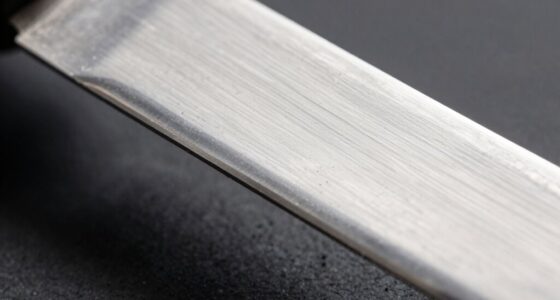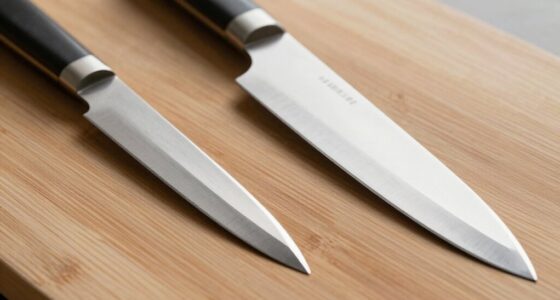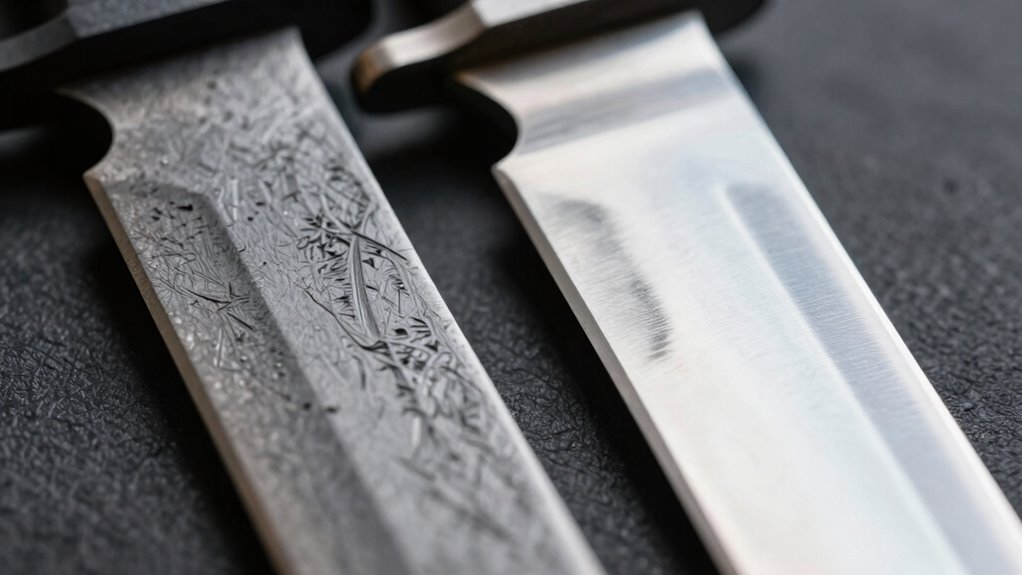

In knife design, toughness and hardness often oppose each other because increasing one usually weakens the other. A harder blade can hold its edge longer but becomes more brittle and prone to breaking—less tough. Conversely, a tough blade absorbs impacts well but may not stay sharp as long. Balancing these properties is essential for ideal performance, and understanding how manufacturers manage this trade-off can help you choose the right knife for your needs. Keep exploring to learn more.

Get kitchen gear delivered free — and shop member deals
- Fast, free delivery on millions of items
- Access to Prime Big Deal Days deals on October 6–7
- Prime Video, Amazon Music and more included
Key Takeaways
- Increasing hardness improves edge retention but makes the blade more brittle, reducing toughness.
- Enhancing toughness allows better impact resistance but often results in a softer edge.
- Material selection and heat treatment must balance the conflicting demands of toughness and hardness.
- Harder blades tend to chip or crack more easily under stress, compromising durability.
- Achieving an optimal balance depends on the knife’s intended use and handling conditions.
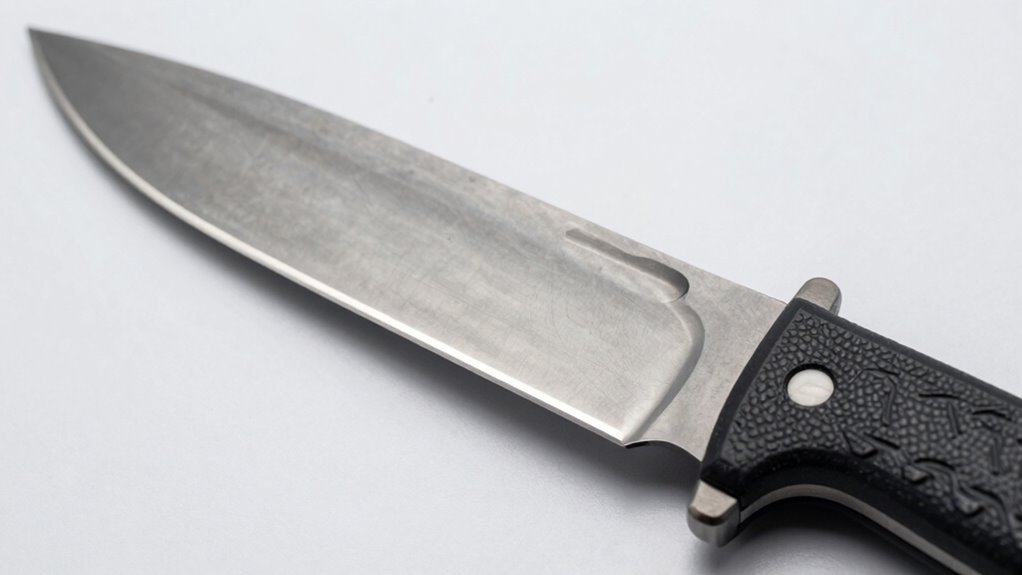
When choosing a knife, understanding the balance between toughness and hardness is essential, because these properties directly impact performance and durability. Toughness refers to the blade’s ability to absorb impacts without breaking, while hardness determines how well the edge retains its sharpness over time. Striking the right balance can be challenging, as improving one often compromises the other. For example, a very hard blade can hold a razor-sharp edge longer but might become brittle, making it more prone to chipping or breaking under stress. Conversely, a tougher blade can withstand rough handling but may require more frequent sharpening to maintain an effective cutting edge. Achieving the right balance often involves considering material properties and how they influence both toughness and hardness. Blade aesthetics also come into play when weighing toughness against hardness. Some manufacturers prioritize a polished, visually appealing finish, which can involve specific manufacturing techniques and surface treatments. Achieving a sleek, high-quality look might increase manufacturing costs but can also influence the choice of materials and heat treatment processes. A well-crafted aesthetic can enhance the overall perception of the knife, appealing to collectors and enthusiasts who value both form and function. However, focusing too much on aesthetics without considering the underlying material properties could compromise the blade’s performance, especially if the surface finish affects the blade’s toughness or resistance to corrosion. Additionally, understanding material selection is crucial for balancing these properties effectively. The heat treatment process, which involves controlled heating and cooling, plays a significant role in developing the desired hardness and toughness in the blade. Proper heat treatment can also help mitigate issues like warping or uneven hardness, which are critical for consistent performance. Manufacturing costs are directly impacted by the choice of materials and the complexity of heat treatments needed to optimize hardness and toughness. High-quality steels with added alloying elements tend to be more expensive but can deliver a better balance of durability and edge retention. Achieving the desired hardness usually requires precise heat treatment, which adds to manufacturing complexity and costs. On the other hand, cheaper steels or simplified production processes might reduce costs but often result in blades that are either too brittle or too soft. This trade-off becomes more evident in mass production, where cost efficiencies can limit the ability to optimize the toughness-hardness balance without sacrificing quality. It is also important to recognize that manufacturing techniques can significantly influence the final properties of the blade, making the choice of production methods an integral part of the design process. Ultimately, your decision hinges on how you plan to use the knife. If you need a tool that can withstand heavy-duty tasks and rough handling, prioritizing toughness makes sense, even if it means sacrificing some edge retention. For precision cutting and slicing, a harder blade that maintains a sharp edge longer might be preferable, despite being more fragile. Understanding these trade-offs helps you select a knife that aligns with your needs, ensuring you get a durable, functional, and visually appealing tool without overspending on unnecessary manufacturing costs.
As an affiliate, we earn on qualifying purchases.
Frequently Asked Questions
How Does Temperature Affect Toughness and Hardness in Knife Steels?
Temperature considerably impacts toughness and hardness in knife steels through microstructure evolution and tempering effects. When you increase temperature during heat treatment, it promotes microstructure changes like carbide precipitation, which can soften the steel, boosting toughness. Conversely, high temperatures can reduce hardness. Proper tempering balances these effects, ensuring your knife remains durable yet resilient. Understanding these processes helps you optimize heat treatment for the perfect blend of toughness and hardness.
Can a Knife Be Both Extremely Tough and Hard Simultaneously?
Yes, you can have a knife that’s both tough and hard, but it’s a balancing act. For example, some high-end steels like S35VN offer excellent edge retention and corrosion resistance while maintaining impressive toughness. Achieving this balance means your knife can stay sharp longer and resist chipping or breaking. Manufacturers optimize heat treatments and alloy compositions to maximize both qualities, so your knife performs reliably in tough and demanding tasks.
What Role Do Alloying Elements Play in Toughness and Hardness?
Alloying elements considerably influence a knife’s toughness and hardness through microstructure control and alloy composition. For example, adding carbon increases hardness, while elements like nickel or molybdenum enhance toughness by refining the microstructure. You should consider how different alloy compositions affect grain size and phase distribution, as these factors determine whether your knife will prioritize durability or edge retention. Balancing alloying elements allows you to optimize both properties effectively.
How Do Manufacturing Processes Influence the Toughness-Hardness Balance?
You can sway the toughness-hardness balance by carefully controlling manufacturing processes. Heat treatment, for example, refines grain size, which directly impacts both properties. Properly tempered steel gets you a tougher blade, while over-hardening makes it brittle. Think of it as walking a tightrope—adjusting heat treatment and controlling grain size allows you to fine-tune the balance, ensuring your knife is both durable and resilient.
Are There Specific Blades Designed to Optimize Both Toughness and Hardness?
Yes, some blades are specifically designed to optimize both toughness and hardness. You’ll find that optimized blade geometry and advanced heat treatments help balance these qualities, enhancing edge retention without sacrificing durability. For example, a well-designed blade with a reinforced spine and a thin, sharp edge can maintain toughness during heavy use while offering excellent hardness for edge retention. This careful engineering allows you to enjoy a versatile, long-lasting knife.
As an affiliate, we earn on qualifying purchases.
Conclusion
In the end, balancing toughness and hardness in knife design is like walking a tightrope—you need both to succeed. If you focus only on hardness, your blade might shatter when it counts most. Go too far on toughness, and your edge could dull quickly. Remember, you can’t have your cake and eat it too, but with careful design, you can get close enough to make a knife that’s tough enough to last and hard enough to cut.
heat treated Japanese chef knife
As an affiliate, we earn on qualifying purchases.
As an affiliate, we earn on qualifying purchases.
As an affiliate, we earn on qualifying purchases.
Fall Picks
fall essentials
As an affiliate, we earn on qualifying purchases.