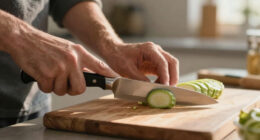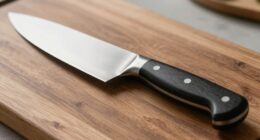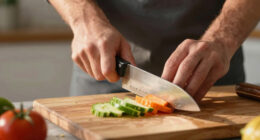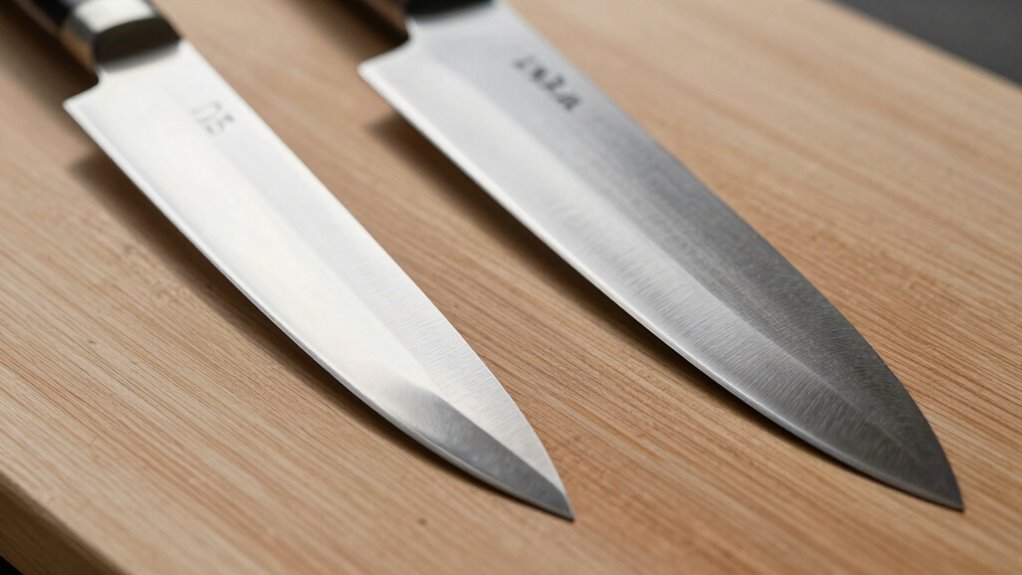
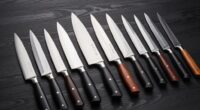
Japanese and German knives differ in blade thickness, balance, and curvature, which influence how they feel and perform in your hand. Japanese blades are thinner, lighter, and often straighter, providing precise control and a balanced, nimble feel suited for delicate tasks. German blades are thicker, heavier, and curved, offering more stability and power for chopping and heavy-duty work. To understand how these design choices affect your cutting style, keep exploring how each style impacts your kitchen performance.
Key Takeaways
- Japanese blades are thinner and lighter, providing a balanced, agile feel for precise, delicate cuts.
- German blades are thicker and heavier, offering stability and a more forceful cutting experience.
- The straight Japanese profile enhances control for downward slicing, while curved German blades facilitate rocking and volume chopping.
- Blade geometry influences the overall balance, with Japanese knives favoring nimbleness and German knives emphasizing robustness.
- The bevel design and curvature shape the cutting feel, affecting how force is distributed and how the knife responds during different tasks.
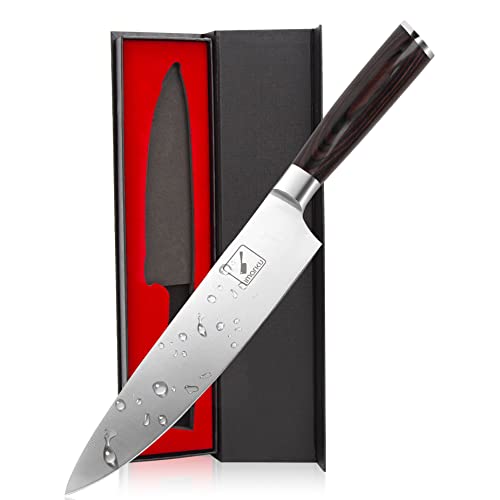
imarku Japanese Chef Knife – Sharp Kitchen Knife 8 Inch Chef's Knives HC Steel Paring Knife, Unique Gifts for Men and Women, Gifts for Mom or Dad, Kitchen Gadgets with Gift Box, Gyutou Knives
High-Carbon Stainless Steel Blade: It is manufactured from high-quality stainless steel that maintains its functionality for a long…
As an affiliate, we earn on qualifying purchases.
As an affiliate, we earn on qualifying purchases.
Differences in Blade Thickness and Material Strength
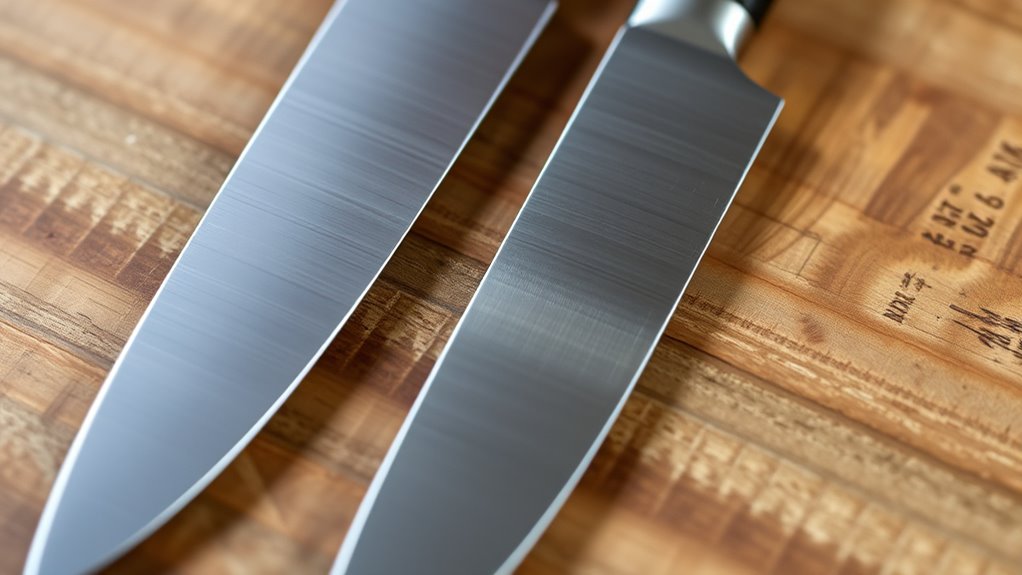
Japanese knives typically have thinner blades than their German counterparts, which allows for more precise slicing and reduces overall weight. This thinner profile means you can make delicate cuts with less effort, giving you greater control. Japanese blades are often made from harder steel, with Rockwell hardness levels around 60-66, enabling a sharper edge that stays longer. Conversely, German knives feature thicker blades, prioritizing strength and durability to handle heavy-duty tasks like chopping bones or dense vegetables. The increased thickness provides more resistance to bending or chipping under pressure. While Japanese blades focus on finesse and precise cuts, German blades emphasize robustness and resilience. The material choices and blade thickness directly influence each style’s performance, shaping how you handle different kitchen tasks efficiently. Additionally, blade geometry plays a crucial role in determining cutting feel and balance, influencing how comfortable and effective the knife is during extended use. A well-designed blade profile enhances cutting efficiency and user comfort, making it a vital factor in choosing the right knife for your needs.

MOSFiATA 8" Super Sharp Professional Chef's Knife with Finger Guard and Knife Sharpener, German High Carbon Stainless Steel EN1.4116 with Micarta Handle and Gift Box
【High Carbon German Stainless Steel Laser-engraved Pattern(Not Damascus Pattern )】 MOSFiATA 8 inch pro chef's knife is made…
As an affiliate, we earn on qualifying purchases.
As an affiliate, we earn on qualifying purchases.
Impact of Bevel Design on Cutting Precision and Technique
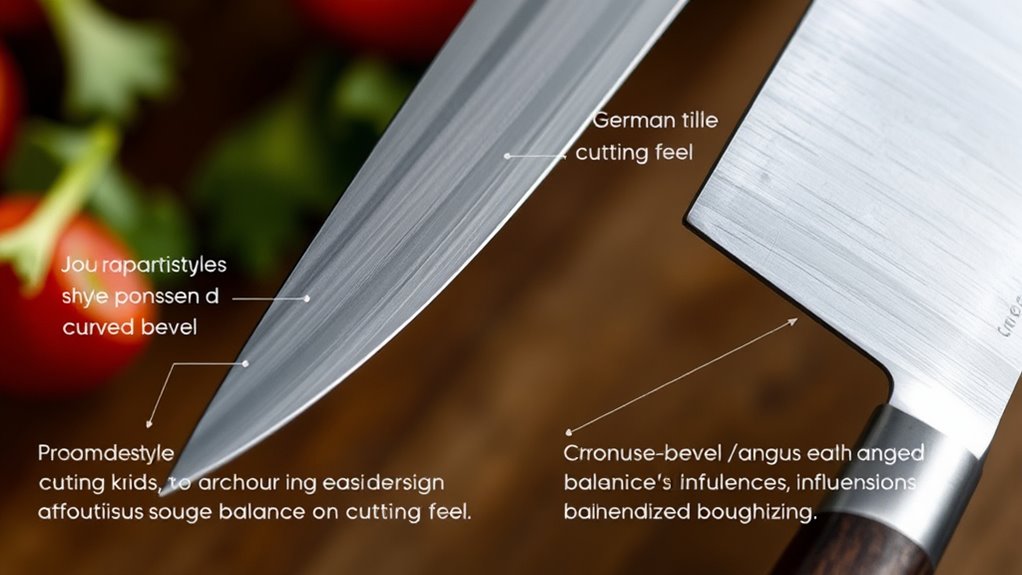
The bevel design of a knife substantially influences your cutting precision and technique. A Japanese single bevel or small double bevel creates a sharper, more precise edge, allowing you to make delicate, controlled cuts. This design concentrates force on a narrow edge, reducing resistance and enabling cleaner slices, especially for intricate tasks like sashimi or garnishing. In contrast, German knives use larger-angle double bevels, resulting in a more durable edge that handles rougher tasks but may sacrifice some finesse. The wider bevel angles increase stability and strength, making it easier to maintain control during heavy-duty chopping. Your technique adapts to these differences: Japanese bevels demand careful, precise strokes, while German bevels support more forceful, versatile movements. European innovation in knife design emphasizes durability and ergonomic balance, influencing how these styles are crafted for different culinary needs.

Lucky Cook 10” Sashimi Sushi Knife – Ultra Sharp Traditional Japanese Sushi Knife for Sashimi, Fish Filleting & Precision Slicing – Premium Stainless Steel Blade, Pakkawood Handle & Gift Box
✅ Razor-Sharp Japanese Edge – Handcrafted for extreme precision; cuts through fish, meat, and vegetables like silk.
As an affiliate, we earn on qualifying purchases.
As an affiliate, we earn on qualifying purchases.
How Edge Angles Influence Sharpness and Durability
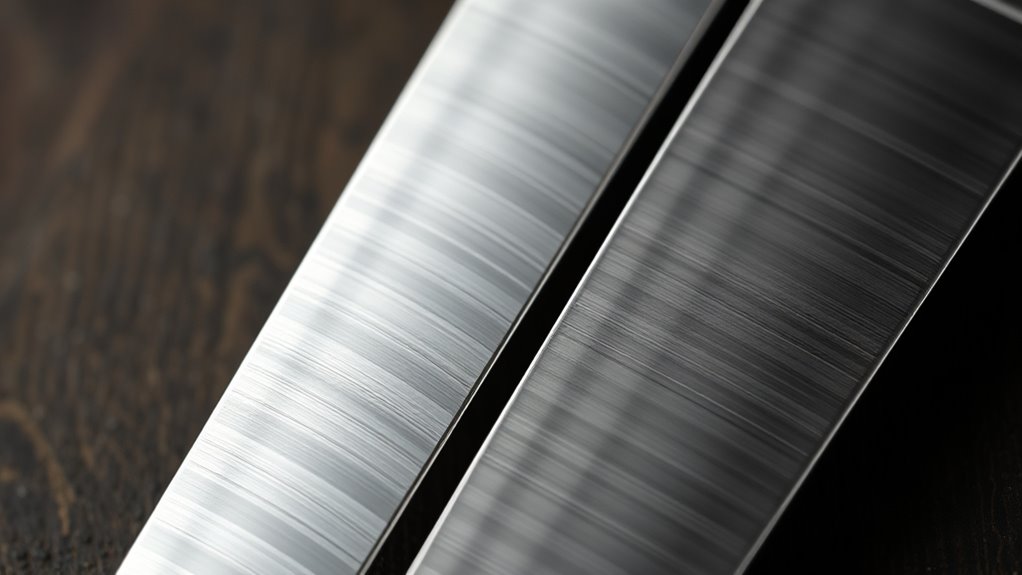
Edge angles directly impact how sharp your knife feels and how long that sharpness lasts. Smaller angles create a finer edge, making cuts smoother and more precise. However, these edges are more fragile and prone to dulling quickly. Larger angles, on the other hand, provide greater durability but sacrifice some sharpness. The table below highlights this balance:
| Edge Angle (degrees) | Sharpness | Durability | Best Use |
|---|---|---|---|
| 10-15 | Very sharp | Less durable | Fine slicing, delicate tasks |
| 17.5-20 | Sharp | More durable | General use, harder materials |
| 7-8 (Japanese) | Extremely sharp | Least durable | Precision cuts, sashimi |
| 10-17.5 (German) | Sharp, balanced | Durable | Versatile chopping |
| >20 | Less sharp | Very durable | Heavy-duty, tough ingredients |
Additionally, understanding blade geometry can help you select the right edge angle to match your specific needs and improve overall cutting performance. Recognizing the impact of edge angles on performance allows for more informed choices tailored to different tasks and preferences. Moreover, edge maintenance plays a crucial role in preserving your knife’s sharpness over time. Proper care and sharpening techniques are essential in maintaining the intended characteristics of various blade styles for optimal results.
MOSFiATA 8" Super Sharp Professional Chef's Knife with Finger Guard and Knife Sharpener, German High Carbon Stainless Steel EN1.4116 with Micarta Handle and Gift Box
【High Carbon German Stainless Steel Laser-engraved Pattern(Not Damascus Pattern )】 MOSFiATA 8 inch pro chef's knife is made…
As an affiliate, we earn on qualifying purchases.
As an affiliate, we earn on qualifying purchases.
The Role of Blade Curvature in Cutting Styles and Control
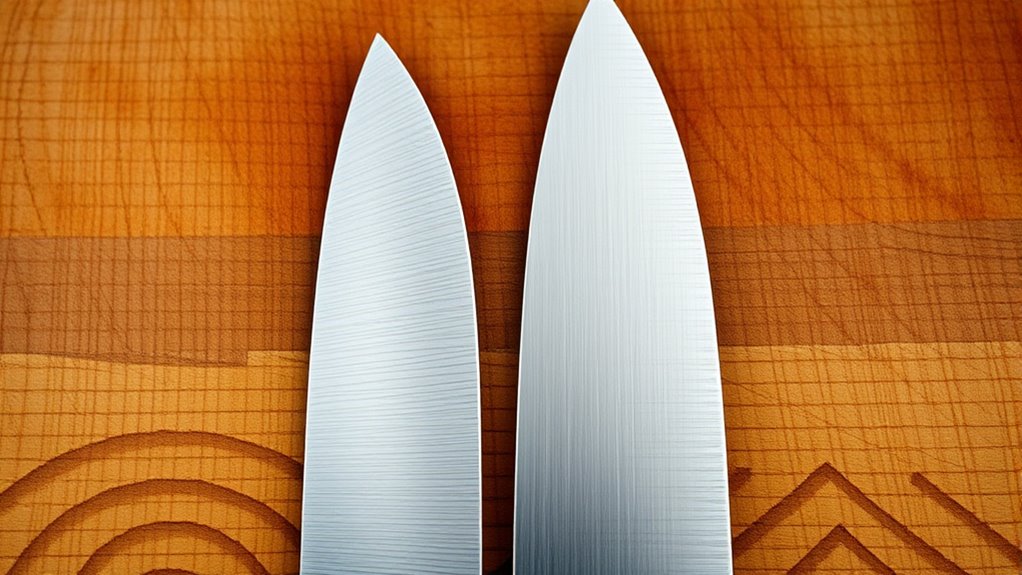
Your choice of blade curvature directly affects your cutting motion, control, and stability. A straighter edge offers more precision for push and tip cuts, while a curved profile enhances rocking and volume tasks. Understanding these differences helps you select the right blade for your specific tasks and control preferences. Additionally, considering surface finishes and materials can optimize your cutting technique to achieve the best results.
Impact on Cutting Motion
Blade curvature considerably influences cutting motion and control, shaping how you approach different tasks in the kitchen. With a straighter Japanese blade, you’ll find it easier to make precise, downward pushes, ideal for slicing thin fish or vegetables. This design encourages a straightforward, controlled motion, reducing the need for rocking or sweeping. In contrast, German blades with a pronounced curve enable a natural rocking motion, making it easier to chop and mince efficiently. The curved profile allows you to leverage the full length of the blade, increasing power and speed during volume cuts. Your choice impacts your technique: a straighter blade supports delicate, precise cuts, while a curved blade enhances versatility and momentum in more robust chopping tasks. Ultimately, the curvature guides your motion and influences your control.
Control and Stability Factors
The curvature of a knife substantially influences how stable and controlled your cuts feel during cooking. A straighter Japanese blade offers greater control with precise, downward pushes, making it ideal for delicate slicing and detailed work. Its minimal curve reduces wobble, helping you maintain steady pressure. Conversely, a curved German blade enhances stability during rocking motions, giving you better leverage for chopping and mincing. The curved profile keeps the edge in contact with ingredients longer, providing more consistent cuts. This design also assists in guiding ingredients smoothly across the board. Your choice depends on your cutting style: if you prefer precision and finesse, a straight Japanese blade grants better control; if you favor a rocking motion for volume, a curved German blade supplies added stability.
Suitability for Tasks
Choosing the right blade curvature directly impacts how well a knife performs for specific tasks. A straight Japanese blade excels at precise, downward cuts like slicing sashimi or filleting fish, offering control and accuracy. In contrast, a curved German blade favors rocking motions, making it ideal for chopping vegetables, herbs, or tougher ingredients. Here’s how the curvature influences task suitability:
- Japanese blades: Perfect for flat, push, or tip slicing, ensuring clean, delicate cuts.
- German blades: Better suited for chopping and mincing with a rocking motion, providing leverage and volume.
- Combination tasks: The curved German profile handles heavier ingredients, while the straighter Japanese blade offers finesse for precision tasks.
Selecting the correct curvature aligns your knife’s design with your specific cutting needs.
Variations in Blade Balance and Overall Weight
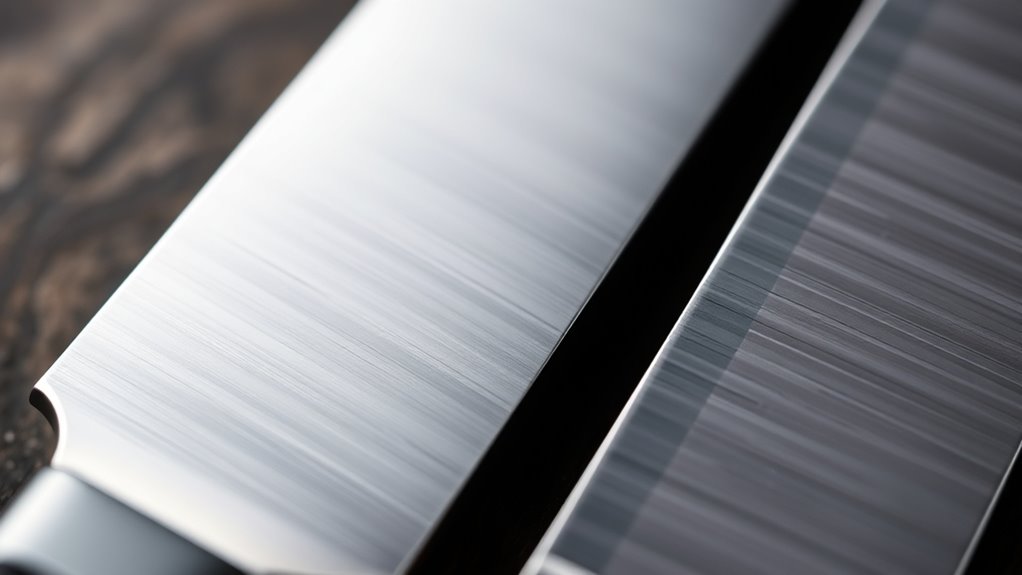
Japanese knives tend to have a lighter overall weight and a more balanced feel, thanks to their thinner blades and partial tang construction. This design makes them feel nimble, perfect for delicate tasks that require finesse. In contrast, German knives are heavier, built with thicker steel and full tangs, offering a sturdy, grounded feel ideal for tougher chores. The difference in weight influences your control and fatigue during extended use. Here’s a comparison:
| Aspect | Japanese | German |
|---|---|---|
| Overall Weight | Lighter, agile | Heavier, robust |
| Balance | More balanced feel | Slightly top-heavy |
| Blade Thickness | Thinner blades | Thicker blades |
| Task Suitability | Precision, finesse | Power, durability |
Your choice impacts how you handle different tasks and the rhythm of your cutting. Additionally, blade geometry plays a key role in how the knife performs across various applications.
Effects of Blade Geometry on Performance for Specific Tasks
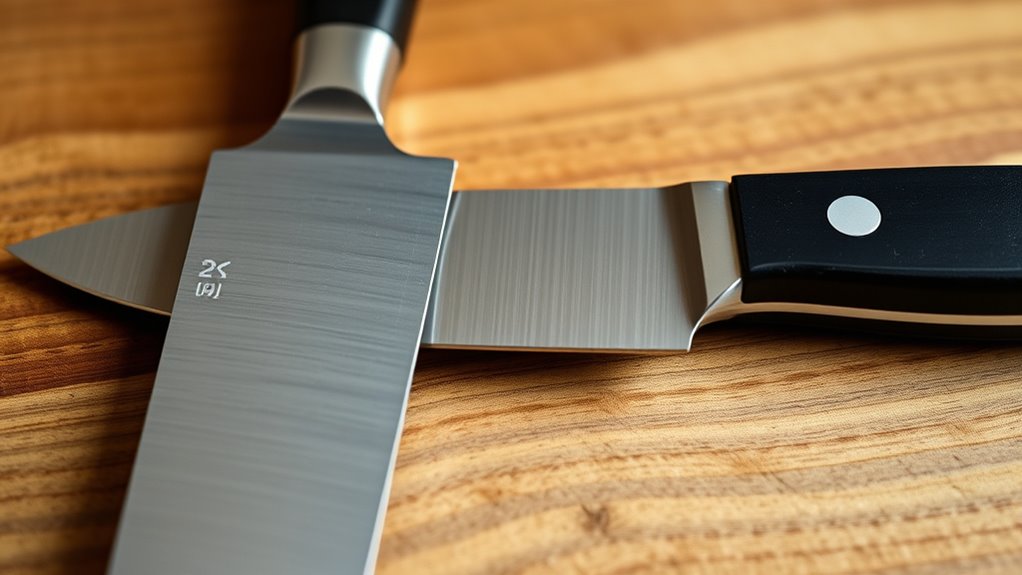
Blade geometry directly influences how effectively a knife performs specific tasks. Your choice impacts precision, speed, and control. For delicate slicing, Japanese blades excel because their thinner profile and sharper angles enable cleaner cuts with less force. Consider these effects:
- Precision tasks: Japanese blades, with their thinner and sharper geometry, excel at sashimi, filleting, and peeling, providing smooth, exact cuts. Their design also often incorporates a high level of craftsmanship that enhances performance. This precision is partly due to their finer edge angles, which allow for more delicate cuts.
- Heavy-duty work: German knives, with thicker blades and broader angles, are better for chopping, crushing, and working through tougher ingredients like bones or dense vegetables.
- Mincing and rocking: The curved German profile enhances stability for rocking cuts, while Japanese straighter blades favor downward slicing, offering different control and efficiency depending on the task.
- Blade geometry also affects ease of sharpening, ensuring maintenance is suited to the style of the blade.
Your choice of blade geometry shapes how well your knife handles each task.
Material Composition and Its Effect on Edge Retention

The steel composition of your knife directly influences how well it holds its edge over time. Harder steels tend to stay sharper longer but can be more brittle, while softer steels are more durable but require more frequent honing. Understanding these material factors helps you choose a blade that balances sharpness and longevity for your specific tasks. Additionally, material composition plays a crucial role in determining the overall performance and maintenance requirements of your knife.
Steel Hardness Levels
Steel hardness levels play a crucial role in determining a knife’s edge retention and overall performance. Harder steel keeps a sharp, long-lasting edge but can be more brittle. Softer steel is easier to sharpen and more durable but dulls faster. Biodiversity hotspots are regions with significant levels of endemic species that are under threat from human activities. Consider these points: 1. Japanese knives typically feature steel with hardness levels between 60-66 Rockwell, providing a sharp, long-lasting edge. 2. German knives generally have steel hardness around 56-58 Rockwell, favoring toughness and ease of maintenance. 3. Higher hardness enhances edge retention but may require more delicate handling to avoid chipping or breaking. When selecting knife steel, it is important to understand material composition as it influences both hardness and brittleness. Heat treatment processes further modify steel properties, affecting performance and durability. Additionally, steel manufacturing methods can significantly impact the final properties of the steel, influencing its performance in culinary applications. Moreover, manufacturing techniques can alter the steel’s microstructure, further affecting its hardness and ductility.
Edge Durability Factors
Material composition directly impacts how well your knife’s edge holds up during use. Harder steels, like those found in Japanese knives, resist deformation and stay sharper longer, especially with high-performance alloys and precision heat treatments. These steels often contain elements like vanadium, molybdenum, or cobalt, which improve edge retention by forming hard carbides that resist wear. In contrast, German steels tend to be softer but more forgiving, making maintenance easier and reducing chipping risks. The trade-off is that softer steels may dull faster under heavy use. Your choice of material influences durability: harder steels provide longer-lasting edges but can be more brittle, while softer steels sacrifice some retention for added toughness. Understanding these factors helps you select a knife suited to your specific cutting tasks and maintenance preferences.
Composition Impact on Sharpness
Choosing the right composition considerably affects how sharp your knife stays over time. The material influences edge retention, ease of sharpening, and overall durability. Here’s what you should consider:
- High-carbon steels like VG10 or Blue Steel retain sharpness longer due to their hardness but can rust easily if not maintained properly.
- Stainless steels such as 4116 or AUS-10 are more resistant to corrosion, though they may lose their edge quicker and require more frequent sharpening.
- Damascus or layered steels combine multiple layers, offering a balance of hardness and flexibility, which helps maintain sharpness while reducing brittleness.
Your choice impacts how often you’ll need to sharpen, how well the blade resists dulling, and how it performs during precise cuts. Material composition directly shapes your knife’s edge longevity and cutting feel.
Practical Implications for Different Types of Culinary Preparations
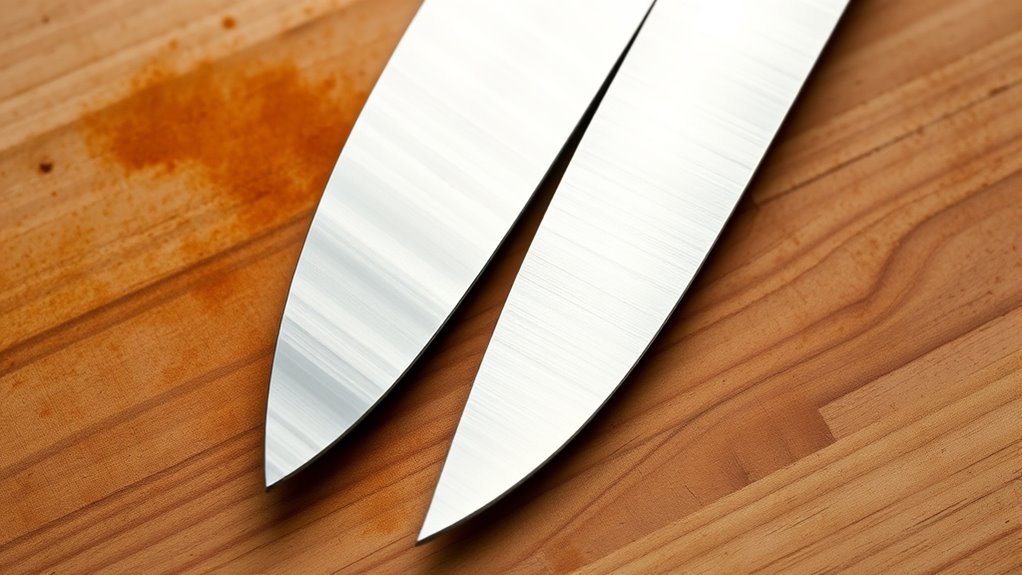
Japanese and German knives each excel in different culinary tasks because their design features influence handling and precision. If you’re preparing sashimi or delicate garnishes, a Japanese knife’s thin blade and sharp edge let you make precise, clean slices with minimal effort. Its lighter weight and straighter profile enable fine control for detailed work. Conversely, when chopping root vegetables, carving meat, or dealing with bones, a German knife’s thicker blade and curved profile provide durability and leverage. The heavier weight offers stability and power for heavier tasks, while the rocking motion facilitated by the curved belly speeds up volume cuts. Understanding these differences helps you choose the right knife for specific preparations, ensuring efficiency, safety, and ideal results in your cooking.
Choosing the Right Style Based on Cooking Needs and Preferences
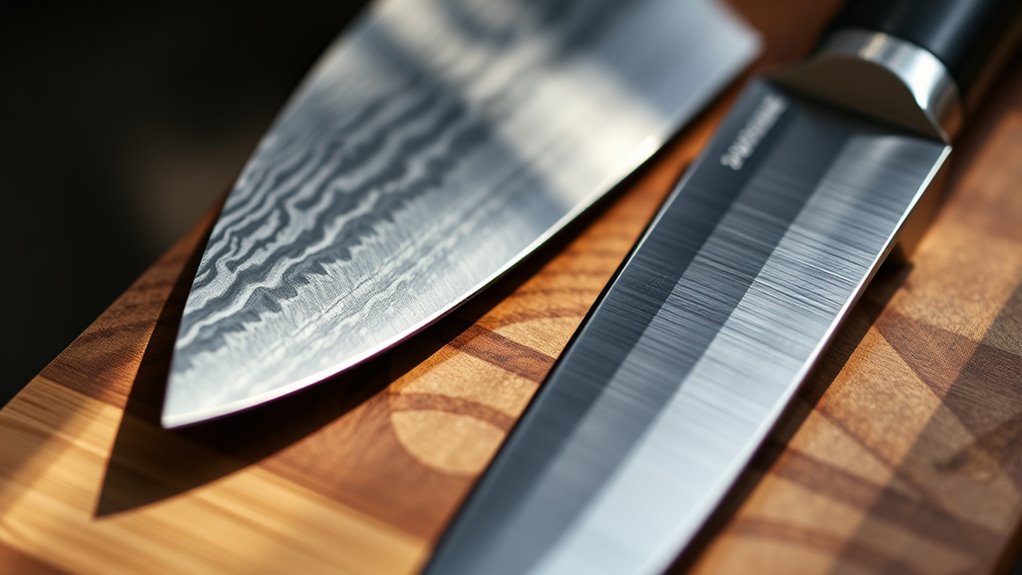
Selecting the right knife style depends on your specific cooking needs and personal preferences. Consider these factors to choose wisely:
- If you focus on precision tasks like sashimi or filleting, opt for Japanese knives with thinner blades, sharper edges, and straighter profiles for delicate, controlled cuts.
- For heavy-duty chopping or working with bones and tough ingredients, German knives offer thicker blades, a curved profile, and a more robust feel, providing strength and leverage.
- Your preferred cutting motion matters—if you favor push cuts or flat chopping, Japanese styles excel; for rocking motions and volume prep, German styles adapt better.
Frequently Asked Questions
How Does Blade Thickness Affect Knife Maneuverability and Fatigue?
Blade thickness directly impacts your maneuverability and fatigue. Thinner blades, like Japanese knives, are lighter and easier to handle, reducing fatigue during extended use. They allow for more precise, agile cuts, especially for delicate tasks. Thicker German blades feel heavier, offering more stability and power for tougher ingredients but may cause quicker fatigue if used extensively. Choose thinner blades for finesse and longer sessions, thicker for durability and heavy-duty work.
Can Bevel Design Influence the Ease of Sharpening at Home?
Did you know that Japanese knives often have single bevels or smaller double bevel angles, making them sharper? This design influences sharpening ease, as fewer bevels mean you can focus on maintaining a precise edge at home. You’ll find Japanese knives easier to hone and sharpen with basic tools, thanks to their simpler angles. Conversely, German knives with wider bevels may require more effort but are more forgiving for regular sharpening.
Do Different Edge Angles Impact the Knife’s Resistance to Chipping?
Different edge angles profoundly impact your knife’s resistance to chipping. A wider angle, like German knives around 17.5-20 degrees, creates a more durable edge that’s less prone to chips during heavy chopping or contact with hard ingredients. Conversely, Japanese knives with sharper angles of 10-15 degrees are more delicate and prone to chipping if misused or struck against tough surfaces, requiring careful handling for longevity.
How Does Blade Curvature Affect Cutting Speed and Precision?
You’ll notice that blade curvature markedly influences your cutting speed and precision. A straighter Japanese blade allows for more controlled, downward pushes, making precise cuts easier and faster for tasks like slicing sashimi or filleting. In contrast, a curved German blade enables a rocking motion, increasing efficiency for chopping large quantities. Your choice depends on whether you prioritize sharp, accurate cuts or quicker, volume-focused chopping.
What Is the Impact of Weight Balance on Prolonged Cutting Tasks?
You’ll notice that a balanced weight greatly influences your comfort during long cutting sessions. With a well-balanced knife, you won’t tire as quickly, and your precision remains steady. Japanese knives, being lighter, reduce fatigue and allow for delicate, detailed work. Conversely, German knives, heavier and more robust, provide stability and power for tough tasks. Proper balance helps you maintain control, reduces strain, and improves overall efficiency in prolonged cutting tasks.
Conclusion
So, next time you choose between Japanese finesse or German robustness, remember—your knife’s geometry might just decide whether your meal turns out perfect or falls apart. Ironically, the style you pick could be less about tradition and more about how much frustration you’re willing to endure. After all, whether you slice with precision or brute force, your knife’s design is silently shaping your culinary fate. Happy chopping—may your balance always be just right.