Chefs comparing German-style and Japanese-style knife sets are usually deciding how they want a knife to behave through a full service: whether it should tolerate rougher handling and frequent honing, or feel lighter and cut with less resistance. The labels cover many makers and designs, so a set’s actual steel, blade geometry, heat treatment, and handle matter more than its country-of-origin shorthand. Still, the broad tradeoff is useful. German-style sets tend to be heavier, tougher, and easier to maintain in a busy shared kitchen. Japanese-style sets tend to be thinner, harder, and more precise, with a sharper edge that asks for more careful use. Choose German-style for resilience and low-fuss work; choose Japanese-style for controlled slicing and cooks who will protect and maintain a finer edge.

Get kitchen gear delivered free with Prime
- Fast, free delivery on millions of items
- Prime Video, Amazon Music and more included
- Member-only deals all year
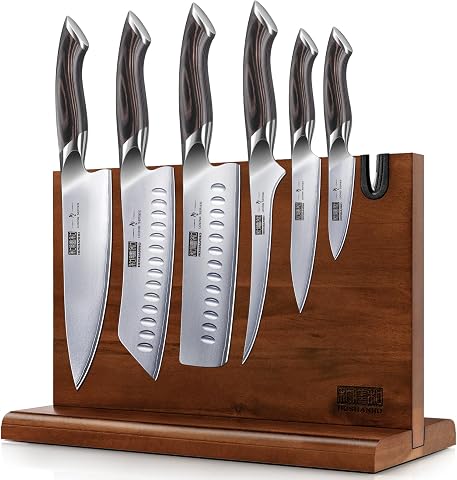
HOSHANHO 7-Piece Kitchen Knife Set with Magnetic Block
- ✔ Set size: 7 pieces
- ✔ Named knives: Chef, santoku, nakiri, fillet, utility, and paring
- ✔ Blade material: High-carbon stainless steel (10Cr15CoMoV)

Chef Knife Set with Roll Bag, 9-Piece Professional Set
- ✔ Set size: 9 pieces
- ✔ Blade material: High-carbon German stainless steel
- ✔ Blade construction: Stamped
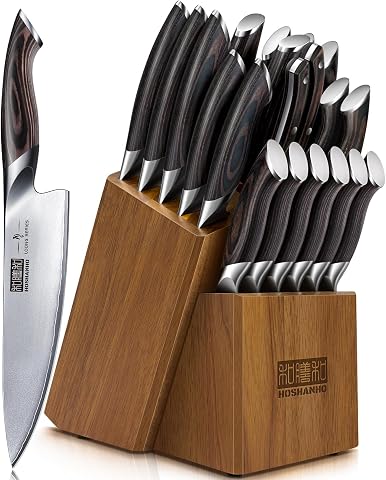
HOSHANHO 20-Piece Japanese Kitchen Knife Set with Block
- ✔ Set size: 20 pieces
- ✔ Blade material: High-carbon stainless steel (10Cr15CoMoV)
- ✔ Blade hardness: 60 HRC
At a Glance
| Criteria | German-style professional chef knife sets | Japanese-style professional chef knife sets | Winner |
|---|---|---|---|
| Cutting feel and precision | Heavier feel; robust geometry suits general prep | Lighter feel; thin geometry supports precise slicing | B |
| Edge durability and toughness | Usually more forgiving of incidental knocks and varied technique | Hard edges can hold sharpness well but may chip if misused | A |
| Sharpening and upkeep | Generally straightforward to hone and sharpen | Benefits from careful sharpening and edge protection | A |
| Weight and balance | Often heavier, with a substantial grip and blade presence | Often lighter and more nimble in controlled cuts | Depends |
| Versatility across kitchen tasks | Strong all-rounder for varied tasks and shared use | Excellent for precision work; some blades are less suited to rough tasks | A |
| Value and replacement cost | Broad price range; practical choice when durability matters | Higher cost can pay off for precision-focused cooks who maintain them | Depends |
HOSHANHO 7-Piece Kitchen Knife Set with Magnetic Block
For cooks who want a professional-style core collection without filling a counter with a large block, this is the most balanced choice in the group. Its six named knives—chef, santoku, nakiri, fillet, utility, and paring—cover varied jobs, including vegetable prep and more delicate slicing. Compared with the 9-piece roll-bag set, it trades portability for a fixed, accessible storage solution and lists forged 10Cr15CoMoV steel up to 60 HRC rather than stamped blades at 56–58 HRC.The double-sided acacia magnetic block makes the knives visible and reachable, which can suit a busy prep area better than unrolling a bag. Its harder steel is presented as an edge-retention advantage, but that does not eliminate sharpening or careful handling. The set includes no sharpening tool or maintenance accessories, so we should plan for upkeep separately. The blades are also described as heavier, which may feel less nimble than a lighter knife to cooks who favor quick, delicate movements.Against the 20-piece HOSHANHO, this set gives up specialty breadth, shears, and a sharpener in exchange for a smaller collection and a less substantial storage commitment. The acacia block needs protection from moisture, and the pakkawood handles still call for sensible care. For cooks who can name the core knives they use and want them organized on the counter, this is the clearest all-around fit.
Pros:
- Six distinct knife types cover a broad range of routine prep.
- Forged 10Cr15CoMoV stainless steel is listed at up to 60 HRC.
- Double-sided magnetic acacia block keeps knives visible and within reach.
- Pakkawood handles are designed for a comfortable, stable grip.
Cons:
- No sharpener or other maintenance accessory is included.
- Heavier blades may feel less agile to some cooks.
- The acacia block requires care around moisture.
Best for: Home cooks who want a varied, forged knife selection in an accessible magnetic block without committing to a 20-piece collection.
Not ideal for: Cooks who need a sharpening accessory included, prefer especially lightweight knives, or want a roll bag for travel.
Bottom line: We recommend it as the strongest balance of useful range, harder forged steel, and manageable storage in this comparison.
“We recommend it as the strongest balance of useful range, harder forged steel, and manageable storage in this comparison.”
Chef Knife Set with Roll Bag, 9-Piece Professional Set
This set is the practical pick when knives need to leave the kitchen. Its roll bag makes it easier to pack and carry than either HOSHANHO block set, which is useful for cooks who move between workspaces or need contained storage. The description highlights high-carbon German stainless steel with rust resistance, an 8-inch blade length, and red pakkawood handles with a non-slip grip and finger guard.Its central tradeoff is construction. The blades are stamped and listed at 56–58 HRC, while both HOSHANHO sets specify forged steel at 60 HRC. That difference makes this less aligned with buyers prioritizing the harder, forged construction in this lineup, though the listed hardness alone cannot tell us how a knife will feel in hand. It also weighs 1.5 kg, lighter than the 7-piece set’s stated 2 kg, and the bag avoids dedicating counter space to a block.The set’s dishwasher-safe claim may appeal to cooks who want simpler cleanup, yet the wooden handles warrant caution with prolonged water exposure. We would not choose it for a permanent countertop station when the magnetic-block HOSHANHO offers a more accessible display and forged blades. Its advantage is specific: a portable package for people who value taking a set with them more than having a fixed knife station.
Pros:
- Roll bag supports transport and compact storage.
- High-carbon German stainless steel is described as rust resistant.
- Non-slip red pakkawood handles include a finger guard.
- At 1.5 kg, it is lighter than the stated weight of either HOSHANHO set.
Cons:
- Stamped construction differs from the forged HOSHANHO blades.
- Listed hardness is 56–58 HRC, below the HOSHANHO sets’ stated 60 HRC.
- Wooden handles may be sensitive to prolonged water exposure despite the dishwasher-safe claim.
Best for: Cooks who transport their knives between kitchens or want a contained set that stores in a bag instead of a countertop block.
Not ideal for: Buyers seeking forged blades, a magnetic or wooden countertop block, or the hardest listed steel in this comparison.
Bottom line: We would choose this set when portability matters most, while cooks building a fixed professional-style station have stronger construction options elsewhere in the lineup.
“We would choose this set when portability matters most, while cooks building a fixed professional-style station have stronger construction options elsewhere in the lineup.”
HOSHANHO 20-Piece Japanese Kitchen Knife Set with Block
When we want a full knife station with accessories in the same package, this is the most expansive option here. The 20-piece assortment includes kitchen shears, a sharpener, and a wooden block; its largest knife is listed at 10 inches. The 15-degree double-bevel edge and 60 HRC 10Cr15CoMoV steel specifications give it a more detailed edge profile than the roll-bag set’s stated specs, while the included sharpener addresses an upkeep need the 7-piece HOSHANHO leaves to the buyer.That breadth only pays off if we have room and will use the additional pieces. At about 7 pounds, the set is heavier than the other two, and the wooden block is a more permanent counter fixture than the compact roll bag. Compared with the 7-piece HOSHANHO, it offers extra range and an included sharpener, but also asks for more storage space and care. The smaller set is more sensible when we mostly reach for a chef knife and a handful of supporting blades.The high-carbon steel is specified at 60 HRC, and the product notes that regular maintenance is needed to help prevent rust. That makes this a considered choice for cooks willing to keep blades dry and maintain their edges, rather than a low-attention set. Its pakkawood handles are described as ergonomic and non-slip, but the main decision is whether the expansive assortment suits our cooking. For a stocked home station, the accessories add convenience; for a compact kitchen, they can become unused bulk.
Pros:
- Twenty-piece assortment offers the broadest selection in this comparison.
- Includes kitchen shears, a sharpener, and a wooden storage block.
- 10Cr15CoMoV stainless steel is listed at 60 HRC with a 15-degree double bevel.
- Pakkawood handles are described as ergonomic and non-slip.
Cons:
- About 7 pounds, making it the heaviest set listed here.
- The wooden block requires dedicated counter or cabinet space.
- High-carbon steel requires regular care to help prevent rust.
Best for: Committed home cooks who want a broad knife assortment, included shears and sharpener, and a dedicated wooden block.
Not ideal for: Small-kitchen users, cooks who need a portable roll bag, or anyone seeking minimal maintenance and storage demands.
Bottom line: We recommend it for cooks who will use its breadth and accessories, while the 7-piece set is the more practical HOSHANHO choice for a focused everyday kit.
“We recommend it for cooks who will use its breadth and accessories, while the 7-piece set is the more practical HOSHANHO choice for a focused everyday kit.”
As an Amazon Associate we earn from qualifying purchases.
Key Differences
The largest practical difference is how much care the edge expects. A typical German-style knife has a thicker, tougher profile that tolerates the pace and variety of a professional station. A typical Japanese-style knife has a thinner, harder edge that can glide through delicate ingredients, but it is less suited to twisting through joints, scraping a board, or being tossed into a sink. In a kitchen with shared tools and mixed experience, that distinction can matter more than peak sharpness.
That sharper feel also changes the value calculation. A Japanese-style set can be worth its higher price for cooks whose work depends on clean, accurate cuts and who already use suitable boards and sharpening methods. German-style sets often deliver better everyday value where knives are used hard, handled by several people, or expected to cover almost every task. Neither label guarantees quality: compare the individual knives and service support before buying.
Detailed Comparison
Cutting feel and precision (Japanese-style professional chef knife sets wins — major)
Japanese-style sets usually win for fine slicing. Their thinner blades meet less resistance in foods such as fish, herbs, and vegetables, and the lighter profile can make small adjustments feel direct. German-style knives tend to feel more substantial and may pass through dense ingredients with reassuring weight, but their thicker geometry can wedge more in delicate cuts. The gap is moderate to major for cooks whose station centers on precise slicing; for routine chopping, it may be minor. Japanese-style takes this criterion.
Edge durability and toughness (German-style professional chef knife sets wins — major)
German-style knives generally have the advantage when work is unpredictable. Their steel and edge geometry are commonly chosen to withstand more incidental contact and less exact technique. Many Japanese-style knives use harder steel that can hold a fine edge for a long time, but hardness does not make the edge immune to chips. A cook who cuts carefully on an appropriate board may see excellent service from either. In a busy shared kitchen, the difference is major: German-style is the safer bet for rough handling.
German-style sets are often easier to keep serviceable with routine honing and familiar sharpening tools. Japanese-style blades can also be maintained well, but their harder steel and finer edges reward more deliberate technique; careless honing or an unsuitable sharpener can damage the edge. The exact steel and maker’s guidance matter, so do not assume all knives in either category behave alike. For a team that needs quick, repeatable upkeep, German-style has a moderate advantage. A skilled sharpener with suitable equipment can narrow the gap.
Weight and balance (moderate difference)
Japanese-style knives are often lighter and feel nimble during repetitive, controlled cuts. That can reduce the sense of effort for a cook who prefers guiding the blade rather than letting its weight do more of the work. German-style knives often feel heavier and more substantial, which some users find reassuring, especially on larger ingredients. Neither balance is universally better; handle shape and personal grip make a real difference. The advantage is moderate for cooks with a clear preference and minor for those who adapt easily.
Versatility across kitchen tasks (German-style professional chef knife sets wins — moderate)
German-style sets are usually the more forgiving all-purpose choice. Their robust profiles suit a broad mix of prep, and a chef can be less anxious about handing one to another trained cook. Japanese-style sets excel at controlled slicing and fine prep, but thin blades should not be used as cleavers, prying tools, or scrapers. A set that includes a sturdy utility knife may still be versatile, yet the user must respect each blade’s limits. For mixed tasks and shared stations, German-style has a moderate edge.
Value and replacement cost (moderate difference)
There is no universal price winner because both styles span entry-level to premium makers, and set contents vary. German-style often represents stronger practical value when toughness and easy upkeep reduce disruption in a demanding kitchen. Japanese-style can justify a premium for cooks who will use its cutting precision daily and protect the edges. Paying extra for a large set is rarely wise if several knives will sit unused. The winner depends on workload, upkeep habits, and the quality of the specific set.
German-style professional chef knife sets: Pros and Cons
Pros:
- Tough, forgiving profile suits demanding and shared kitchen use.
- Often easier to hone and maintain with common sharpening routines.
- Good all-purpose choice when tasks and users vary.
Cons:
- Heavier feel may tire cooks who prefer a nimble blade.
- Thicker geometry may be less precise for delicate slicing.
- A sturdy design does not excuse using the knife to pry or cut bones.
Japanese-style professional chef knife sets: Pros and Cons
Pros:
- Thin, sharp geometry supports accurate slicing and fine prep.
- Light handling can feel nimble during repetitive work.
- Hard steel can hold a fine edge well when properly cared for.
Cons:
- Finer edges can chip when twisted, dropped, or used on hard surfaces.
- Requires more deliberate sharpening and edge care.
- Not every blade is suited to rough tasks or untrained shared use.
Who Should Choose What
Choose German-style professional chef knife sets if:
- You need a set for varied prep, fast service, or several cooks with different habits.
- Durability and straightforward upkeep matter more than the lightest cutting feel.
- You want a dependable all-round set and do not need the finest slicing performance on every task.
Choose Japanese-style professional chef knife sets if:
- Your daily work depends on precise cuts, fine slicing, or delicate ingredients.
- You prefer lighter knives and have the technique to protect a hard, thin edge.
- You have appropriate boards, sharpening tools, and a reliable routine for maintenance.
Skip both if: Skip buying a full set if you only need one or two knives; select individual blades that match your work, hand, and sharpening support.
Value for Money
Pay more for a Japanese-style set only when its lighter handling and fine cutting performance will make a regular difference in your work, and when you can maintain the edges properly. In that case, the premium buys a useful cutting experience, not an automatic upgrade across every kitchen task. German-style is often the better value for shared kitchens, broad prep, or cooks who prioritize resilience and simple upkeep. Compare the knives included, warranty, sharpening guidance, and replacement availability. A carefully chosen chef’s knife and paring knife may serve better than a costly block full of blades you rarely reach for.
Final Verdict
For most professional kitchens that need a durable set to handle varied work and shared use, choose German-style. It is the more forgiving default, and its easier upkeep can matter more over a long service than a finer edge. Choose Japanese-style if precision and a light, low-resistance cut are central to your station, and you are prepared to protect and sharpen the blades with care. The deciding factor is how the knives will be used: rough, mixed, or shared work favors German-style; controlled precision work favors Japanese-style. If your needs are narrow, buy individual knives instead of paying for a set with tools you will not use.
Frequently Asked Questions
Are Japanese-style professional knives sharper than German-style knives?
They are often ground to a thinner edge and can feel sharper in use, especially on precise cuts. Actual sharpness depends on the individual knife and its maintenance, so the style label alone does not settle the comparison.
Which style is better for a busy shared kitchen?
German-style is usually the safer choice because its sturdier profile tends to tolerate varied technique and incidental knocks better. A shared kitchen can use Japanese-style knives successfully if staff know how to handle and store them.
Is a Japanese-style set worth paying more for?
It can be worth the premium for cooks who regularly make precise slices and can maintain the edges. If your priority is a durable, versatile set for general prep, the added cost may not produce a meaningful day-to-day benefit.
Should I buy a knife set or individual knives?
Choose individual knives when your work centers on a few tasks or you already own useful tools. A set makes sense when you need several complementary knives and know you will use them; check each blade’s purpose before paying for the block.